
Healthy Strings: Posture, Movement and Sound in Violin Performance
🎻 Violin Posture, Sound, Performance & Technology
Healthy Strings is an international interdisciplinary research collaboration investigating posture, movement, playing technique, sound and physical strain in violin performance. Specialists in music physiology, violin pedagogy, physiotherapy, musical acoustics, music psychology, movement analysis, sensor technology, biorobotics and data science are developing shared methods for recording and analysing violin performance.
The project does not assume that there is one “correct” violin posture. Instead, it investigates which instrument-specific asymmetries are functional and how potentially demanding posture and movement patterns can be identified and assessed. Movement data are interpreted in relation to the musical task, the resulting sound and the individual performer.
Research Aims
- Develop a standardised protocol for video and audio recordings of violinists that can be used across research sites.
- Improve video-based assessments of posture and movement by physiotherapists, performing arts health specialists and violin pedagogues.
- Bring together markerless movement analysis, expert assessments and acoustic features.
- Integrate, where appropriate, sensor data, motion capture and electromyography (EMG).
- Review existing tools, datasets and research approaches, build on suitable methods and develop shared analytical tools where needed.
- Establish a basis for future studies on playing technique, physical strain, prevention and pedagogical feedback.
Key Research Questions
- Which small set of variables can describe posture and movement in violin performance reliably while remaining relevant to practice?
- How can functional asymmetries be distinguished from movement patterns that might be associated with increased physical strain?
- Which playing tasks and camera perspectives produce recordings that are suitable for expert assessment and stable technical analysis?
- How reliable are video-based measurements and assessments across different professional groups?
- How do movement and playing technique relate to acoustic features such as intonation, dynamics and timbre?
- How can video-based movement analysis be combined with motion capture, EMG and instrument-based sensor data?
Methods and Technical Approach
The recordings combine video and audio with a brief standardised performance and assessment protocol. Standardised playing tasks are designed to make different aspects of violin posture, movement and playing technique visible and comparable across performers and research sites.
The project examines markerless methods that estimate body movement from standard video recordings. One central starting point is the SInES Tools platform developed at the University of Vienna. Machine-learning-based pose tracking, including BlazePose, is used to extract 2D and 3D body landmarks from video recordings and to visualise movement as interactive stick figures and three-dimensional representations.
Current analyses include joint trajectories, joint angles, movement velocity and acceleration, path length and selected posture-related parameters. The SInES workflow can also incorporate data from other movement-analysis systems and combine movement data with acoustic features.
Where appropriate, sensor data, professional motion capture and electromyography (EMG) provide additional reference information. This allows markerless video analysis to be compared with laboratory-based measurement systems and supports multimodal analyses combining movement, muscle activity, instrument interaction and sound.
In parallel, the group is developing a structured approach to video assessment. Physiotherapists, performing arts health specialists and violin pedagogues record observations from their respective professional perspectives. An important methodological question is which features can be assessed reliably from short video recordings and how expert assessments relate to quantitative movement parameters.
A further task is the systematic review of existing tools, datasets and research approaches, including SPD, PyEyesWeb, TELMI and related movement-analysis approaches. The group identifies methods and data structures that can support Healthy Strings and determines where new shared tools need to be developed.
Current Project Status
From 28 August to 2 September 2026, members of the international research collaboration met for a research retreat in Lucca and Pisa. The retreat brought together expertise in music physiology, physiotherapy, violin pedagogy, musical acoustics, movement analysis, sensor technology, biorobotics and data science.
The group worked on standardised recording tasks, camera perspectives, physiotherapy and violin-pedagogy assessments, audiovisual analysis, markerless motion tracking, sensor technologies, existing datasets and possible joint research and funding projects.
Current work focuses on three main areas: developing and validating the standardised recording protocol, refining expert assessments of posture and movement, and developing the multimodal analysis workflow linking video, SInES Tools, motion capture, EMG, sensors and sound.
Initial qualitative method comparisons are encouraging for larger movements of the torso and arms. Smaller rotations, particularly of the forearm and wrist, require further validation. These early observations do not yet support conclusions about an individual performer’s health risks.
Collaboration and Next Steps
Through 2027, the group plans to develop the shared study design and international research collaboration further. Planned work includes aligning recording and assessment procedures, conducting pilot studies at participating sites, analysing existing datasets, developing sensor-based subprojects and preparing joint research and funding applications.
In the longer term, recordings and assessments may take place at several international sites. This requires comparable protocols, appropriate ethics procedures and informed consent, agreed data-protection standards, and secure arrangements for international data storage and transfer.
Potential Applications
- Low-threshold movement analysis using standard cameras or smartphones.
- Research on movement, sound and physical strain in violin performance.
- Methodologically grounded video assessment in music physiology, violin pedagogy and physiotherapy.
- Integration of video, motion capture, EMG, sensor and acoustic data.
- Development of clear and individualised feedback methods for healthy and efficient practice.
- Open and transparent analytical workflows for research and teaching.
Scientific Coordination
- Ao. Univ.-Prof. Mag. Dr. Matthias Bertsch, Motion-Emotion-Lab, Centre for Music Physiology, mdw – University of Music and Performing Arts Vienna 🇦🇹 – bertsch@mdw.ac.at
- Univ.-Prof. Dr. Christoph Reuter, SInES Lab, Department of Musicology, University of Vienna 🇦🇹
Project Team and International Research Collaboration
- Matthias Bertsch (1, 8) 🇦🇹 – research coordination, music physiology, musical acoustics and data collection
- Christoph Reuter (2, 8) 🇦🇹 – musical acoustics, audio analysis and SInES Tools
- Alexandra Türk-Espitalier (1, 8) 🇦🇹 – violin pedagogy, physiotherapy and posture assessment
- Tina Margareta Nilssen (1) 🇳🇴🇦🇹 – music performance, music physiology, movement analysis and expert assessment
- Tobias Großhauser (1) 🇦🇹 – sensor technology and interaction design
- Felix Kloos (2) 🇦🇹 – audiovisual analysis, SInES Tools and data processing
- Alessio Nacuzi (3, 4, 8) 🇮🇹 – violin pedagogy, biorobotics, motion capture, movement analysis and data collection
- Alberto Carratello (4, 8) 🇮🇹 – violin performance, violin pedagogy and data collection
- Alberto Bologni (4) 🇮🇹 – violin pedagogy, recruitment of musicians and institutional collaboration
- Giorgio Stefano Gnecco (5) 🇮🇹 – machine learning, data science and research funding
- Christoff Zalpour (6, 8) 🇩🇪 – physiotherapy, prevention, functional movement and movement analysis
- Elisabeth Grain (6, 8) 🇩🇪 – physiotherapy and movement analysis
- Nikolaus Ballenberger (6) 🇩🇪 – biomechanics and posture and movement analysis in upper string players
- Dirk Möller (6, 8) 🇩🇪 – music physiology, physiotherapy, EMG and movement analysis
- Bronwen Ackermann (7) 🇦🇺 – performing arts health, physiotherapy and musculoskeletal health in musicians
- Veronica Santoro (3) 🇮🇹 – biorobotics, functional movement analysis and data analysis
- Calogero Maria Oddo (3) 🇮🇹 – biorobotics, neuroprosthetics and sensor technology
- Antonio Camurri (9) 🇮🇹 – expressive movement, multimodal interaction and computational analysis of music performance
- Gualtiero Volpe (9) 🇮🇹 – movement analysis, trajectory analysis and multimodal interaction
Participating Institutions and Research Groups
- Motion-Emotion-Lab, Centre for Music Physiology, mdw – University of Music and Performing Arts Vienna, Vienna 🇦🇹
- SInES – Space for Interdisciplinary Experiments on Sound, Department of Musicology, University of Vienna, Vienna 🇦🇹
- The BioRobotics Institute, Scuola Superiore Sant’Anna, Pisa 🇮🇹
- Conservatorio di Musica Luigi Boccherini, Lucca 🇮🇹
- Scuola IMT Alti Studi Lucca, Lucca 🇮🇹
- INAP/O – Institute of Applied Physiotherapy and Osteopathy, Osnabrück University of Applied Sciences, Osnabrück 🇩🇪
- University of Sydney, Sydney 🇦🇺
- Austrian Society for Music and Medicine (ÖGfMM), Vienna 🇦🇹
- University of Genoa / Casa Paganini, Genoa 🇮🇹
The 2026 international research retreat in Lucca and Pisa was supported by the Austrian Society for Music and Medicine (ÖGfMM) 🇦🇹.
Publication
- Bertsch, M., Reuter, C., Türk-Espitalier, A., Nilssen, T. M., Großhauser, T., Nacuzi, A., Carratello, A., Grain, E., Brüggemann, J., & Leitz, T. (2026). Healthy Strings: AI-Powered Posture Tracking for Violinists: Markerless 3D Motion Analysis in Violin Performance – Validation, Multimodal Synchronisation, and Physiologically Informed Posture Assessment . Proceedings of the Symposium Beyond the Score – Health & Well-Being in Music and Performing Arts. https://doi.org/10.13140/RG.2.2.36013.04324
Presentation
- Bertsch, M., Reuter, C., Türk-Espitalier, A., Nilssen, T. M., Großhauser, T., Nacuzi, A., Carratello, A., Grain, E., Brüggemann, J., & Leitz, T. (10 April 2026). Healthy Strings: AI-Powered Posture Tracking for Violinists [Poster presentation]. Symposium Beyond the Score – Health & Well-Being in Music and Performing Arts, Salzburg, Austria.
Contact
Ao. Univ.-Prof. Mag. Dr. Matthias Bertsch
Motion-Emotion-Lab, Centre for Music Physiology
mdw – University of Music and Performing Arts Vienna 🇦🇹
bertsch@mdw.ac.at
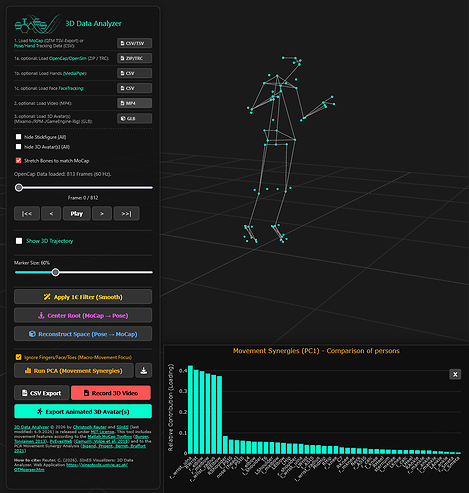
Example of a multimodal SInES app currently under development: The 3D Data Analyzer displays movement data as an interactive stick figure and as graphs. It can import data from OpenCap, OpenSim and Sim2Pose. Its analysis functions draw on the RITMO VideoAnalyser, the MATLAB Motion Toolbox, Bigand PCA and PyEyesWeb (Camurri et al., 2016). Movement measures for the whole body or individual body parts can be exported as a CSV file. See https://sinestools.univie.ac.at/QTMparser.htm