When we describe singing, we often resort to terms from the realm of visual perception—words like vibrant, warm, colourful, or smooth. One such tried-and-true term in vocal pedagogy is chiaroscuro, the balance of bright and dark timbre in a sung tone.
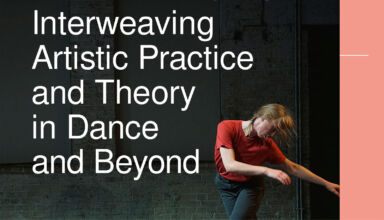
How are music / sound and dance / motion interwoven with one another in artistic processes? What patterns can be recognised when examining their interrelationships, and what aesthetic intentions do they serve? The preceding questions were central to “Bodies and Sounds in Motion”, a research project funded by the German Research Foundation (DFG) that began at the Free University of Berlin in autumn 2017 and was concluded at the mdw in summer 2024, which included publishing the edited collection discussed here.
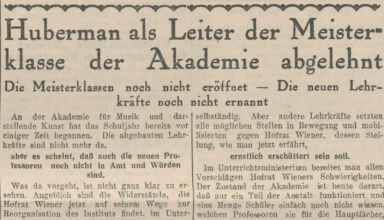
On 28 February 1936, the Polish star violinist Bronisław Huberman (1882–1947) performed on his Guarneri at Carnegie Hall in New York. While he was onstage, his most valuable instrument—the “Gibson” Stradivari of 1713—was stolen from his dressing room. It had already been stolen from him once before, at Vienna’s Hotel Imperial in 1919, but that case had been quickly solved.
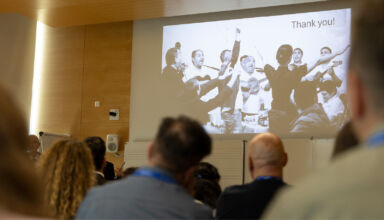
In July of this year, Montreal hosted the 37th World Conference of the International Society for Music Education (ISME), one of the largest international music education conferences worldwide. This latest edition welcomed more than 1,900 participants from over 70 countries and featured upwards of 1,300 presentations. The mdw’s Department of Music Education Research and Practice (IMP) was represented by multiple individuals.
What happens when music isn’t just music? When a wedding performance determines a family’s social status, when a dance course becomes a space of migrant belonging, or when algorithmically generated music replaces labour performed by musicians? Such questions featured prominently at the 10th Symposium of the ICTMD Study Group on Music and Dance in Southeastern Europe, which was hosted at the mdw from 23 to 29 September 2026.
It was through the Department of Folk Music Research and Ethnomusicology that mdw graduate Mira Perusich found her way back to her Burgenland Croatian roots. And today, the singer-songwriter captivates audiences with her multilingual lyrics, researches the development of the Burgenland Croatian music scene, and is helping to shape the next generation as an artist and voice teacher.
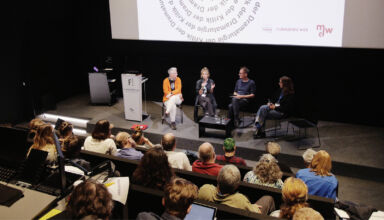
The first weekend of October saw the mdw’s Arthouse Cinema host the conference “Kritik der Dramaturgie” [Critiquing Dramaturgy], a joint event of the screenplay research organisation Netzwerk Drehbuchforschung, Film Academy Vienna, and Screenwriters Forum Vienna.
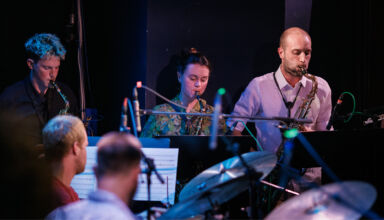
What happens when young jazz musicians from multiple European countries come together to engage with the Second Viennese School and produce new music for large ensemble? This question took centre stage at the European Jazz Workshop, whose 2026 edition was the first to be organised by the mdw.