Stephanie Schroedter (ed.), Music and Motion – Interweaving Artistic Practice and Theory in Dance and Beyond, mdwPress/transcript, Vienna/Bielefeld 2026, 694 pages
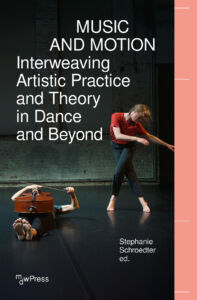
How are music / sound and dance / motion interwoven with one another in artistic processes? What patterns can be recognised when examining their interrelationships, and what aesthetic intentions do they serve? The preceding questions were central to “Bodies and Sounds in Motion”, a research project funded by the German Research Foundation (DFG) that began at the Free University of Berlin in autumn 2017 and was concluded at the mdw in summer 2024, which included publishing the edited collection discussed here. The overall project started from the observation that musical and bodily motions are closely associated in artistic processes but often end up being examined separately by researchers. The resulting volume aims to overcome this separation and illuminate the relationships and multifarious interactions between sound and motion in all of their aesthetic, perceptual, and practical complexity. Alongside a foreword and introduction, it brings together 33 contributions from the fields of musicology, dance and theatre studies, artistic research, and music and movement education to present a broad spectrum of multidimensional and international perspectives on the entanglements of music and movement in artistic practice and theory from the historical avant-garde to the present.
The various contributors’ chapters stand out for their notable methodological and thematic diversity. In this, the publication makes an important contribution to the advancement of research on music, dance, and performance art while also offering valuable points of reference for artistic research as well as music and movement education. Its special strength lies less in any presentation of a final theory than in its productive analysis and furtherance of an open, dynamic research field. Again and again, one sees clearly just how much potential inhabits research that conceives of artistic practice not just as an object of study but also as a way of knowing.
Alongside addressing artists, researchers, and arts mediators, this volume is aimed especially at students of music and movement education as individuals whose specialised competencies in the areas of composing, choreography, and improvisation are particularly focused on the interweaving of music and movement. In this spirit, it represents an inexhaustible source of inspiration for interactive inter- and transdisciplinary work that takes shape as what is probably the most primal form of artistic and cultural expression: that of bodies and sounds in motion.