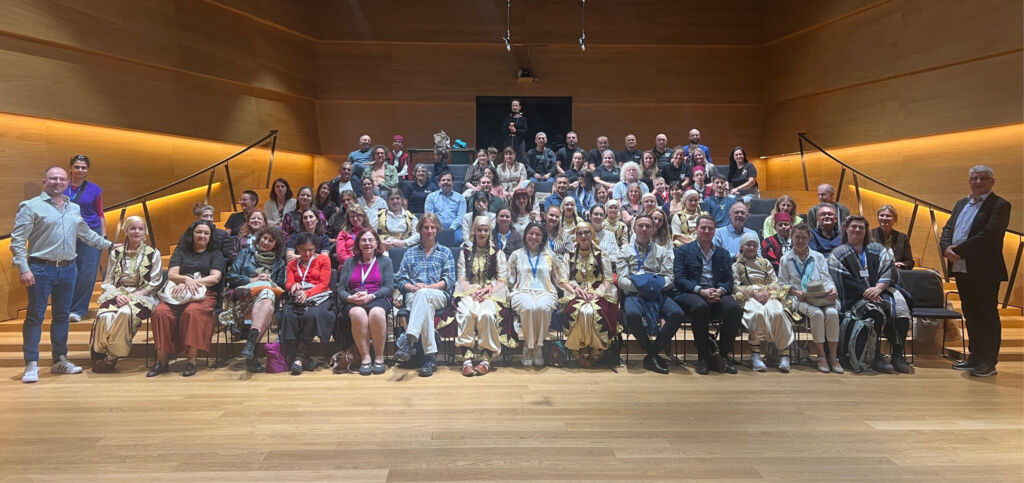
What happens when music isn’t just music? When a wedding performance determines a family’s social status, when a dance course becomes a space of migrant belonging, or when algorithmically generated music replaces labour performed by musicians? Such questions featured prominently at the 10th Symposium of the ICTMD Study Group on Music and Dance in Southeastern Europe, which was hosted at the mdw from 23 to 29 September 2026. This symposium saw 72 scholars present their research in 38 solo lectures, six panel discussions and two round tables.
When Does a Cultural Practice Become Labour?
A major focus of this symposium was the question of how musical labour is valued. Events like wedding celebrations and cafanas are not just sites where music is made but also social and economic spaces. Daniel Petrovski used the example of Roma weddings in Skopje and in diaspora communities to demonstrate how music, high fees, tips, and choosing renowned ensembles can contribute to families’ representation of wealth and social prestige. In such cases, music becomes a medium that renders social status visible.
Carol Silverman, in a talk entitled “Blood and Money”, discussed the conditions under which Roma musicians organise their work and ensure their subsistence.1 Other lectures focused on Roma musicians in Yugoslav hotels, the portrayal of Roma music in Serbian cinema, and the question as to how algorithmically generated music can alter human musicians’ visibility and economic room for manoeuvre. An especially current perspective was contributed by Shaun Williams, who spoke about his investigation of AI-generated Roma music in Romania. He asked what the implications are when Roma musical aesthetics continue to circulate while the human musicians whose work created these aesthetics increasingly disappear from the picture. Together, these contributions made clear how music is not just an expression of culture but also an arena where recognition, economic opportunity, and power are unequally distributed.
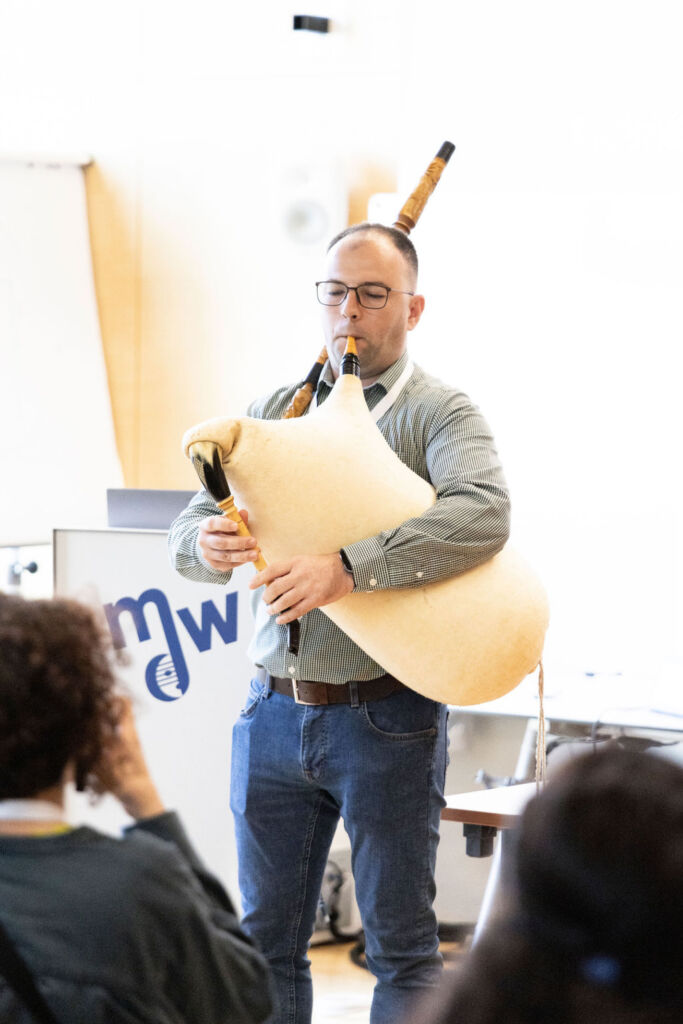
Traditional music is among the areas that can be viewed anew from this perspective. Melita Ivanovska investigated the ritual singing practice of women in south-eastern Macedonia as a form of physical and cultural labour. Although this practice was of central importance to the community, it was hardly understood as labour in exchange for economic remuneration. The disappearance of the relevant protagonists therefore entails not only the threat that a musical tradition will go extinct but also that a certain form of women’s cultural work will disappear along with it.
From “Migrants” to a Post-Migrant Society
A second central question was: What does belonging entail in a society where migration has long since become an everyday phenomenon that extends across multiple generations?
The round table discussion “Postmigrant Views on Southeastern European Music Practice in Vienna” saw Jelena Gligorijević, Marko Kölbl, and Hande Sağlam talk about why many present-day life realities can no longer be sufficiently described by the category “migrant”. Austria has now been home to people with family ties to Turkey or Yugoslav successor states for several generations. The contexts in which their musical practices play out range from those of folk associations and religious music to folk pop, club culture, rap, and hybrid forms. In this, music is becoming the manifest expression of a post-migrant urban society: it can engender connection with family and diaspora origin stories but at the same time bring forth new forms of culture and belonging.
Belonging, Danced
The fact that belonging is not just narrated by also experienced and created on the bodily level became evident in several contributions focused on practices of dance. One example was ethnomusicological research concerning dance rehearsals of ethnic Bosniaks from present-day North Macedonia who live in Vienna. Many family histories feature the region of Sandžak, North Macedonia and eventual labour-related migration to Austria. In the rehearsals, such multi-layered belongings are repeatedly renegotiated through shared movement, repertoire, and social interaction.
Comparative perspectives, on the other hand, were opened up by Katarina Petrović and Magdalena Wolf’s respective investigations of Serbian dance clubs in Vienna and transnational Bulgarian folk dance groups. The two researchers showed how dance neither preserves an immutable tradition nor automatically expresses a clear identity.
A strong point of this symposium lay precisely in the way that it refrained from reducing different regional and societal contexts to a common “Balkan tradition”. Instead, it lent visibility to just how diverse the relationships between cultural practice, labour, migration, and social position are. Viewed this way, music and dance appear not as isolated witnesses to people’s origins but as lively practices through which they shape their presents and repeatedly redefine how they relate to society at large.
- The male form of “musician” that appears frequently in the original German version of this text refers to the male professional Roma musicians who were the theme of the discussed presentations, especially in the context of wedding and other commercial performance situations. As Carol Silverman emphasised in her lecture “Blood and Money: How Balkan Romani Musicians Negotiate Musical Labor”, gender is one of the aspects that characterises musical labour and the associated practices relating to exchange and income. Although woman also make music, their opportunities to participate in certain professional performance contexts differ.