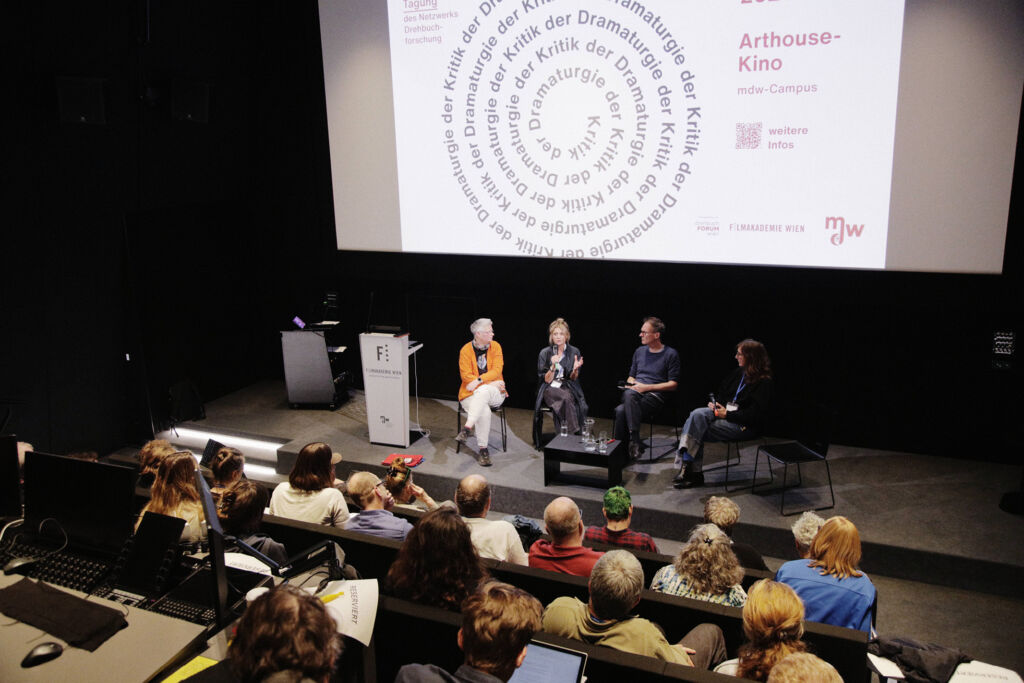
The first weekend of October saw the mdw’s Arthouse Cinema host the conference “Kritik der Dramaturgie” [Critiquing Dramaturgy], a joint event of the screenplay research organisation Netzwerk Drehbuchforschung, Film Academy Vienna, and Screenwriters Forum Vienna. Its two days were filled with presentations and discussions relating to dramaturgy’s theoretical and practical aspects. Christine Lang, a professor of film and media studies at Film Academy Vienna and the conference organiser, offered mdw Magazine deeper insights concerning dramaturgy as a whole and this successful conference in particular.
It was from two perspectives that dramaturgy was approached in this conference. The first centred on “critiques of dramaturgy”—that is, scrutiny concerning the extent to which dramaturgy functions as a gatekeeper that decides which stories get told and which do not. The second perspective taken up by the discourse was that of “criticism with dramaturgy”, where dramaturgy is not the object of criticism but its tool—conceived of as an aesthetic and scholarly practice that can be applied.
But what does dramaturgy actually mean? “Dramaturgy encompasses various things. On the one hand, it refers to the structure of works—not just in film or in television. For that matter, there’s a dramaturgy to every movement through time and space. It’s essential in structuring audiences’ aesthetic experiences and evoking emotions,” explains Christine Lang, herself a film scholar, dramaturge, and filmmaker. But dramaturgy is a practical field, as well—not just in theatre but increasingly in film, where it had formerly been in retreat. “Dramaturgy also embodies both a methodology and a way of thinking, in which sense it functions as a practice-oriented scholarly discipline,” Lang adds. Anna Schlote, in her lecture “Dramaturgie und Kritische Theorie” [Dramaturgy and Critical Theory] on the first day of the conference, described dramaturgy as “a transdisciplinary, cross-cutting practice” that figures into various fields such as theatre and film studies, art history, and literary studies but derives its concepts from practice and tests them against it.
This conference aimed to bring diverse voices together in one place and allow for insights, discussion, and criticism. “The aim here was to put theory and practice in dialogue with each other. And it was fascinating to observe how different people’s ways of talking about dramaturgy are,” said Lang. The opening panel already included a diverse range of positions, represented by Lucia Haslauer of the ZDF series Das kleine Fernsehspiel, producer Barbara Pichler, and screenwriter Thomas Reider. The differences and similarities between their dramaturgical working processes quickly became clear, as did the requirements and constraints imposed by their differing professional fields. All agreed that dramaturgy represents an important foundation for every area of film-related work. “At Film Academy Vienna we train filmmakers—and for them, dramaturgy is an important tool,” emphasises Lang. As a film scholar, she finds it essential to engage with dramaturgy’s foundations: “When writing a screenplay, you can get quite far on intuition alone. But when you eventually hit a wall where the work you’re creating no longer matches what you’d actually set out to do, that’s the point at which dramaturgical knowledge comes into play. Writers need to be clear on what story they want to tell in the first place and on what a given character needs.”
Kritik der Dramaturgie concentrated on the German-speaking region due to its shared cultural characteristics. But despite this focus, the conference also succeeded in attracting international contributions by Antje Budde (Toronto), Sylke Rene Meyer (Boston), and Tanja Oestergaard (Edinburgh) thanks to a call for papers that drew numerous responses. This call also made it possible to combine established experts with first-time presenters. “Having a diverse range of perspectives along with the attendant tolerance of criticism and contradictions is, after all, a hallmark of a high-quality academic conference,” said Lang.
This notwithstanding, Oestergaard’s presentation in particular made it clear how the degrees to which dramaturgy is established in the academic realm differ greatly between German- and English-speaking contexts, with the latter featuring only little theoretically accessible knowledge. “In the Anglo-American world, dramaturgy isn’t something that’s established. Even the term ‘dramaturgy’ is unpopular. In academic contexts the idea is subsumed under ‘narratology,’ which has its roots in literary studies—where films are viewed more as texts,” Lang emphasised. But even so, she holds that dramaturgy is central to understanding film as a medium: “Dramaturgy is part of aesthetics as a philosophical domain, and this approach is part of a German-speaking tradition. Dramaturgy can describe the overall aesthetic experience of an artwork, whereas narratology describes works’ explicitly textual level.” The conference, with its focus on the DACH region, hence also provided an opportunity to critically examine the dominance of the Anglo-American approach.
AI and the attendant digital developments were likewise a topic at the conference. For example, works from the genre alternately known as duanju, micro-drama, or vertical drama—which are increasingly available as AI-generated content—were examined in terms of their functional implications for democracy as such. The presentation by Gabriele C. Sindler, on the other hand, addressed the use of LLMs (large language models) for the analysis of screenplays and noted how they still produce errors or even hallucinate. “Here, it was fascinating to see the current state of this technology. In the artistic realm, it’s clear that AI can be a tool that’s helpful for things like research. But it can’t replace artistic work itself,” sums up Lang.
The papers introduced at this two-day conference are slated to appear shortly as a publication of the screenwriting-oriented series Studien zum Drehbuch.