New Concepts of the 2nd Viennese School: Artistry in Rhythm
What happens when young jazz musicians from multiple European countries come together to engage with the Second Viennese School and produce new music for large ensemble? This question took centre stage at the European Jazz Workshop, whose 2026 edition was the first to be organised by the mdw.
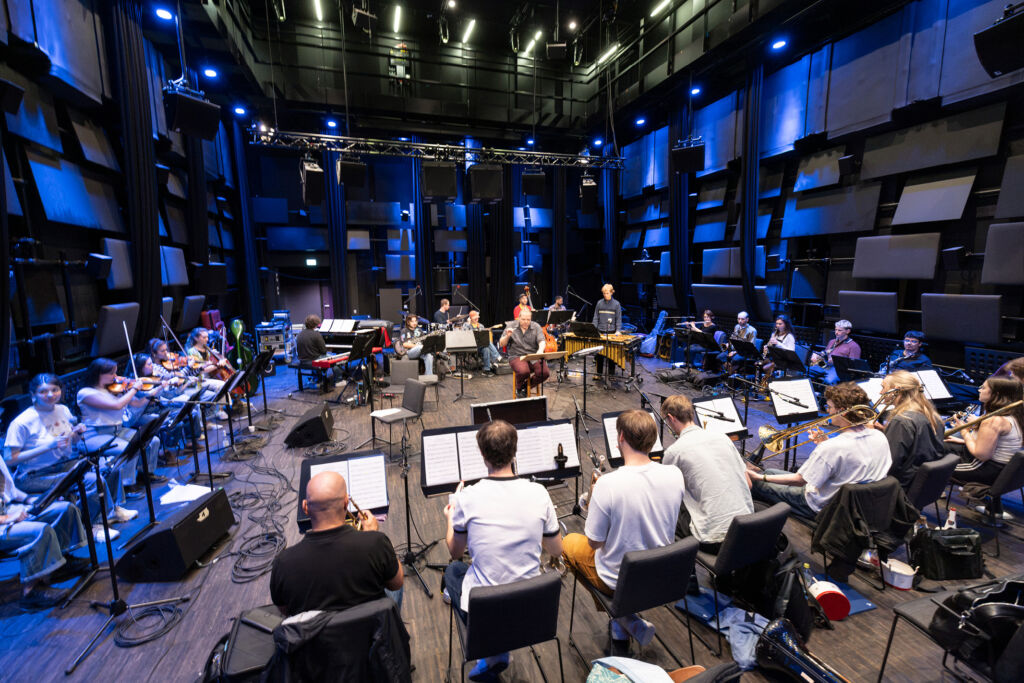
The European Jazz Workshop (EJW) is carried out as an Erasmus+ Blended Intensive Programme (BIP) and encompasses two phases of onsite work linked by online meetings. Responsible for the EJW on the mdw side were Markus Harm and Markus Geiselhart of the Department of Popular Music. The EJW’s 2024 edition had taken place in Parma, followed by Oslo last year.
The EJW provides regular opportunities for collaboration between students and faculty of the Norwegian Academy of Music in Oslo, the Nuremberg University of Music, the Conservatorio di Musica Arrigo Boito in Parma, and the mdw—a group that expanded in 2026 to include ESMUC – Escola Superior de Música de Catalunya Barcelona. A total of 28 students ultimately took the stage in Vienna as the workshop’s “Large Ensemble”. They were joined by two music production students from the mdw, who took charge of audio engineering at the rehearsals and concerts.
The motto of this year’s European Jazz Workshop was “New Concepts of the 2nd Viennese School: Artistry in Rhythm”. Its starting point was the question of how composing principles of the Second Viennese School, especially the twelve-tone technique developed by Arnold Schönberg, Alban Berg, and Anton Webern, might be employed in present-day compositions for large jazz ensembles—as both an overt composing tool and a source of inspiration for new aesthetic approaches. At the same time, the phrase “Artistry in Rhythm” was intended to encourage the participating students to take a deep dive into rhythm and complex metres as creative means. “Artistry in Rhythm” also referred to the orchestra of Stan Kenton and composer Bob Graettinger—who had already integrated Second Viennese School influences into his music during the late 1940s—as well as to Mathias Rüegg and his Vienna Art Orchestra, who marked the turn of the millennium by releasing an album entitled Artistry in Rhythm on which each number was dedicated to a European capital.
The first phase of work took place in Vienna in February 2026. The students, having already met virtually to prepare, showed up with initial compositional ideas that they then discussed and tried out as an ensemble. Their practical work was joined by instructional sessions devoted to composing, arranging, and improvisation. The involved tutors also gave brief talks introducing the jazz and large ensemble scenes in their respective countries, and Mathias Rüegg made a guest appearance to speak about his work with the Vienna Art Orchestra, his creation of the jazz club Porgy & Bess, and his composing techniques.
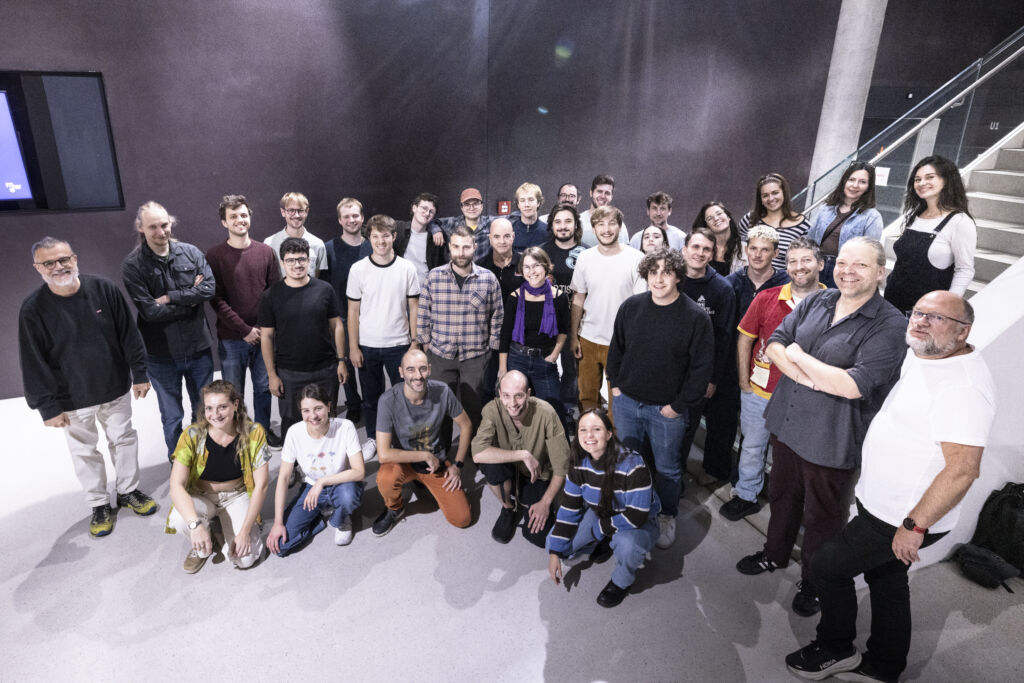
Over the months that followed, the students developed their ideas into full-fledged new compositions—a process that was accompanied by the participating teachers. As they composed, the students kept in touch both with their respective tutors and with Markus Geiselhart via e-mail or Zoom in order to obtain feedback on their music’s refinement. September saw the students reconvene in Vienna for a second phase together. At this point, the focus was on concrete rehearsals of the newly created works: within the space of just a few days, their wide variety of musical approaches had to be combined into a shared concert programme and a balanced orchestral sound. Markus Geiselhart assumed the artistic and organisational helm for this phase of work and also led the large ensemble in the two concerts that concluded the project. He was supported by Roberto Bonati from Parma, Helge Sunde from Oslo, and Néstor Giménez from Barcelona.
A central feature of the European Jazz Workshop is that students participate not only as performers but also as composers and musical co-creators. This year’s concert programme comprised nine compositions that had crystalised since February as part of the EJW and were rehearsed together in September. In the concerts themselves, two of the works were conducted by their own composers. Such a mix of composition, improvisation, ensemble work, and musical autonomy gives rise to a special space of learning—with new music being tried out right away with an international ensemble, reworked, and ultimately performed onstage.
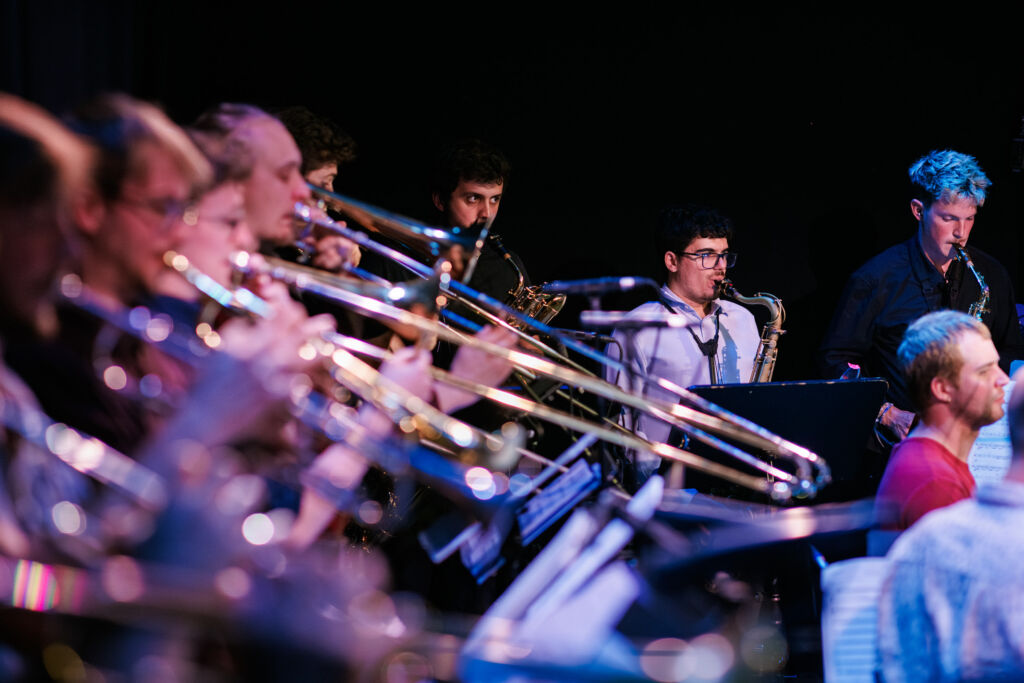
A further important aspect here is international exchange—based on which the contacts established between students and teachers from the various institutions can extend beyond the workshop itself and be of great future importance in a professional field that’s full of individual projects and collaborative efforts.
With this in mind, shared musical and cultural experiences were deliberately planned into the project’s September phase. On Wednesday, the students grouped themselves into smaller formations to play an evening concert featuring their own compositions and jazz standards at Vienna’s Jazzland club. Thursday’s activities were topped off by an evening together at Kierlinger, a tradition-steeped wine tavern once frequented by no less a figure than Ludwig van Beethoven, while Friday’s trip to the nearby town of Baden included a visit to the house there where Beethoven had once lodged. Two concerts—on Friday, 18 September at the Theater am Steg in Baden and on 19 September at Vienna’s renowned Porgy & Bess—concluded this year’s project.
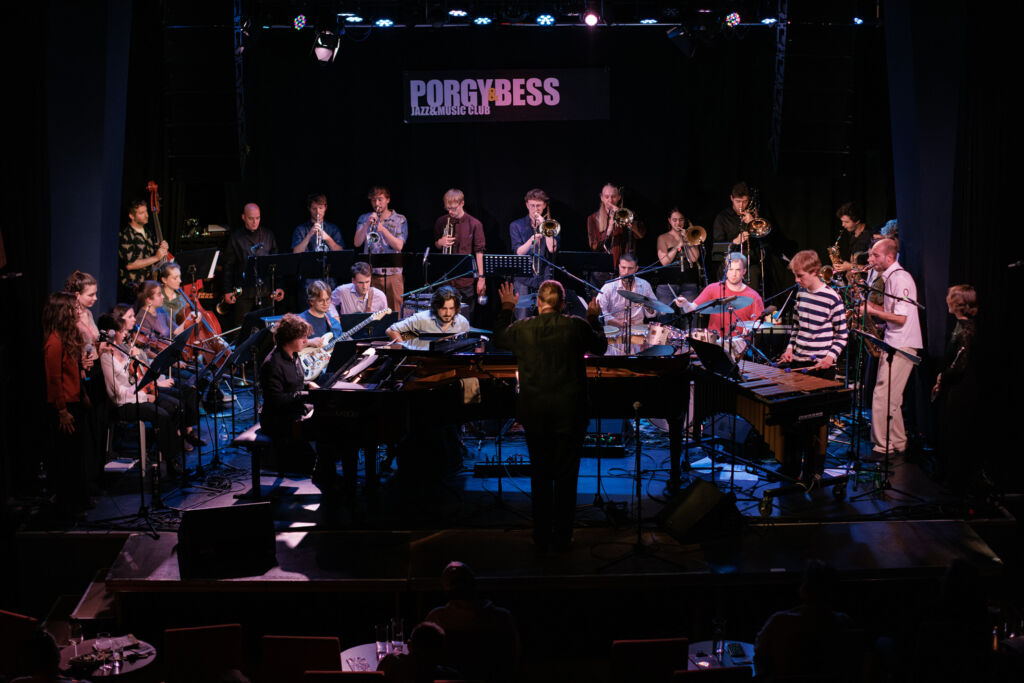
An international project of this magnitude can only go forward thanks to cooperation between numerous participants. A special measure of support for the European Jazz Workshop came from the mdw’s International Office. Its head, Bojana Tesan, accompanied both phases of work in an organisational capacity and also facilitated countless solutions on short notice during the intensive concert days. The European Jazz Workshop also demonstrates how international cooperation between universities can extend far beyond mere international exchange—for when students and teachers from different tertiary-level music schools join hands to compose, arrange, rehearse, and play concerts, such exchange becomes an integral part of an artistic process. In the process that took place here, engaging with the Second Viennese School was conceived of not as historical study but as a starting point for new music. And maybe, just maybe, this will serve to open the door at least a crack to a Third Viennese School.