Elisabeth Höhndorf is an mdw voice student. Katharina Adamcyk is a soprano, voice teacher, and mdw alumna. Michael Grohotolsky teaches at the Anton Bruckner Department of Choral and Ensemble Directing and Music Theory in Music Education and leads both the Vienna Chamber Choir and the mdw Youth Choir. Together, they spoke with mdw Magazine about the voice as an instrument—about its special aspects and challenges and just why nobody could ever make an instrument quite like it.
The voice as an instrument: What does this descriptive metaphor bring to mind?

Katharina Adamcyk (KA): The voice, unlike other instruments, is quite literally part of one’s own body. As such, it’s inhabited by our entire personalities and hence something incredibly individual. And there’s also its connection with language, which entails even greater diversity and expressive potential. That’s something wholly unparalleled.
Michael Grohotolsky (MG): What’s intriguing to me is how the voice also consistently traces the personality’s development. As an expressive instrument, it’s associated with our bodies and our attitudes as well as our personalities—and hence with what we experience. Emotions, family, friends, situations: they all have a constant influence on our voices.
Elisabeth Höhndorf (EH): Since we singers are in such close touch with our emotions and with how we feel on a day-to-day basis, the instrument we have to work with is one that nobody could ever make in quite the same way. We’re very strongly connected with it—and also entirely at its mercy. We can’t ever set our instrument aside; we always take it with us. So the voice has to be very resilient and endure far more than any other instrument, which is why we need training so that we can maintain it with the perfection that singing requires.
So it sounds like you have to be especially mindful of your voice and prioritise caring for it…
EH: Caring for it definitely needs to be a big priority. I’m still trying to find out for myself how to take proper care of my voice; that’s an aspect that really has to be learned. On which days do I need to do what for it? You have to learn to listen to yourself and sense what the voice needs in a given moment.
KA: In speech and language therapy, there’s the term “vocal pacing”. Speech therapists say that when you’re healthy and fit, you have 100 % of your vocal capacity at your disposal. If you’ve slept less, if you’re stressed, if you have an infection, or if you’re facing other vocal challenges, your capacity might be reduced to 80 %. So if you need to be at 100 % the next day, you start that day underwater. That’s a feeling we all know. And when you notice you’re starting to have more and more difficulty getting your voice to function, you’re headed for trouble. So you have to learn to allocate your resources.
MG: Vocal resilience is something highly individual. There are some people who seem to have “vocal chords of steel”, who can sing and speak all day and be ready to go at it again tomorrow. For other people, things are different. So it’s about listening to yourself and becoming aware of how much you can ask of your voice while still ensuring that it can deliver in full the next day. Do I have a performance, a long rehearsal, or even an entire weekend of rehearsals? If so, I have to allocate my resources accordingly. And I’ll go so far as to apply my singing technique to my speaking voice when I rehearse, since that’s easier on my voice.
Doing justice to the diversity of the voice is a wonderful challenge.
Katharina Adamcyk
So the technique people train as singers is easier on the vocal apparatus than their normal speaking voice?
KA: Absolutely. It’s even the case sometimes that you can sing but not speak—which I’ve experienced myself. In speaking, we often develop counterproductive habits that are hard on our voices. I’ve gathered some experience in terms of how long I can speak in a healthful way and still sing afterwards. And as far as that goes, there do exist a couple of tricks and exercises. I used to underestimate how, as a teacher, you can easily get deep down into what you’re doing and forget about how you’re speaking.
EH: You have to learn to figure out just when you need which kind of voice—and how singing requires that you use your voice differently than when you speak.
So there’s a difference between the voice we speak with and the one we sing with?
KA: Right. And teachers’ voices have to withstand particularly heavy use. Unfortunately, that’s something we often only notice when our voices give out. If your voice is in good shape, you can teach for ten hours and then sing a concert that evening. It’s when problems come up that you notice how much strain speaking can entail. It always feels to me like this aspect gets too little attention. The amount of strain our “instrument” experiences in individual lessons, choral work, and concert performance is something I’ve often hugely underestimated myself.
MG: I notice when I teach and then lead the Youth Choir in the evening—perhaps with a meeting in between—that I have to treat my voice as a precious resource. Because you’re not automatically protected from sounding strained in the evening. You have to make sure to speak with lots of support and resonance, just like we learned in our own voice lessons. And especially when leading a choir, you often switch between the two modes: you’ll explain something and then sing it to demonstrate. It would actually be better to concentrate more on demonstrating how to sing things—in my experience, anyway.
In our voices, we have an instrument that nobody could ever build in quite the same way.
Elisabeth Höhndorf
So the voice is called upon to do different things, depending on whether you’re onstage or in a lesson. How can the voice be trained for these different areas?
EH: In performance degree programmes, the focus is on developing both your technique and a vocal foundation for your future professional life so that you can always rely on and be assured of a functioning voice in concert situations. We work on our voices in great detail, on improving and perfecting them, and in the master’s programme we turn our attention to the next level—that of appropriate expressivity and emotionality. That’s the focus in terms of the opera profession, as I see it.
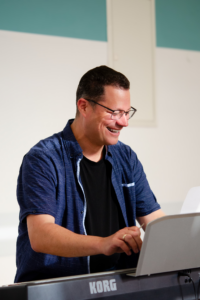
MG: I think that in performance, it’s very much about what one does oneself: How can I fully develop my own voice? But the vocal training I provide as a graduate of the Music Education for Voice and Instruments (IGP) programme is joined by a pedagogical ideal whose focus has to be adapted to the individual I have before me. So I’ve learned to convey content without imposing what I do myself on that person. As a choir director, on the other hand, what I’m after is to realise something as a collective—though I also have to make sure the singers don’t negate themselves. Giving way without giving oneself up—that’s a core idea of teaching as such.
KA: It’s also important to have mastered switching between various contexts: Are you singing in a big choir or in a one-to-a-part ensemble? With piano or with orchestra? And on top of that, there are stylistic considerations as well as performance practice—like in the mdw’s early music MA programme. I sing differently with a lute than I do with a modern orchestra. There are so many different contexts in which this instrument of ours needs to be mastered, and learning to do justice to such diversity is a wonderful challenge. I think this is a major strong point of formal vocal instruction—how you learn to reliably call upon the appropriate technique independent of the musical context at hand, be it in a choir, in an ensemble, in an individual lesson, or onstage, regardless of the setting or format.
EH: I sometimes find it difficult to think just about technique. And even so, I’ve understood for myself how important it is to regularly give it my undivided attention. The point here is being able to strike a good balance when I’m onstage in a concert situation. I want my technique to go unnoticed while also being something I can rely on so that I can devote myself fully to expression and emotion from moment to moment when I’m onstage.
The greatest thing for a pedagogue is when you can show someone the way forward, set the coals a-glowing, and ideally light the fire.
Michael Grohotolsky
The mdw offers quite a variety of voice-related degree programmes. How do I know which programme I’m suited for?
EH: Based on your own interests and where you envision yourself. At least that’s how it was for me. I knew that I wanted to be onstage, in part because I’m so fond of acting. So it was especially important to me to study something where dramatic work would play an important role.
MG: I’d originally wanted to go into singing as such rather than lead ensembles. I started out in the programme for school music teachers, and it was only later on that I continued in the IGP programme. So it’s ultimately a question of where you want to go: Do you want to become a voice teacher, a schoolteacher, or both?
KA: In my case, it all began not with singing but more with general musical pursuits. The teacher education programme is also where I started; to my mind, that was one of the best programmes at the mdw, and I very much enjoyed it. But I eventually dove deeper into singing, continued as an IGP student, and found my way from there to the performance programme. Along the way, I discovered that I wanted to work both as a singer and as a teacher. The nice thing about the mdw is that you have the opportunity to investigate which path is the right one for you. I know lots of biographies that are similar to my own; you start with one thing but then get led elsewhere by new experiences, degree programmes, or teachers. My everyday professional life today is entirely different from the one I envisioned ten years ago.
MG: The various degree programmes are also very closely related. Without voice teaching, for example, there can’t be any choir directing. After all, I also provide vocal training to the people I work with in a choir.
The various programmes that involve singing don’t just train the voice, though. What other elements do their curricula feature?

EH: In performance programmes, it’s your overall profile as an artist that gets cultivated—including stage presence and the relevant languages. What’s more, you’re also trained in acting as well as in speech technique, dance, and movement.
MG: In the education programmes, there’s the versatility you acquire through learning instruments in addition to your own voice—and you also have the dual experience of being trained and learning to provide training as a singer. This back-and-forth between the perspectives of leading and being led—which you see in my field of choir directing, for instance—is what’s challenging about being an educator. But as time goes by, you do acquire a sense that enables you to refrain from putting yourself first and instead be part of what you’re seeking to achieve as a collective: a maximum of musical expression.
AK: In pedagogical work, another important point is being aware of music-making’s significance to people individually and making others aware of the impact singing can have in a psycho-social sense. Like how it can help prevent anxiety and benefit people with dementia. Or how singing can sharpen children’s faculties of perception and breath control. Adolescents also get to know their bodies better through singing and come to understand their efficacy as part of a collective.
It’s enriching for me to stand onstage and have the privilege of touching other people with my voice.
Elisabeth Höhndorf
What aspect makes the things you do so special, and what’s the biggest challenge you face?
MG: Students you see on a weekly basis come in a different mood each time. As a pedagogue, I’m constantly having to adapt to that—which is far removed from my official duty of simply rehearsing musical works. So when I want to rehearse a certain piece and notice that I’m not getting anywhere, do I turn up the pressure? Switch to another piece? That’s the biggest challenge: taking a group’s temperature, perceiving how the students are doing at a given moment, and attempting to pick them up wherever they are.
KA: It’s something special for a teacher to generate a spark and experience how it feels when that spark actually gets transferred to a student. Regardless of their level, whether layperson or professional. When you notice in a lesson or onstage that they’ve just truly made music. That’s extremely enriching and sustaining, in a way I never would’ve imagined. The same applies to your own artistic pursuits, when you manage to get into this flow state alongside your other work, your technical practicing, your teaching. What it’s ultimately all about, with the voice, is making music. And enabling that to happen in both realms, in teaching and onstage, is the ultimate challenge and the biggest enrichment.
EH: In my case, the themes are somewhat different from those of the educational field. What I find most enriching is to stand onstage and be able to get a feel for different people every day, again and again—to get to know my own limits and have the opportunity to try out crazy things or sometimes just go wild, to open up emotionally and ideally touch and reach other people when I go out there. Performances and concerts always provide me with lots of energy for all the days that follow, and I leave every performing situation feeling unbelievably enriched. A challenge is being able to deal with the uncertainties that this profession entails. We’re entering a very competitive professional field in which only a small percentage of us will be able to make a living. They make this clear to us very early on in our studies. You receive criticism every day, learn to deal with it, and learn to take along what you can use in a productive way. So I think that staying self-confident and hopeful is the real challenge.