When we describe singing, we often resort to terms from the realm of visual perception—words like vibrant, warm, colourful, or smooth. One such tried-and-true term in vocal pedagogy is chiaroscuro, the balance of bright and dark timbre in a sung tone. Coined in the context of late 17th-century visual art to represent bright and dark contrasts within an image, chiaroscuro entered the world of singing by the late 18th century and has been used there ever since, primarily where classical singing is concerned.
The enduring nature of chiaroscuro in classical singing has made it both a sought-after vocal quality and an enigma when it comes to pedagogical standardisation, resulting in ambiguity both for pedagogues endeavouring to teach it and for singers trying to achieve it. Research and pedagogical observations from between the 17th and 21st centuries highlight two levels on which chiaroscuro can be examined: 1) the physiological (physical) level at which a singer must finesse their vocal system to produce such a balanced timbre—including fine-tuned manipulations of the respiratory system, vocal folds, and vocal tract; and 2) the perceptual (psychoacoustic) level, which determines how such timbral qualities are heard and perceived in the resulting sound. To date, however, only limited empirical work has been done to investigate chiaroscuro in an according manner. My research aims to fill this gap by way of a three-part study, examining chiaroscuro first perceptually, then physiologically, and finally via the linkage of these two levels. The ultimate objective is to better understand the perceptual and physiological elements of chiaroscuro both individually and relationally, thereby developing a greater knowledge base for pedagogical standardisation.
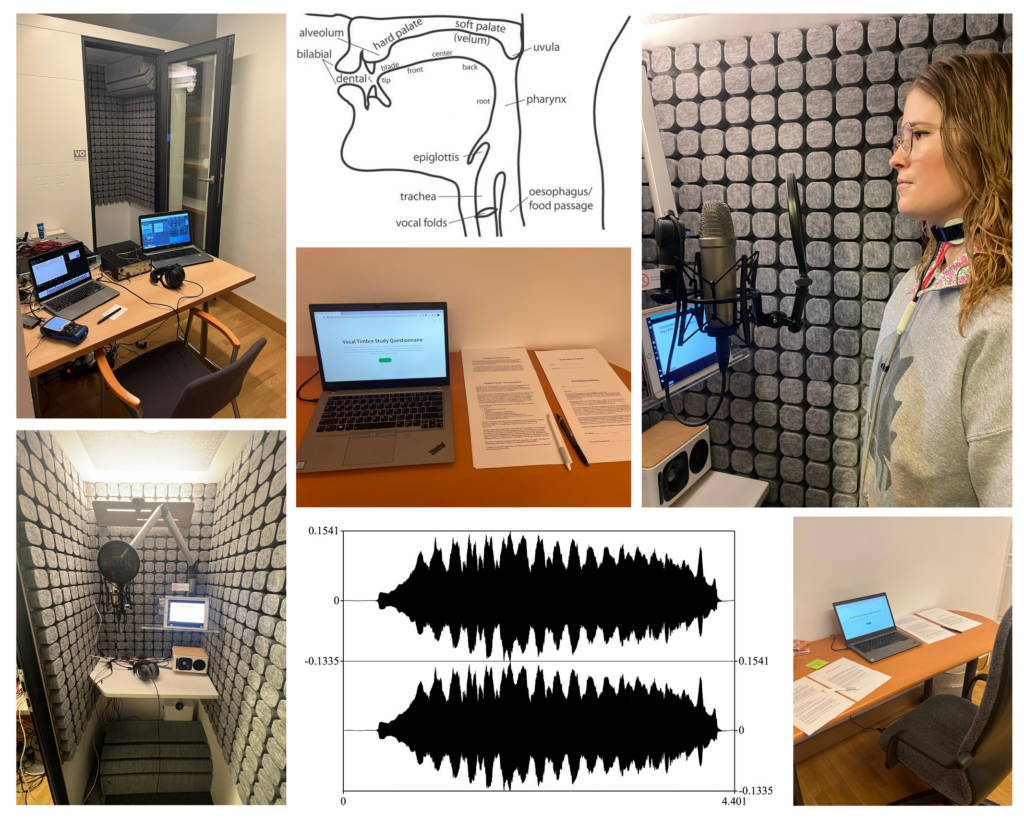
Part I attempted to understand how experienced voice pedagogues hear chiaroscuro by having them rate the perceived degree of it in sound samples systematically altered to highlight or diminish specific acoustic/spectral elements identified in the literature as potentially linked to the term. Part II took a closer look at the physiological voice production gestures associated with chiaroscuro based on data collected by way of electroglottography (a non-invasive method of monitoring the relative vocal fold contact area during voice production) and live singing voice samples as singers systematically changed vowels, timbre, pitch, and dynamics. Part III then sought to connect the prior two parts, with experienced voice pedagogues rating recordings from Part II in terms of their perceived degrees of chiaroscuro as well as chiaro and scuro individually, linking the perceptual with the physiological and revealing whether the singers’ intentions aligned with pedagogues’ perceptions.
As the project now draws to a close, its findings will hopefully enable a more explicit grasp of this centuries-old concept and its place within a field where voice pedagogy and voice science are increasingly integrated, translational, and evolving.