A Violin Theft
On 28 February 1936, the Polish star violinist Bronisław Huberman (1882–1947) performed on his Guarneri at Carnegie Hall in New York. While he was onstage, his most valuable instrument—the “Gibson” Stradivari of 1713—was stolen from his dressing room. It had already been stolen from him once before, at Vienna’s Hotel Imperial in 1919, but that case had been quickly solved. This time, however, Huberman was never to see his Stradivari again: it resurfaced only in 1987, long after his death. “The first violinist of Vienna (and the world)” is how he was described in the Viennese daily Wiener Tag. This was just one of many similar sobriquets that newspapers bestowed upon Huberman, who was doubtless regarded as one of the foremost virtuosos of his era. Alongside being revered for his artistry, he was also famed for his socio-political commitment. A tireless advocate for a peaceful, united Europe, the violinist caused quite a stir when he cancelled a 1933 concert in Germany and wrote an open letter explaining his decision as a reaction to the politics of the National Socialists. He was also noted for his establishment of an orchestra in then-Palestine, which ultimately became today’s Israel Philharmonic Orchestra. This ensemble was comprised largely of Jewish emigres who had fled National Socialist persecution. Less well known today is Huberman’s stint as a master-class teacher at what was then the State Academy of Music and Performing Arts Vienna, a predecessor to today’s mdw. But back when his Stradivari was stolen in 1936, the famous violinist’s much-discussed employment here was already nearing its end.
“A Gigantic Sensation”
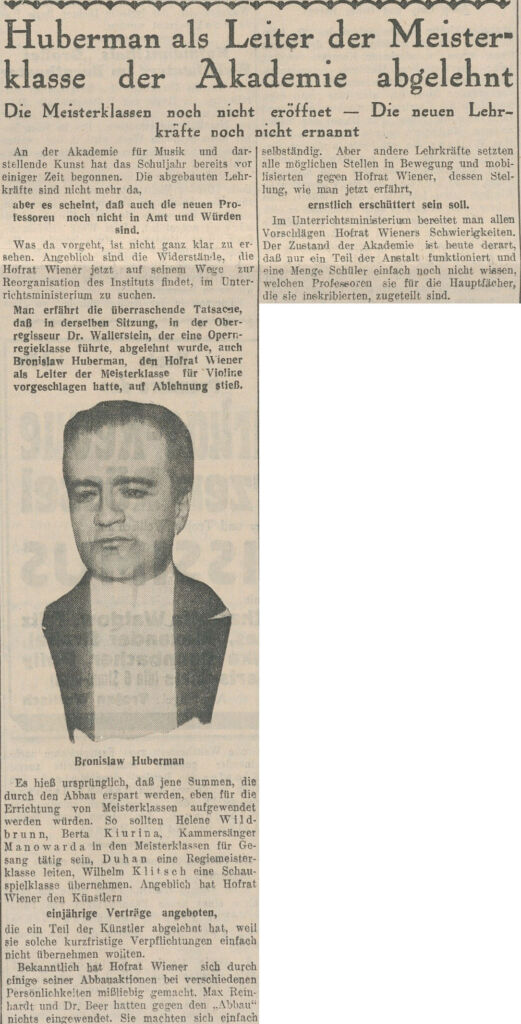
In 1931, Karl Wiener was appointed as the State Academy’s president. Wiener envisioned the establishment of master classes led by prominent teachers, and Huberman had actually declared his willingness to lead the one for violin. But Wiener’s dream of “a gigantic sensation” was met by the reality of the violinist’s demand for 50,000 Austrian schillings, whereas other highly paid masters were to receive at most S 20,000. In order to prevent jealousy and resentment from arising, Wiener planned an official salary in this amount for Huberman, as well—with the other S 30,000 being paid out as a “secret personal allowance”. In view of these exorbitant demands, however, the Ministry of Education vetoed his scheme to win over this “most outstanding violinist in the world”. Two years later, Wiener’s successor Karl Kobald made a renewed attempt. Huberman once again expressed his willingness to cut back on concert-giving and share his art at the mdw. Kobald, knowing that he could not meet the star violinist’s salary expectations, turned to his prospective students: up to S 5,000 a year in tuition had to be paid for one of the coveted places in Huberman’s class, compared with around S 1,000 in the other master classes. As if this were not enough, Huberman also demanded tenancy of an apartment in Schloss Hetzendorf on special terms, including remodelling, as well as tax-exemption on his earnings. The Minister of Education proved willing to make enormous concessions, with the employment contract finally being signed in April 1934. Universal elation ensued, and the prominent teacher’s first set of entrance examinations was held in public.
A Disappointing Conclusion
Huberman ultimately failed to establish an artistic tradition in Vienna. At between two and five a year, the number of his students was quite small. Moreover, the violinist’s frequent concert tours prevented him from teaching on a regular basis to begin with. And by early 1936, Huberman was unwilling to extend his contract. The “remuneration is lower than that of some primary school teacher”, he complained. The artist was also piqued at having not been invited to that year’s Salzburg Festival. President Kobald, at pains to do everything possible to retain his biggest star, successfully intervened with Salzburg’s provincial governor—but the special concert that he secured failed to take place due to Huberman’s fee demands. A visibly crestfallen Kobald had to accept Huberman’s departure. The hoped-for radiance had never manifested, and the attempt to secure a world-class artist as a permanent faculty member had come to naught.