
*****
Project Overview
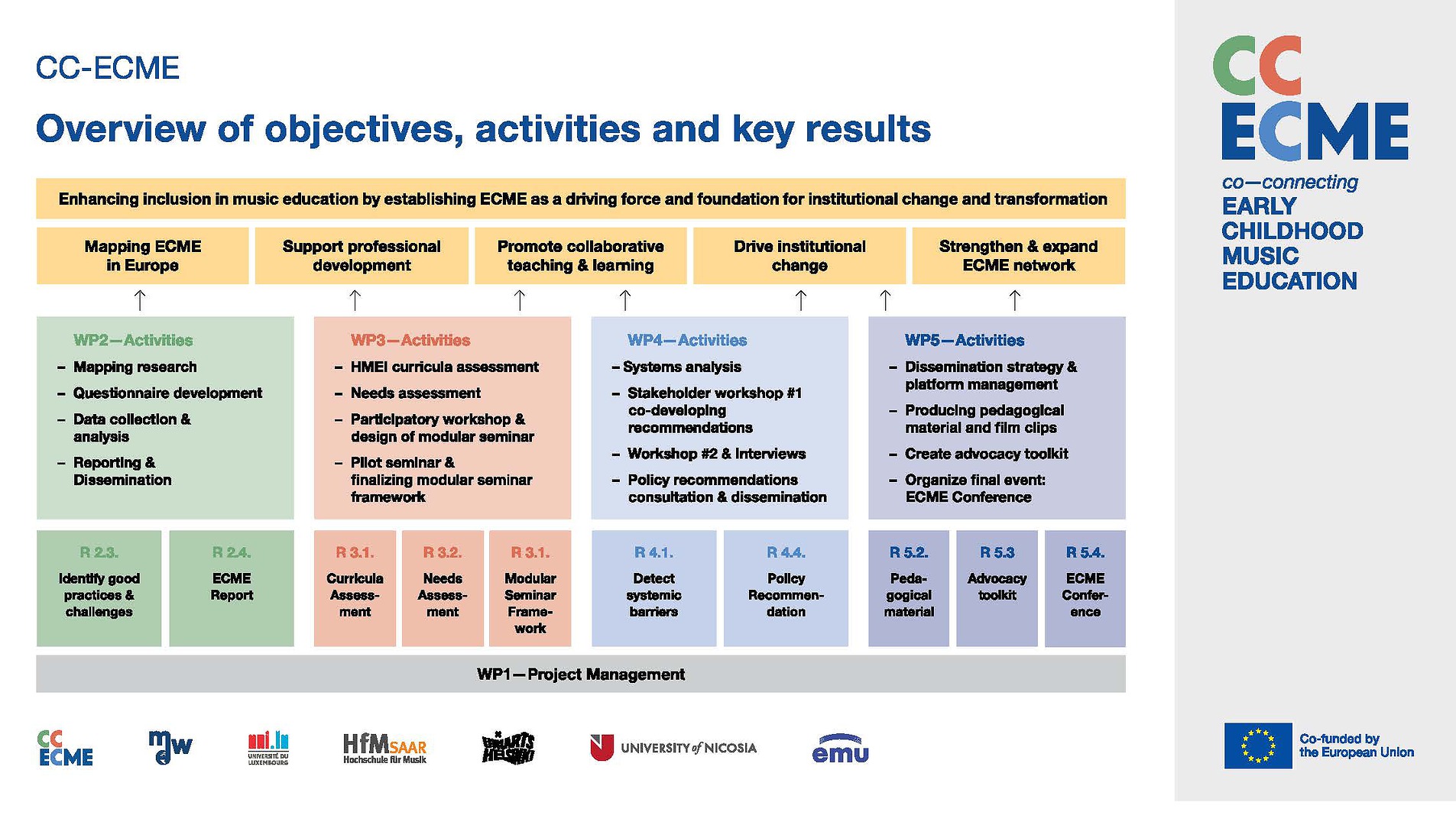
*****
Work package 2 - ECME Mapping & Good Practices
Lead: Natasa Economidou
The ECME landscape in Europe is highly diverse: responsibilities are distributed across different institutions, national systems vary significantly, and collaborative practices take many forms. WP2 responds to this complexity by building the project’s evidence base through a systematic mapping of ECME provision, needs, and good-practice examples of inclusive and cross-institutional collaboration across Europe. The result is a comprehensive, research-informed overview of ECME for children aged 4–7, covering institutional collaborations, training pathways, pedagogical approaches, and barriers to access. Its findings feed directly into the development of the modular seminar framework in WP3 and the policy work in WP4.
WP2 operates through a structured sequence of literature review, questionnaire development, data collection, and comparative analysis. It identifies good practices and activates an expert community that will contribute to subsequent work packages. This expert pool will be carried forward beyond the project’s lifetime and embedded within an ECME Special Interest Group (SIG) of the EMU, ensuring continuity, sustained exchange, and long-term impact.
The WP operates in clearly defined phases:
- Literature review (Oct 2025–Mar 2026) with support from HfM Saar.
- Development of mapping template & questionnaire (Nov 2025–Mar 2026) with iterative expert feedback.
- Data collection (Feb 2026–Feb 2027) in two stages: (1) music schools via EMU networks, (2) pre-/primary schools.
- Analysis & reporting (Apr–Nov 2027) resulting in the European ECME Report with cross-country comparison, good practices, thematic findings, and validated tools for future European studies.
*****
Work package 3 - Modular Professional-Learning Framework
Lead: Luc Nijs, University of Luxembourg
The professional training of ECME educators across Europe is characterized by considerable variation in curricula, institutional priorities, and expectations regarding collaboration and inclusion. WP3 responds to these differences by developing a modular, hybrid seminar framework that strengthens educators’ competences for inclusive and cross-institutional ECME. Drawing on three complementary sources—the evidence generated in WP2, a comparative mapping of HMEI curricula, and a needs assessment through focus groups with educators and leaders—WP3 translates research insights into practical, scalable learning opportunities for teachers and institutions. Its outputs directly support capacity-building in music schools and provide curriculum-related recommendations for HMEIs, while also informing the policy development in WP4.
WP3 follows a combined research–development approach that links curriculum analysis, stakeholder consultation, participatory design, and piloting.
It examines how ECME is currently embedded in higher music education curricula, identifies gaps and needs through focus groups with educators and leaders, and co-designs seminar modules through an international workshop. The resulting framework integrates collaborative, inclusive, and interdisciplinary pedagogies (including movement and language), offers digital learning components, and is designed to be scalable and adaptable to diverse national and institutional contexts.
The WP proceeds in structured phases:
- Curricula analysis (Nov 2025–Apr 2026): mapping 20+ HMEI curricula to identify competences and gaps.
- Needs assessment (Jan–Apr 2026): 4–5 online focus groups with 40–50 educators and leaders.
- Participatory design workshop (Jun 2026–Feb 2027): co-creating seminar modules with partners and experts (workshop Vienna, Sep 2026).
- Pilot seminar (May 2027–Jan 2028): testing, evaluating, and refining the framework in collaboration with associated partner AZUS-CZ.
*****
Work package 4 - Evidence-Based Policy Recommendations
Lead: Taru Koivisto, University of the Arts Helsinki
Policy frameworks for ECME differ substantially across Europe in terms of access, affordability, institutional structures, and expectations for collaboration. WP4 addresses these disparities by conducting a system-level analysis of ECME conditions and by developing evidence-based policy recommendations that strengthen inclusion and cross-institutional cooperation. Building on the findings of WP2 and the curriculum-related inputs from WP3, the work package identifies systemic barriers and enablers and formulates actionable guidance at the micro (local), meso (institutional), and macro (system) levels.
WP4 combines analytical, consultative, and co-creative methods. Using a structured systems analysis approach, it examines how ECME is governed and delivered across different national and institutional contexts. Two iterative workshop phases capture and refine stakeholder perspectives, allowing participants to co-develop feasible and context-sensitive practical solutions. These insights feed into a draft policy brief, which undergoes a structured consultation process within the networks of the associated partners (AEC, EAS, EMU, ISME-ECME, MERYC). The consolidated results subsequently flow directly into the advocacy toolkit developed in WP5.
The WP progresses through four core phases:
- System analysis (Nov 2025–Aug 2026): reviewing policy papers, legislation, access, availability, funding, institutional structures, and collaboration models.
- Stakeholder Workshop 1 (Aug–Dec 2026): 25–35 participants (educators, leaders, researchers, municipal actors, parents) reflect on system findings and identify key leverage points (workshop Vienna, Sep 2026).
- Stakeholder Workshop 2 & interviews (Jan–Feb 2027, online): 20–50 participants provide feedback on preliminary policy directions and co-develop practical recommendations.
- Policy drafting, consultation & dissemination (Mar–Dec 2027): preparing policy recommendations for inclusive and collaborative ECME, followed by consultation and targeted dissemination across networks.
*****
Work package 5 - Dissemination, Digital Resources & Stakeholder Engagement
Lead: Till Skoruppa, European Music School Union
Effective dissemination and sustained stakeholder engagement are essential for ensuring that the project’s results reach practitioners, institutions, policymakers, and the wider public. WP5 coordinates all communication and dissemination activities, manages the project’s online presence within the EMU website, and ensures that findings, materials, and recommendations are shared in accessible and engaging formats. By connecting research, practice, and policy, WP5 supports the long-term uptake of project outcomes and the strengthening of ECME across Europe. Beyond supporting teachers, institutions, and national associations, EMU will also draw on the project’s outcomes—including the advocacy toolkit—to strengthen its Europe-wide advocacy efforts and contribute to raising the visibility and priority of ECME at the European policy level.
WP5 integrates dissemination, resource development, and community-building into a coherent transfer strategy. It produces pedagogical materials and video clips that complement the modular seminar framework developed in WP3, and it develops a multi-level advocacy toolkit based on the policy recommendations created in WP4. To ensure sustainability beyond the project period, WP5 facilitates the establishment of an ECME Special Interest Group (SIG) within EMU, providing a platform for continued exchange, professional learning, and networking across Europe.
The WP unfolds in four main phases:
- Dissemination strategy & website setup (Oct 2025–May 2026): establishing communication structures, website integration, and initial outreach channels.
- Pedagogical materials & video clips (Oct 2026–Jul 2027): producing approximately 15–20 pedagogical materials and around 10 video clips in collaboration with mdw, UNIC, and HfM Saar, aligned with the WP3 seminar framework.
- Advocacy toolkit (Nov 2027–Apr 2028): creating templates, guidelines, infographics, and communication strategies for engaging institutional and policy stakeholders, based on WP4 outputs.
- Final ECME Conference (Mar–Jun 2028): presenting the project’s results alongside the EMU General Assembly, launching the ECME SIG, and activating multipliers through keynotes, workshops, and interactive formats.
*****