
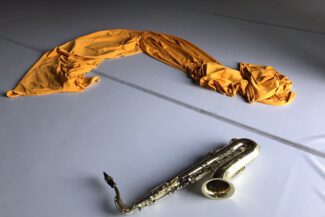
Birgitta Flick – Refiguring Composition
How can it be possible to delineate a composition when it gets in touch with improvisation and the outside world? What idea, what concept of a musical composition can be gained from this – and which new artistic and other insights and consequences arise from there?
Historic and current practices open composition to improvisation. As I have researched earlier in my master thesis, where I investigated the contact of composition and improvisation from the perspective
of permeability, a composition seems to be perceivable as something ongoing. Something ongoing, that through its enormous permeability is constantly in the process of becoming, with continuous transformation processes, stimulated by the connection and interaction with other components such as improvisation. Nevertheless, it must be possible to delineate a composition when it gets in touch with improvisation and the outside world, asking, so to say, what remains when improvising with a composition. To investigate this question, I want to undertake an artistic experiment with different experimental and reflective circles and follow an initial “seed” compositionally. I want to develop a network of new compositions through interweaving the composition process with purposefully exposing the composition seed in its different stages of development to outer contacts, especially improvisation by myself and other musicians – both following improvisational structures integrated into the composition in different ways or meeting the composition totally freely. My artistic method shall be interwoven with and informed by academic approaches, such as the method of génétique in vivo (or live genetics) as Nicolas Donin et. al. described it and applied it to musical composition and Interpretative Phenomenological Analysis (IPA). Through that, I aim to get an understanding of the inner happenings that are spurred by composition’s contact with improvisation and other components or activities of the outside world, thus delineating composition – an area that seems not to be researched yet. As both a methodological means and goal of the project I also want to look closer at the composition process itself which is permeable for so many components as particularly the composer’s own artistic practice and history. Also, I want to consider improvisation’s role for the composition process and for the composition itself as well as to investigate the composer-improviser’s double role more deeply. The research project seems very relevant for the practical dealing with an existing composition (e.g. copyright questions, set up of rehearsal processes a.o.), but through the artistic practice of creating both through composition and improvisation and to look at the impact that other individual and collective creative processes have on the individual composition process, I foremost aim to contribute to a new understanding of the concept of a musical work, as well as (co-)authorship, musical identity and also collaborative creating. The research questions arise from my personal improvisation and composition practice that is rooted in contemporary Jazz but stretching out beyond that.
Birgitta Flick is a Berlin based improviser and composer. Educated as saxophonist at Jazz-Institut Berlin (UdK/HfM „Hanns Eisler“) and in composition at the Royal College of Music in Stockholm, she works internationally as a freelance musician with her own groups based in a.o. Berlin, Stockholm and New York City. As a sidewoman she works right now with e.g. the Pål Nyberg ensemble in Stockholm and Nico Lohmann’s quintet in Berlin. As a composer she writes for her own groups as well as choir music and instrumental and vocal works for ensembles such as LUX:NM (DE), Vokalensemblen i Sundbyberg (SE) or Aulus Duo (GB). Since 2015 she serves as artistic director for the concert series InSpirit at Kaiser-Wilhelm-Gedächtnis-Kirche in Berlin. Concert tours and festival appearances have taken her to Sweden, the US, Bahrain and the Middle East. Her artistic work is documented and presented on numerous CD and LP productions and has been supported by the Berlin senate, the country of Berlin/UdK, Initiative Musik gGmbH, Musikfonds, JazzBaltica Förderpreis and the Goethe-Institut.
Supervisors: Tasos Zembylas, Samuel Grillusz, Annegret Huber, Fredrik Hedelin
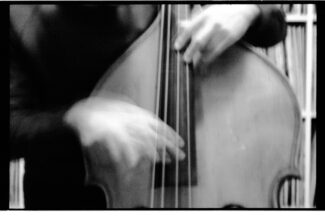
Ivar Roban Križić – Performing Reflection: Improvisation in Word, Thought and Action
Free improvisation in music offers a unique field for exploring how artistic practices develop through embodied engagement, critical reflection, and collaborative experimentation. This research focuses particularly on the process of practicing within this context, tracing the evolution of specific exercises and preparatory methods. These were initially tested in collaborative projects with other musicians and later refined through a series of workshops. A central theme that emerged throughout this process is the role of reflection—both musical and verbal—as a vital component of artistic development. This realization culminated in the project Performing Reflection, which established a dialogical relationship between musical improvisation and reflective discourse. The work contributes to a deeper understanding of how structured exercises and reflective practices can support and expand the art of free improvisation, offering new perspectives on its preparation, pedagogy, and performance.
Ivar Roban Križić is a double bassist, improviser, composer-performer, artistic researcher, curator, and educator based in Vienna. His work spans contemporary jazz, experimental music, free improvisation, and interdisciplinary performance. He combines embodied improvisation with philosophical inquiry and technological experimentation, developing performance setups involving feedback systems, custom electronics, and various extensions of the double bass.
He completed a Doctorate in Artistic Research at the University of Music and Performing Arts Vienna, focusing on the epistemology of free improvisation, tacit knowledge, and critical reflection in performance. He previously studied jazz double bass at the University of Music and Performing Arts Graz, as well as German Studies and Philosophy at the University of Zagreb.
His recent and ongoing artistic research concentrates on the relations between improvisation, difficulty, embodiment, self-sabotage, cognition, and interactive technologies. This includes collaborative work in ensemble-based composition, AI-mediated improvisation, and long-term explorations of performer interaction. His theoretical background draws on phenomenology, cognitive science, critical improvisation studies, and distributed or relational models of creativity.
As a curator, he runs the symposium series Perspectives on Improvisation, which connects approaches from dance, electro-acoustic music, pedagogy, instrument building, and critical theory. He teaches courses on improvisation, artistic research, and reading at both the mdw and the MUK, and has given workshops and lectures at institutions in Vienna, Graz, Linz, Oslo, and elsewhere in Europe. His pedagogical work emphasises reflective practice, heterarchical learning, and his constants/variables model for improvisation.
His artistic output includes solo and ensemble performances, lecture-performances, research-creation formats, and technologically augmented works that combine musical performance with theoretical reflection and documentation.
Supervisors: Tasos Zembylas, Thomas Grill, Peter Herbert, Burkhard Stangl
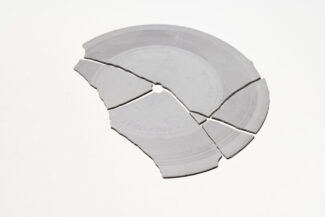
Karl Salzmann – To Start from Scratch
In the project To Start from Scratch the record player is used as an apparatus and a starting point for further investigations. To Start from Scratch is therefore both a title and a method.
The project is currently divided into three sub-areas: while at the beginning of the project the focus was on researching and re-evaluating historical facts about modifications and performance practices with the gramophone (including Hindemith, Toch, Moholy-Nagy), over time the focus shifted to observing contemporary artistic practice with the medium of the record player. Through a variety of experimental settings, both installative and performative in nature, I have been able to carry out autoethnographic research as well as phenomenological investigations into the practice of other artists working with the turntable. Another area of the research, which is also an essential component of all the previous sub-areas, is the materiality of sound. Here, the materials of the recording media (including PVC and shellac) are at the focus of a critical examination of their economic and ecological aspects.
The materiality as well as the apparatus and the artistic practices are always considered and examined as relational in the project. I use strategies such as participant observation, autobiographical narration and dense description. In order to convey the content – especially that of materiality in the sense of auditory information, the reflection and documentation of the project is conceived in the form of audio-papers, sculptural and audio-visual objects, among other things.
Supervisors: Hans Schabus, Thomas Grill, Annegret Huber, Alexander Damianisch