Research Centre for European Multipart Music
Multipart music represents one of the most fascinating phenomena in the European musical practices. It has therefore been a favoured object of research for a long time now, particularly in a national context. Regional studies which extend outside of political boundaries, were until the beginning of the 21st century, however, rare and sporadic. But, as a rule, the regional and the political boundaries in Europe do not coincide. Thus an almost untouched area for investigations has emerged here. Following a detailed analysis in 2003, the establishment of a Research Centre for European Multipart Music as an international network of specialists seemed to have become more than necessary.
A thorough examination of the diverse European multipart music practices can only be made by concentrating on specific topics and areas. The investigations include up to now the following issues: Multipart Singing in the Balkans and the Mediterranean (EV I), Cultural Listening and Local Discourse in Multipart Singing Traditions in Europe (EV II), The Instrumentation and Instrumentalization of Sound (EV III), Multipart Instrumental Music. Soloist and Ensemble Traditions (EV IV) and Music for Dance (EV5) and Singing, Song and Sound (EV VI).
Some of the results of the work carried out until now are published on this website to provide insights into this work and to obtain new impulses and suggestions from interested users.
Ardian Ahmedaja
New Publication
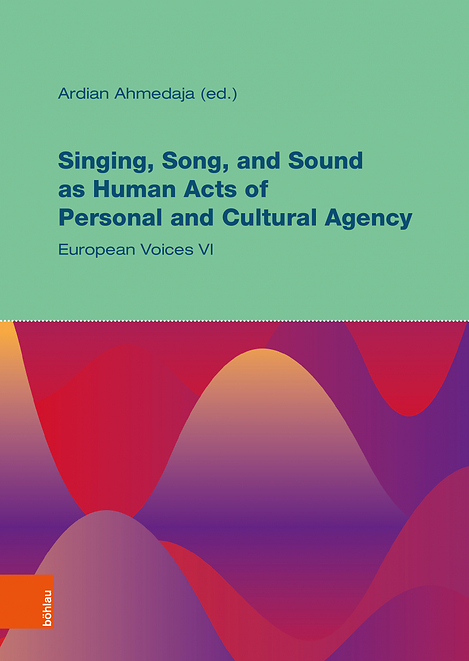
European Voices VI
Ardian Ahmedaja (ed.) Singing, Song, and Sound as Human Acts of Personal and Cultural Agency. European Voices VI. Music Traditions/Musik Traditionen Vol. 5. Wien: Böhlau. 2025. 308 pp., map, photographs, sheet music, tables, list of audiovisual examples, notes on contributors, index.
ISBN 978-3-205-22374-0 (Print)
ISBN 978-3-205-22375-7 (OpenAccess)
Johann Gottfried Herder characterised singing and song as human acts of personal and cultural agency (Herder and Bohlman 2017). These agencies are enacted musically, centralising the idea of “performance”. In this context, “singing” refers to the act of performance, which, due to its interactive nature in real time, is the most important moment of music-making, particularly in multipart music traditions, while “song” and its emergence remain the object and subject of the act of creation. “Sound” is an indispensable part of all these processes. The perception and interpretation of these aspects by different people affect both the practice and discourse of music, shaping meaningful experiences in terms of the attitudes and cognitive processes involved in its creation (Blacking 1973).