Evelyn Annuß 
How to cite
How to cite

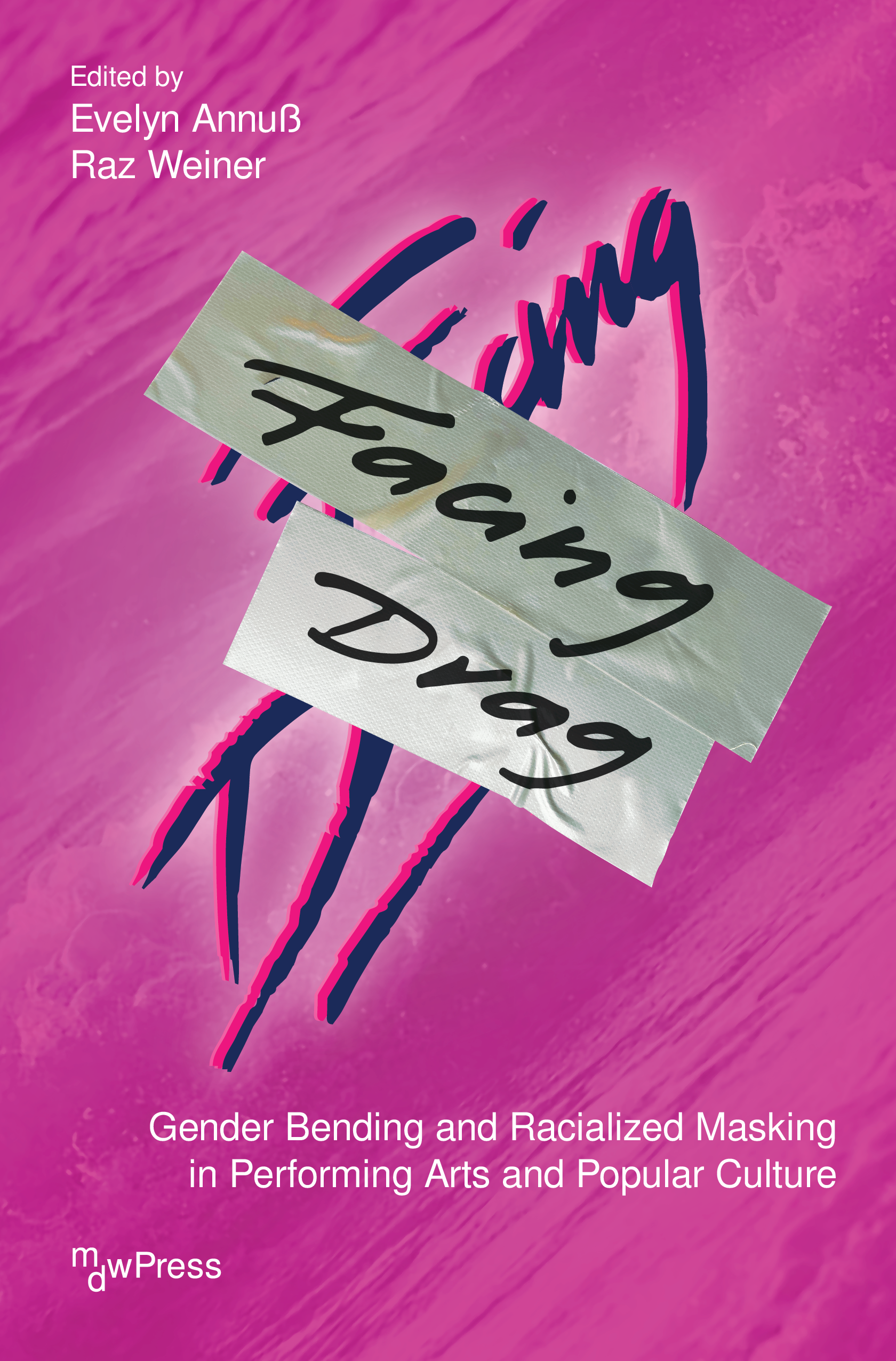
How do we connect the manifold carnivalesque articulations of colonialism and racism to a queer understanding of drag in the sense of exaggerated display (Lorber 2004)? In what ways are these articulations reinvoked and commodified within new media assemblages and differentiated within diverse geographical contexts and varied trajectories of racialization and Othering? How might they be conceived from a global perspective that also questions the reification of the putative color line through the lens of the Global South?1 And how might we foreground existing forms of performingsocietal alternatives? Facing Drag is dedicated to exploring these questions by critically engaging with the paradigm of performativity as a key concept in gender studies (Parker and Sedgwick 1995): drag was theorized in the 1990s as a transgressive performative practice that exposes difference in repetition—reflecting the possibility of (re)signification and the change of norms (Butler 1990, Muñoz 1999). Against the backdrop of the ongoing resurgenceof attempts to theorize critical drag in both recent and forthcoming publications, it seems timely to face—to address, confront—transgressive practices through the questions posed above (Heller 2020, Khubchandani 2023, McGlotten 2021, Schroedl 2025).
However, performativity itself has been resignified over the last decades. Once understood as a figure of critical thinking, it has also been absorbed into management rhetoric, where it affirmatively promotes successful self-presentations (Cabantous et al. 2016). The deconstructive turn from expressivity to performativity has been co-opted as a tool for neoliberalization and the political spectacles accompanying it. Today, the term is increasingly associated with the dragging—that is, with the gravitational, depressing, advent of new modes of governmentality that seem to bury not only the phantasm of an authentic inner self, but the dream of alternatives to capitalist relations—of alternative Beziehungsweisen, to cite Bini Adamczak (Adamczak 2017). Over the last decades, something already appears to have been lost in the translation of performativity into the celebration of individualized competitiveness under liberal economic regimes. This resignification, which undermines performativity’s critical potential, may have gradually indicated the limitations of 1990s happy queer theory readings of performativity as gender-bending drag.
We are living in dragging timesindeed—a historical shift in which the deconstructive force of earlier queer theoretical interventions has been overtaken by a new form of neoliberal dismantling: what was predominantly associated with the undoing of a (hetero)normative matrix has been superseded by the libertarian far right’s systematic destruction of institutions—infrastructures and material conditions whose relevance was often sidelined in the wake of the performative turn of the 1990s (Annuß 1998, originally published in 1996). Contemporary assaults on queer, reproductive, and trans rights—manifestations of so-called antigenderism (Butler 2024, Sauer and Penz 2023)—are only one dimension of a broader neoauthoritarian turn and the potential fascization of economic liberalism on a global scale. While dismantling may resonate as an anarchic rallying cry,2 undoing now risks becoming a new normal of unregulated racket ruling—a mode of organized destabilization performed as the destruction of “the establishment” (Bröckling 2024; Žižek 2024). Foucault identified queer liberties as the flipside of a new control society (Foucault 2008, 239—266), but that may already be water under the collapsing bridge. In the mid-1980s, he could still stress the ambivalences of neoliberalism—economic deregulation alongside the recognition of minority liberties. Decades later, in the wake of economic liberalization, populist politics of resentment have hit full scale to accompany what Naomi Klein termed disaster capitalism and what Alberto Toscano more recently calls late fascism (Klein 2007, Toscano 2023). As DEI initiatives and poverty relief programs are systematically defunded, antigenderism needs to be contextualized not as an isolated backlash, but as integral to this broader shift. Today, hegemonic appropriations of minority rights discourses in service of majoritarian rule (Farris 2017, Puar 2007) not only reenforce exclusionary politics, but also fuel a form of belligerent accumulation3—one whose targets are volatile, shifting with geopolitical, class, or cultural location. In this very context, drag needs to be rethought as a situated practice (Annuß 2025).
This is especially pertinent given that the global right-wing backlash is increasingly accompanied by carnivalesque performances that celebrate the destruction of infrastructure and the destitution of law (Annuß 2019, 2024). Performative transgressions from the right—such as the costumed storming of government buildings during the COVID-19 pandemic in Berlin or in Washington, DC, or the chainsaw theatrics of figures like Javier Milei and Elon Musk—compel us to reconsider the biopolitical environments in which transgressive bodily appearances gain significance. Where some of us within gender studies used to conceptualize the carnivalesque primarily through the lens of queer subversion, as in gender-bending drag, it may now be necessary to critically reassess our research designs and the habitual use of certain figures of thought. This includes historicizing our analytical categories and recognizing their (geographical, often privilege-based) embeddedness.
Our understanding of drag as a paradigm in theorizing queer performativity may thus need expansion. We ought to account for destructive forms of mimesis, for stagings of excess referentiality that weaponize performative spectacle rather than parody hegemonic culture. And in this broader sense, drag has long been part of the spectacles of the right. If understood as a situated practice of transgressive public appearance, it might be reactivated as a tool for critical thinking on the specificity of particular political environments. Rather than confining drag to the domains of queer performance and disidentification, this book reconceptualizes it as an allegory of the ambivalent messiness of mimesis—with all its potential for both subversion and instrumentalization. Facing Drag thus interrogates the divergent affordances of situatedness in order to understand how mimetic practices can function across, and sometimes against, societal conditions and political imaginaries.
In light of today’s appropriation of performative transgressions by the political right, studies of drag may be shifting—from a predominant focus on gender play to an expanded analysis that incorporates its historical and structural entanglement with performative practices of racialization: as early as the 2000s, Katrin Sieg proposed such a move, shifting the analysis of queer drag toward racialized forms of theatrical appearance (Sieg 2002). This implied a critical turn from the liberatory connotations of “dirty” bodily stagings to the invective exposure of “dirty”faces—exemplified by blackfaceas a form of racialized drag in the wake of colonial entanglements and overexploitation. Such performative practices—marked by grotesque distortion and figurations of difference—have long weaponized the constitutive referential messiness of mimesis, predating queer theory’s institutionalization (Balke and Linseisen 2022). Mimesis, then, is not inherently subversive, but can also be complicit with hegemonic culture and, at times, operate in the wake of eliminatory violence.4 By extending our conception of drag beyond its semiotic and affective potential for queer subversion to its transgressive appeal within a politics of resentment and destruction, we can more thoroughly historicize its ambivalent forms and functions and reflect the right’s current occupation of mimetic transgression in the context of its historic precedents, particularly in the racialized articulations of the carnivalesque (Mbembe 2001).5 This, however, calls for reassessing its scope of reference—specifying its usages within the slippery terrain where libertarianism intersects with alt-right forms of transgression: What does it imply when it is not the subaltern, but the dystopian anarchism of the self-proclaimed fittest that sets about dismantling what once was called the master’s house (Lorde 2018, originally published 1970)? How does today’s “rebellious, anti-systemic theater” (Schuster 2020, 234) of the ruling class reshape calls to recognize representations of queerness as a means of disrupting normative interpellations? In light of these questions, how might we rethink drag?
Extending the concept to encompass color bending—that is, practices of racialized masking—broadens the analytic horizon to include the dynamics of political violence more thoroughly. In this expanded frame, drag’s alleged etymology of “towing a stage costume” comes into play. We might thus “face”—in both senses of confronting and giving face—the act of dragging as the schlepping-along of social entanglements.6 Rather than relegating performativity to a coaching ideology or reducing drag to representationalism and politics of recognition, this volume foregrounds the analytic relevance of queer theories’ postdeconstructive, materialist conceptual contributions. Elizabeth Freeman’s take on drag, for instance, underscores a “necessary referential vulgarity”—a desire to relate to Other(ed), queer bodies across time and space (Freeman 2010). Her approach moves beyond abstract notions of resignification to highlight drag’s affective charge. Crucially, Freeman’s theorizing of drag as a historical pullback also helps to understand the affective operations of right-wing politics—particularly the mobilizations of resentment (Vogl 2022). In this light, drag emerges as a Gedankenfigur, a figure of thought, not only of queer memory and longing, but also as a vehicle for the actual dismantling of material relations and societal infrastructures—hard-won policies and institutions aimed at redressing structural inequalities. To summarize, drag may have lost some of its appeal as a subversive, empowering, and liberatory mode of staging our messy selves, particularly in the wake of neoliberalism’s increasingly destructive materializations. Yet appearing in drag has been and remains to be contested. An extended notion of dragging, one attentive to its embeddedness in specific historical and sociopolitical contexts, may open up avenues for analyzing the collective trajectories of public appearance and for imagining multidirectional solidarities (Rothberg 2009) that counter the co-optation of the transgressive. This could contribute to a rethinking of what Meredith Heller has called queering drag (Heller 2020).
As theorists of creolization have emphasized (Glissant 1990, 1997; Erasmus 2011, 2012, 2020), reappropriations of colonial and exoticist modes of performing illustrate the uncontrollable entanglements of mimesis. These entanglements carry the potential for new agencies. Analyzing and bringing together diverse historical constellations and mimetic practices may expose the possibility of collective acts of microresistance. These performative practices may not offer direct solutions to today’s political catastrophes. But they may give form to a desire for otherwise—to what Saidiya Hartman has called performing (an) otherwise (Hartman 2020). In a time marked by political defeatism, such performative modes of relating may allegorize a disposition to move beyond competitive self-fashioning, provoking us to imagine transversal flight lines—forms of solidarity not bound to groupism, a terrain successfully occupied by the political right.
How, then, might this concept of drag intersect with questions of temporality and fabulation? What tools can critical race studies and perspectives based in the Global South offer toward an expanded understanding of drag as a mimetic practice embedded in systems of power? Moreover, what is the biopolitical backdrop of drag’s contemporary theorization—especially within today’s media assemblages and commodified visual politics? How can we map the historical, geographical symptomatology of what we involuntarily drag along when we appear in public? And what are the (post)colonial implications of performing within different contexts—contexts shaped by asymmetrical histories of representation, violence, and resistance?
*
Engaging with these concerns, Facing Drag is the outcome of international conferences and a concomitant lecture series taking place between 2022 and 2024 at the University of Music and Performing Arts Vienna (mdw)—conceived at a time when the postpandemic transformations of neoliberalism were not yet as visible as today.7 These events were organized by what has since become the International Research Center Gender and Performativity (ICGP).8 The contributions assembled here are primarily grounded in theorizations of performativity and performing arts studies. As a collection ranging from theoretical approaches developed in the Global South to the analyses of premodern European court spectacles, modern minstrelsy, and contemporary popular culture, as well as transcultural entanglements in modern theater, Facing Drag spotlights racial masking, colonial mimicry, and digital performance in connection to questions of gendering. In its deliberate heterogeneity and openness, it complements a monograph on minor mimesis and the reconceptualization of dragging as schlepping-along, titled Dirty Dragging (Annuß 2025, 2026), which explores the transoceanic trajectories of performative transpositions with regard to apartheid, Nazism, and the Jim Crow era. This volume likewise aims to rethink drag—bringing together scholars and artists from different fields of study and parts of the globe to address, historicize, and contextualize—that is, to face—practices of Othering and of mimesis in the performing arts and in popular culture. Elaborating on aesthetic materials, the assembled contributions to Facing Drag analyze differing performative modes of appearing in public. Diverse as they may be, these contributions indicate together a shift in perspectives—a postintersectional, transversal reflection of colonial relations and their afterlife, a new emphasis in questions of societal environments (Hörl 2018), the drive to rethink what drag might mean against the backdrop of today’s political affordances.
Overview
Facing Drag is framed by contributions from intellectuals who stress the relevance of the Global South for rethinking drag: sociologist Zimitri Erasmus and artist nora chipaumire in conversation with curator Jay Pather. Possible reformulations of dragging are addressed in four sections following Erasmus’s opening essay, Caribbean Critical Thought and “Drag” Performances of Indigenization, in which she reflects on the distant kinship of theorizing creolization and creolized masking practices in the Archipelago as well as in Southern Africa, seeking to extend established perspectives on coloniality and race.
The book then offers four sections. It starts with issues of temporality in film studies, followed by case studies of racialized drag in the United States and a section on visual popular culture, and concludes with historical prefigurations of what an extended understanding of drag might imply. It does not seek to give a complete overview on phenomena related to these themes and questions, but rather to offer exemplary readings that resonate, however distantly, with one another.
Temporal Drag and Queering Fabulations (Section 1) opens with two case studies in film. These contributions aim to reconceptualize our understanding of drag in relation to cinema as a paradigmatic medium of transtemporality (Freeman 2010) and to explore the relational dimension of fabulation (Nyong’o 2018). Sam Ehrentraut analyzes Jessie Dunn Rovinelli’s So Pretty and its instrumental quoting of Ronald M. Schernikau’s 1980s novel So schön, which depicts the West Berlin drag scene before the fall of the Wall. The film transposes Schernikau’s book into a contemporary transgender constellation in New York City during the Black Lives Matter protests. Revisiting Freeman’s concept of temporal drag, Ehrentraut’s essay Transtemporal Making-Out—On “Temporal Drag” in Jessie Dunn Rovinelli’s “So Pretty” (2019) studies the film’s aesthetics to envision entangled forms of relating. It explores nonappropriative encounters that stage a blurry portrait of collective queer becoming—beyond the representation of fixed queer identities and beyond a respective “faceism” (Weigel 2013, 11). Nanna Heidenreich’s “Whose Portrait?” Fabulations and Triangulations in Shirley Clarke’s “Portrait of Jason” (1967) likewise develops a relational understanding of dragging as a queering practice. Through an analysis of cinematic documentation, fluid appearances and their reception in the context of racialized projections and desires, Heidenreich examines the triangular dynamics within the production and the reception. Her reading explores the potentiality of the film portrait beyond its definition as a medium of self-representation and exemplifies the violence inherent in social and love relations—violence that is dragged along in the cinematic capture of “the Other.” In terms of temporal drag and queering fabulations, both contributions move beyond representationalism and reductive notions of binary relations. Ehrentraut emphasizes the queer utopian potential of rethinking drag in temporal terms; Heidenreich, in turn, foregrounds its biopolitical embeddedness within a specific context haunted by racialized violence.
Performing along “the” Color Line(Section 2) further drags the notion of drag from its associations with empowerment into contexts of racist violence in the United States. By historicizing blackening-up in popular culture, this section reflects on the invective flipside of transgressive performativity in drag. Again working with the trope of temporal drag, Eric Lott’s Blackface from Time to Time addresses the deployment of the minstrel mask coined in the nineteenth century and their survie in contemporary popular culture. He reads the ongoing reappearances of this form of racial drag as indicators of the “time-to-time-temporality” of unresolved racist relations haunting popular culture—in film, music, masquerade practices, and political performances. Blackface, Lott argues, has a specific “throwback quality” that goes beyond “cross-racial” appropriative desires and instead exposes how its afterlife can be mobilized within the political present to “theatricalize” and thus reinforce the US color line through a recursiveness out of joint. While Lott focuses on the contemporary afterlife of blackface, Elaine S. Frantz’s Reading the Blackened Faces of the Ku-Klux Klan in the Reconstruction-Era United States studies its use as racial mimicry by vigilante white supremacists’ performing carnivalesque terror in the wake of abolition. Drawing on a multiplicity of historical sources, Frantz contextualizes these terrorist masquerades of the first Klan of the late 1860s within the broader popular culture of the time—especially in racist caricatures of minstrel shows. As she demonstrates, however, blackening the face was not only a mode of cross-racial misrepresentation, but also a sensationalist tool entangled with other traditions of violence. It was associated with nocturnal crime and the return of the undead. In this reading, blackface becomes an empty signifier with multidirectional referentiality, yet within a context of racialized violence that demanded its spectacular promotion. Its referential excesses may thus be understood as prefigurations of today’s right-wing carnival. The section concludes with an outlook on performing arts neglected by hegemonic receptions: on Black drag shows in the mid-twentieth-century “Big Easy.” Aurélie Godet’s Gender Bending in the Southern Babylon: Black “Female Impersonators” in 1940s—1960s New Orleans focuses on queer performances within the Black community of a Southern city long associated with vice. Drawing on photos, text sources and oral history, Godet revisits the paradigm of performativity theory by foregrounding a community whose drag history has rarely been documented. She sketches out how performing in drag challenged not only binary gender norms, but also a specifically sexualized color line. Focusing on pre-Civil Rights New Orleans, the essay dispels the myth of the Black community as uniformly antiqueer and instead highlights how stars of Black drag—from Patsy Vidalia to Little Richard and Roberta—along with the “cross-fertilizing” longue durée of their shows, can be read as embodied prefigurations of a societal otherwise: one that transcends intersecting binaries of race, gender and sexuality.
Facing Contemporary Commodification(Section 3) addresses contrary afterlives of blackface: (1) with regard to affect politics in meme culture, and (2) through representations of “the Other” beyond the US color line. Contemporary media assemblages, shaped by affective politics of resentment, have generated new forms of facial drag that circulate globally—targeted at distinct societal bubbles, increasingly detached from live appearances. Social media platforms facilitate parallel public spheres in which transgressive visualizations of “the Other” can circulate and go viral. However, as noted above, drag may also be mobilized in service of racist representational regimes. There is a plethora of ways to “give a face,” to deface or reface. This is where performance and media analysis can help illuminate the workings of spectacular symbolic politics—including the ones we are currently confronted with. Analyzing a popular Oprah Winfrey meme, Katrin Köppert’s Digital Blackface and Memetic Ambiguity reads today’s meme culture as a continuation of the minstrel tradition’s grotesque defacing of Black people—now instrumentalized as digital signifiers of affect. Focusing on its feminized stagings on social media, Köppert shifts the lens from minstrelsy’s masculinism to a contemporary regendering of “the mask.” She interprets meme culture as a performative appropriation of a specifically situated notion of Blackness in the sense of asignification, that is, as the racialized visualization of affect. Raz Weiner’s On Arab Masquerades and Necropolitics: Invisibilization and Hypervisibilization in Israeli Popular Culture transposes the question of facing and othering to the Middle Eastern conflict zone. His essay compares strategies of invisibilization and hypervisibilization—and their political function—through representations of Arabness in Israeli popular culture. Through contextualizing and recontouring the broader political fantasies upon which these impersonations rely, the necropolitical dimension of ethnic mimicry or drag is exposed—after all evoking today’s sociocidal war crimes.
Staging (Post)Colonial Relations(Section 4) furtherglobalizes and historicizes perspectives. This section discusses manifold appropriations of theatrical performances within early colonialism and modern exoticism and outlines complex transcultural entanglements. Karin Harrasser’s Borrowed Plumes, Jesuit Drag, and Costumes as Uncontrollable Residuals analyzes European performances of indigeneity in the sixteenth century—long before the nineteenth-century US fashion of playing Indian (Deloria 2022). Ranging from courtly cross-dressing allegorizations of America by Friedrich I, to Jesuit performative conquista in Latin America as a governmental tool accompanying colonial extractivism, and to the “indigenizing” of Christian rituals in the context of anticolonial resistance and satire, these historical enactments indicate layers of ambivalent cultural techniques. Their afterlife, Harrasser suggests, may bear witness to an uncontrollable dragging-along of violence—as well as to the enduring dream of social change within the postcolonial imaginary. Julia Ostwald’s Japonist Drag: Performing Entangled Exoticisms in Dance and Theater around 1900 interrogates differing modes of (self-)exoticization within European-Japanese cultural encounters. Bringing together performances of Japonisme by the Kawakami ensemble in fin-de-siècle Europe and its queer reception by Alexander Sakharoff—as well as their later straightening Westernization of Japanese modern theater—Ostwald challenges the notion of drag as cultural appropriation. In a detailed analysis of complementary dance performances, her essay underscores how phantasms of exotic authenticity, their performative queering, and reversals of exoticism complicate retrospective projections of binary power relations. Harrasser’s and Ostwald’s essays thus transpose manifestations of exoticism into a broader quest for epistemologies beyond representation.
The Epiloguereturns to the questions raised by Zimitri Erasmus in the openingsection of Facing Drag. Jay Pather’s artist talk with choreographer, performer, and filmmaker nora chipaumire addresses practices of drag within contemporary performing arts against the backdrop of colonialism and globalization, while rhetorically staging the shapeshifting dimension of drag itself. This shapeshifting is also reflected in the constellation of our volume—dedicated to research from differing, yet corresponding, angles.
Facing Drag thus brings together prominent thinkers from various disciplines to reconsider drag beyond its conventional reading as a performance of gender transgression. Through original contributions that engage with cinema, choreography, online media, and critical historiography, the volume examines how drag has transformed through figures of analysis such as temporal and ethnic drag, and how it intersects with legacies of colonial domination, social entanglements, and political spectacle. Amid a worldwide resurgence of hostility against queer and gender-nonconforming articulations, the essays in this volume engage with political implications of various forms of drag. Drawing on contributions from diverse fields of cultural studies and geographic contexts, Facing Drag aims to broaden the conversation beyond dominant Northern paradigms, and to provide a cross-cutting, transversal intervention into contemporary debates on performativity and power.
References
Adamczak, Bini. 2017. Beziehungsweise Revolution: 1917, 1968 und kommende. Berlin: Suhrkamp.
Annuß, Evelyn. 1998. “The Butler-Boom: Queer Theory’s Impact on Women’s/Gender Studies.” In Queering the Canon: Defying Sights in German Literature and Culture, edited by Christoph Lorey and John L. Plews, 73—86. Columbia: Camden House. German original, 1996: “Umbruch und Krise der Geschlechterforschung: Judith Butler als Symptom.” Das Argument 216 (1996): 505—524.
Annuß, Evelyn. 2019. “Populismus und Theater.” In Was zu fürchten vorgegeben wird: Alterität und Xenophobie, edited by Susanne Teutsch, 226—236.Vienna: Praesens.
Annuß, Evelyn. 2024. “Populismus und Kritik.” In Populismus kritisieren: Kunst—Politik—Geschlecht, edited by Evelyn Annuß, Ralf von Appen, Sarah Chaker, Silke Felber, Andrea Glauser, Therese Kaufmann, Susanne Lettow, 23—39. Wien/Bielefeld: mdwPress.
Annuß, Evelyn. 2025. Dirty Dragging: Performative Transpositionen. Wien/Bielefeld: mdwPress.
Annuß, Evelyn. 2026. Dirty Dragging: Performative Transpositions. Wien/Bielefeld: mdwPress.
Balke, Friedrich and Elisa Linseisen, eds. 2022. Mimesis Expanded: Die Ausweitung der mimetischen Zone. Paderborn: Wilhelm Fink.
Bröckling, Ulrich, Susanne Krasmann, and Thomas Lemke, eds. 2024. Glossar der Gegenwart. Berlin: Suhrkamp.
Butler, Judith. 1990. Gender Trouble: Feminism and the Subversion of Identity. New York: Routledge.
Butler, Judith. 2024. Who’s Afraid of Gender? London: Penguin Books.
Cabantous, Laure, Jean-Pascal Gond, Nancy Harding, and Mark Learmonth. 2016. “Critical Essay: Reconsidering Critical Performativity.” Human Relations 69, no. 2: 197—213. doi.org/10.1177/0018726715584690.
Deloria, Philip J. 2022. Playing Indian. New Haven: Yale University Press.
Erasmus, Zimitri. 2011. “Creolization, Colonial Citizenship(s) and Degeneracy: A Critique of Selected Histories of Sierra Leone and South Africa.” Current Sociology 59, no. 5: 635—654.
Erasmus, Zimitri. 2012. “Apartheid Race Categories: Daring to Question Their Continued Use.” Transformation 79: 1—11.
Erasmus, Zimitri. 2020. “‘Who Was Here First?’ or ‘Who Lives Here Now?’: Indigeneity, a Difference Like No Other.” In Persistence of Race, edited by Nina G. Jablonski, 155—165. Stellenbosch: African Sun Media.
Farris, Sara R. 2017. In the Name of Women’s Rights: The Rise of Femonationalism. Durham, NC: Duke University Press.
Foucault, Michel. 2008: The Birth of Biopolitics: Lectures at the Collège de France 1978—79, edited by Michel Senellart, translated by Graham Burchell. Basingstoke: Palgrave Macmillan.
Freeman, Elizabeth. 2010. Time Binds: Queer Temporalities, Queer Histories. Durham, NC: Duke University Press.
Glissant, Édouard. 1990. Poétique de la relation. Paris: Galimard.
Glissant, Édouard. 1997. Poetics of Relation. Ann Arbor: University of Michigan Press.
Hartman, Saidiya. 2020. Wayward Lives, Beautiful Experiments: Intimate Histories of Riotous Black Girls, Troublesome Women, and Queer Radicals. New York: W. W. Norton.
Heller, Meredith. 2020. Queering Drag: Redefining the Discourse of Gender-Bending. Bloomington: Indiana University Press.
Hörl, Erich. 2018. “The Environmentalitarian Situation.” Translated by Nils F. Schott. Cultural Politics 14, no. 2: 153—173.
Khubchandani, Kareem. 2023. Decolonize Drag (Decolonize That!). New York: QR Books.
Klein, Naomi. 2007. The Shock Doctrine: The Rise of Disaster Capitalism. New York: Metropolitan Books, Henry Holt and Company.
Lorber, Judith. 2004. “Preface.” In The Drag Queen Anthology: The Absolutely Fabulous but Flawlessly Customary World of Female Impersonators, edited by Steven P. Schacht and Lisa Underwood, xv—xvi. New York: Harrington Park Press.
Lorde, Audre. 2018. The Master’s Tools Will Never Dismantle the Master’s House. London: Penguin Books.
Mbembe, Achille. 2001. On the Postcolony. Berkeley: University of California Press.
McGlotten, Shaka. 2021. Dragging: Or, in the Drag of a Queer Life. New York: Routledge.
Muñoz, José Esteban. 1999. Disidentifications: Queers of Color and the Performance of Politics. Minneapolis: University of Minnesota Press.
Nyong’o, Tavia. 2018. Afro-fabulations: The Queer Drama of Black Life. New York: New York University Press.
Parker, Andrew and Eve Kosofsky Sedgwick. 1995. Performativity and Performance. New York, London: Routledge.
Puar, Jasbir K. 2007. Terrorist Assemblages: Homonationalism in Queer Times. Durham, NC: Duke University Press.
Reed, Adolph. 2018. “Antiracism: A Neoliberal Alternative to a Left.” Dialectical Anthropology 42: 105—115.
Reed, Adolph. 2022. The South: Jim Crow and Its Afterlive. London: Verso.
Rothberg, Michael. 2009. Multidirectional Memory: Remembering the Holocaust in the Age of Decolonization.Stanford: Stanford University Press.
Sauer, Birgit and Otto Penz. 2023. Konjunktur der Männlichkeit: Affektive Strategien der autoritären Rechten. Frankfurt: Campus Verlag.
Schroedl, Jenny and Samu/elle Striewski, eds. 2025. Drag hier und heute! Theoretische und ästhetische Positionen zu einer queeren Praxis der Gegenwart. Berlin: Neofelis.
Schuster, Aaron. 2020. “Beyond Satire: The Political Comedy of the Present and the Paradoxes of Authority.” In Sovereignty, Inc.: Three Inquiries in Politics and Enjoyment, edited by William Mozzarella, Eric Santner, and Aaron Schuster, 161—250. Chicago: University of Chicago Press.
Sieg, Katrin. 2002. Ethnic Drag: Performing Race, Nation, Sexuality in West Germany. Ann Arbor: University of Michigan Press.
Thomas, Greg. 2018. “Afro-Blue Notes: The Death of Afro-pessimism (2.0)?” Theory & Event 21, no. 1: 282—317.
Toscano, Alberto. 2023. Late Fascism: Race, Capitalism, and the Politics of Crisis. London: Verso.
Vogl, Joseph. 2022: Capital and Ressentiment: A short Theory of the Present. Cambridge: Polity.
Weigel, Sigrid. 2013. “Das Gesicht als Artefakt: Zu einer Kulturgeschichte des menschlichen Bildnisses.” In Gesichter: Kulturgeschichtliche Szenen aus der Arbeit am Bildnis des Menschen, edited by Sigrid Weigel, in collaboration with Tine Kutschbach, 7—29. Munich: Wilhelm Fink.
Žižek, Slavoj. 2024. “After Trump’s Victory: From MAGA to MEGA.” e-flux. November 13, 2024. www.e-flux.com/notes/641013/after-trump-s-victory-from-maga-to-mega. Accessed December 10, 2024.
Endnotes
-
See Erasmus in this volume; on the critique of Afro-pessimist US exceptionalism and its ahistoricity see—from within US academia—Thomas 2018, Reed 2018.↩︎
-
See Jack Halberstam’s opening keynote “Dereliction: On Feminist Violence”at the 2025 opening of the International Research Center Gender and Performativity at the University of Music and Performing Arts Vienna, www.mdw.ac.at/icgp/events/international-research-center-gender-and-performativity-icgp-opening/, accessed July 25, 2025.
-
See Katja Diefenbach, Ruth Sonderegger and Pablo Valdivia Orozco at https://accumulation-race-aesthetics.org/, accessed September 25, 2024.↩︎
-
See Weiner in this volume.
-
On US blackface minstrelsy, see Lott in this volume.↩︎
-
See the companion monograph Dirty Dragging for a differentiation of heterogeneous modes of drag and a more extensive conceptualization of its relation to dragging as schlepping (Annuß 2025, 2026); see also McGlotten 2021, 7.↩︎
-
For more information on the conferences, see www.mdw.ac.at/ikm/facing-ethnic-drag/ and www.mdw.ac.at/ikm/?PageId=4744; for more information on the film and lecture series, see www.mdw.ac.at/ikm/facing-drag-film-and-lecture-series/, all accessed September 11, 2024.
-
For more information, see www.mdw.ac.at/icgp/, accessed July 25, 2025.↩︎