
The 2026 MMRC Lecture + Workshop.
Minority Music Cultures of South Asia: Agency – Representation – Activism
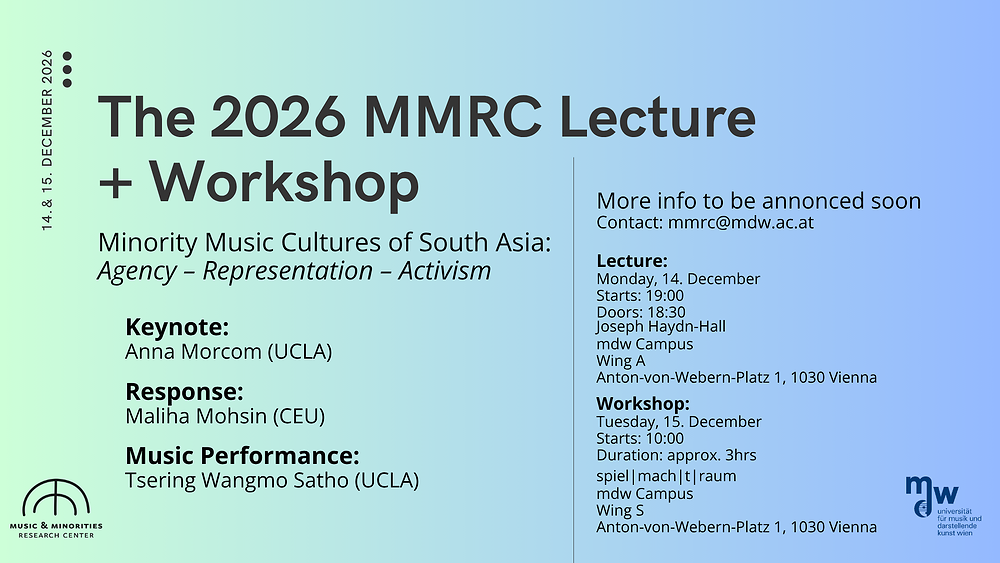
Taking current research hosted by the MMRC on music and conflict in Northeast India as a point of departure, the 2026 MMRC Lecture will engage with minority music cultures of South Asia. What processes of marginalisation have contributed to minority music cultures on the subcontinent? How do minority musicians whose roots trace back to South Asia express themselves through their art globally? How can research contribute to the adequate representation of their music cultures in scholarly discourses, in times when freedom of academic research is threatened by authoritarianism and the backsliding of civil rights?
Addressing these questions, the 2026 MMRC Lecture will explore agency, representation, and activism in South Asia and beyond by bringing together diverse scholarly and artistic perspectives and considering their relevance to ethnomusicological minority research today. In doing so, the lecture draws on the MMRC's core principles concerning the role of music in the relationship between dominant and marginalised groups, while acknowledging the fluidity of minority and gender concepts. For the first time, the MMRC will offer an additional workshop to reflect on topics and questions raised, providing a platform to share experiences and expertise.
In her keynote, Anna Morcom (UCLA) will discuss the responsibilities, potentials, and challenges of researching music, minorities, marginality, and marginalisation in the wider South Asian region. Focussing on India and Tibet, her lecture will examine the key question of how to undertake research with people and their music who are displaced or marginalized, such as Tibetans, or who have been erased from mainstream, hegemonic national traditions, as has been the case with low-caste hereditary or non-heteronormative ‘traditional’ performers in India (courtesan, and Kothi transgender performers.) Morcom will probe how engaged research can challenge the canonisation of such traditions in national educational contexts and facilitate more inclusive approaches, even when intense political repression is extra-territorial or pervasive, leading to fear or aversion to studying ‘sensitive’ topics.
In their response, Maliha Mohsin (CEU) will examine the role of music practices in emergent Hijra and transgender identities, rights, and mobilisation in Bangladesh. Juxtaposing the fading livelihood practices of Kothi erotic dancers and Hijra performers with the emergent category of “transgender” as subjects of modern neoliberal nation-states, their lecture emphasises the decolonial need to theorise gender as performative subject positions mediated by social, moral, and spiritual economies. In this context, they will demonstrate the emergence of agentive, self-authored performances by non-heteronormative, transgender, and queer artists in the era of TikTok reels, illustrating how online visibility democratises digital self-representation across class, caste, and rural/urban divides. Lastly, Mohsin will reflect on the methodological potential of such self-authorship for collaborative ethnographic research with marginalised populations, guarding against misrepresentation and cultural co-optation.
The event will be framed by Tsering Wangmo Satho (UCLA), who will present a taste of the richly diverse and distinctive performing arts of the Tibetan plateau, including styles such as Ache Lhamo (opera) from Lhasa, dranyen (Tibetan lute) dance-songs from Lhasa, Tö, and Dingri, and dance-songs of Kongpo in South Tibet. Born into a Tibetan refugee community in South India, she began learning traditional Tibetan performing arts from her parents. In 1983, she joined the Tibetan Institute of Performing Arts (TIPA) in Dharamsala (India). Later, she moved to the US, where she co-founded the traditional Tibetan performing arts troupe Chaksampa in the San Francisco Bay Area. In 2022, she was named a National Endowment for the Arts (NEA) National Heritage Fellow. In 2026, she was appointed as the instructor of UCLA’s new Tibetan Music and Dance Ensemble.
The workshop on the following day, which will be facilitated by Peter Lell, will provide an opportunity for participants to share and explore questions and perspectives sparked by the lecture. These will then form the basis of a broader discussion on topics such as the role of academia within power structures, questions of representation, collaborative research and the potential and limitations of digital self-representation.
Programme (14.12.2026):
Musical Performance
Tsering Wangmo Satho (UCLA)
Opening
Ulrike Sych (rector of mdw) and Ursula Hemetek (director of the MMRC)
Introduction
Christian Poske (Research fellow, MMRC) and Bisakha Goswami
Keynote: "Music, minorities, and marginalization: Researching with Tibetan and traditional Indian performers"
Anna Morcom (UCLA)
Response: "Performance, Embodiment and Agency: Self-Authorship amongst Gendered Minorities"
Maliha Mohsin (Central European University)
Moderation & Q&A Session
Chaired by Bisakha Goswami & Christian Poske
Musical Performance
Tsering Wangmo Satho (UCLA)
Programme (15.12.2026):
Workshop: Continuing the Conversation
Facilitated by: Peter Lell (MMRC, mdw)
Participants:
Anna Morcom
Maliha Moshin
Tsering Wangmo Satho
Info:
This workshop is open to the public!
Registration needed!
Time and date:
Lecture:
Monday, December 14, 2026
Doors 6.30 PM, starts 7.00 PM (CEST)
Workshop (duration 3hrs.):
Tuesday, December 15, 2026
starts 10.00 AM (CEST)
Registration:
via registration form (tba)
Location:
Lecture:
Joseph Haydn Hall
mdw-Campus (Building A)
Anton-von-Webern-Platz 1
1030 Vienna, Austria
Workshop:
spiel|mach|t|raum
Raum S 0225 (Building S)
Anton-von-Webern-Platz 1
1030 Vienna, Austria
The locations are wheelchair accessible. For questions and support please contact us: mmrc@mdw.ac.at