Threefold Benefits – for Studies, Teaching, and Research
How can the development of a voice be not only perceived but also measured and documented? This is the question behind the project StiMMonitor [Voice Monitor], which the Antonio Salieri Department of Vocal Studies and Vocal Research in Music Education is launching this semester for all students enrolled in the mdw’s music education and/or singing-oriented programmes. The focus here is on fine vocal coordination and vocal endurance as they apply to both speaking and singing function, viewed over the long term.
In lessons, we often experience progress in a direct way: a phrase gets easier, a shift between registers goes more smoothly, or performance requires less effort. StiMMonitor aims to document such progress objectively and allow it to be tracked and understood on an individual basis. For students, the project provides an opportunity to have their personal vocal characteristics documented and obtain a clearer sense of their strengths and weaknesses. This can support more assured handling of their own voices onstage and in lessons as well as individual goal-setting. The point here is not to judge voices schematically or reduce musical quality to measurable values, but rather to supplement individual perceptions and trace individual developmental paths.
At the same time, this project is also aimed at the future of teaching. If data can be collected and evaluated over an extended period, it might become possible to discern overarching patterns: With what vocal foundations do students start, and what challenges preoccupy them most? Where might a need for development become apparent? And to which content might more attention be devoted? The project’s findings should help adapt teaching to current needs and, where appropriate, contribute to curricular development in the interest of optimally preparing students for professional life. The data will also be examined to determine which measured values adequately express relevant vocal qualities and are therefore of pedagogical significance.
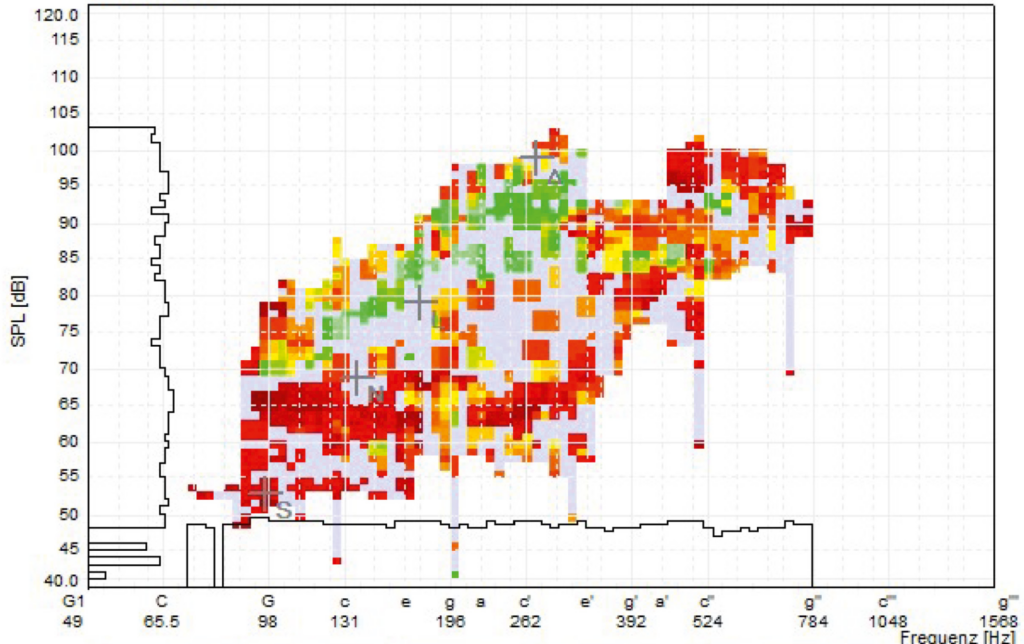
Comparable longitudinal studies have already been conducted at the Dresden University of Music as well as once before at the mdw, but with different emphases—such as the basic parameters of pitch range and dynamic range, timbre, vibrato development, and lifestyle habits. By contrast, the StiMMonitor data are intended to reveal individual changes across various parameters and, in particular, to relate these to training and specific requirement profiles. In the process, the informative value of this study will increase year by year as more and more people participate.
This project is explicitly designed to include students with little previous voice training as a control group as well as singers at all levels in their initial semesters of study. Taking the relevant measurements lasts a maximum of one hour and involves acoustic and electrographic methods that are non-invasive, safe, and well established in voice science. These measurements will be repeated annually and—wherever possible—continued into participants’ professional lives following conclusion of their studies. Moreover, optional recording of “milestones” can provide insights into important developmental steps and perceptual changes between measurement dates.
Protecting personal data is accorded high priority in this project. For this reason, measurement results will be anonymised prior to evaluation and processed such that they can no longer be attributed to individual participants. The participants, on the other hand, will receive their personal measurement profiles along with information on how to interpret them following each measurement. These results can be used by participants for private reflection, discussed with teachers, and taken as starting points for further work with their voices. In this way, students will gain a concrete point of reference, teaching will gain an additional perspective, and research will ultimately obtain a valuable longitudinal dataset on students’ vocal development during their studies.
Anyone who is curious and would like to discover their own vocal profile is welcome to register for the StiMMonitor project with the mdw’s voice research team (voiceresearch@mdw.ac.at) and arrange their own appointment.