 © privat
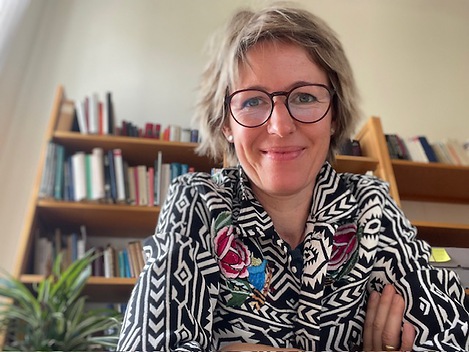
Katja Kaiser: archivist, flutist, teacher. After studying flute, music pedagogy and special needs education, she used rhythmic-music education to work with hearing impaired children, taught flute at the College of Music, Mahidon University in Bangkok, and took a position at the music publishing house Universal Edition in Vienna, where she managed the publishing archive.
Since 2022, she has been working as an archivist at the Exilarte Centre of the mdw – University of Music and Performing Arts Vienna, focusing on the music and fates of composers from the first half of the 20th century. She is responsible for the Exilarte music edition, the music archive and has curated an exhibition on composers of the Second Viennese School.
In March 2025, she began her PhD studies at the mdw and her dissertation on the composer Hans Winterberg.
The working title of my dissertation is:
“Hans (Hanuš) Winterberg (1901–1991): A Forgotten Composer of Multifaceted Identities.”
My dissertation project seeks to investigate the ways in which political and social developments shaped the life and musical output of Hans (Hanuš) Winterberg, a Jewish composer born in Prague in 1901 and rooted in German language and culture. Adopting an exploratory research design, the study relies primarily on archival sources such as documents, certificates, correspondence, and musical manuscripts.
The role of identity—and its influence on Winterberg’s oeuvre—is examined from multiple perspectives. Particular attention is devoted to the musical milieu that surrounded Winterberg during his formative years as a student, as well as to his artistic shaping, theoretical studies, and historical education. It also asks in what ways Winterberg was able to translate his musical skills into economic means of subsistence, situating his creative work within the realities of professional livelihood. Contextualizing his personal and professional trajectory within the shifting political landscapes of Central Europe between 1918 and the late twentieth century, the dissertation also traces the broader musical currents that emerged from these transformations.
Finally, the research explores what insights into his personal circumstances may be gained from a philological analysis of his manuscripts, and how his compositional developments correspond to his lived realities.
By bringing historical and biographical inquiry into dialogue, the dissertation establishes the critical foundation for a reassessment of Hans Winterberg as a composer of complex and layered identities.