 Privat
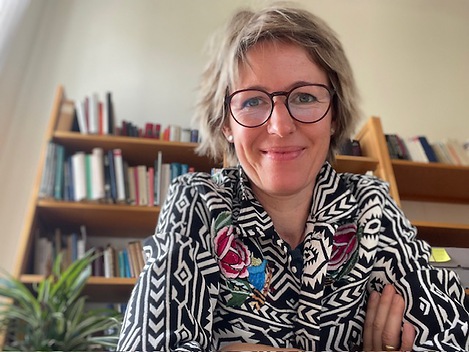
Katja Kaiser: archivist, flutist, teacher. After studying flute, music pedagogy and special needs education, she used rhythmic-music education to work with hearing impaired children, taught flute at the College of Music, Mahidon University in Bangkok, and took a position at the music publishing house Universal Edition in Vienna, where she managed the publishing archive.
Since 2022, she has been working as an archivist at the Exilarte Centre of the mdw – University of Music and Performing Arts Vienna, focusing on the music and fates of composers from the first half of the 20th century. She is responsible for the Exilarte music edition, the music archive and has curated an exhibition on composers of the Second Viennese School.
In March 2025, she began her PhD studies at the mdw and her dissertation on the composer Hans Winterberg.
The working title of my dissertation is:
“Transmission and Sources of the Works of the Composer Hans Winterberg (1901–1991).”
The aim of this dissertation is to investigate the transmission and source materials relating to the life and works of the composer Hans (Hanuš) Winterberg, who was born in Prague in 1901. As a Jewish musician who grew up in the German-speaking cultural environment of Prague and worked in various political and cultural contexts throughout the twentieth century, Winterberg left behind a body of work that is today documented primarily through a diverse body of sources, including archival documents, correspondence, radio materials, and musical manuscripts.
The study is based on a source-oriented methodology that combines historical source criticism, archival approaches to the analysis of transmission, and music-philological investigation. The focus lies on the examination of these sources with regard to their origin, provenance, and evidential value.
While archival documents are primarily examined in terms of their transmission history, the music-philological analysis of the manuscripts addresses questions of compositional genesis, notational practice, and the material characteristics of the sources. In this way, different groups of sources are brought into relation with one another in order to open new perspectives on Winterberg’s works and their transmission.
Furthermore, the dissertation considers the institutional framework of the transmission of these sources, in particular the role of the Bayerischer Rundfunk in the documentation and dissemination of Winterberg’s music. In doing so, the study contributes to the scholarly examination of the surviving sources and highlights their significance for future research on Hans Winterberg.