Performance Practice, Composition, and Notational Formats in Neapolitan Keyboard Music ca. 1600
Ian Pritchard
How to cite
How to cite
Outline
Outline

‘Partite artificiose sopra il Tenor de Zefiro con alcune Partite approportionate per l’Arpa, havertendo però, che se in questo presente libro stà intitolate alcune cose per l’Arpa, non per questo si soprasedisca il Cimbalo, perche il Cimbalo è Signor di tutti l’istromenti del mondo, & in lei si possono sonare ogni cosa con facilità.’
(‘Partite artificiose on the tenor of Zefiro, with some variations allocated for the harp. However, that some items in this book are designated for the harp does not mean to supersede performance on the harpsichord, as the harpsichord is the Lord of all instruments of the world, and on it one can play anything with ease.’)1
With this statement, Giovanni Maria Trabaci clearly indicates that all of the music published in his printed volume, Il secondo libro de ricercate, & altri varij capricci (Naples, 1615) should be playable – and con facilità at that – on a harpsichord. However, as many a modern performer knows, this isn’t necessarily the case. The point was dramatically illustrated in a recent YouTube performance by the Italian harpsichordist Marco Mencoboni of the Toccata prima à quattro, in which the performer uses his nose to cover a middle part that is simply not executable with two hands.2 (See Ex. 1 for some particularly treacherous excerpts.)
Ex. 1a–d: Passages in early Neapolitan keyboard music that are difficult to play with two hands. The music, originally printed in open score, has been transcribed into modern keyboard notation, with stem directions reflective of the parts in the open score (e.g. the tenor is notated on the bottom staff with upward stems).
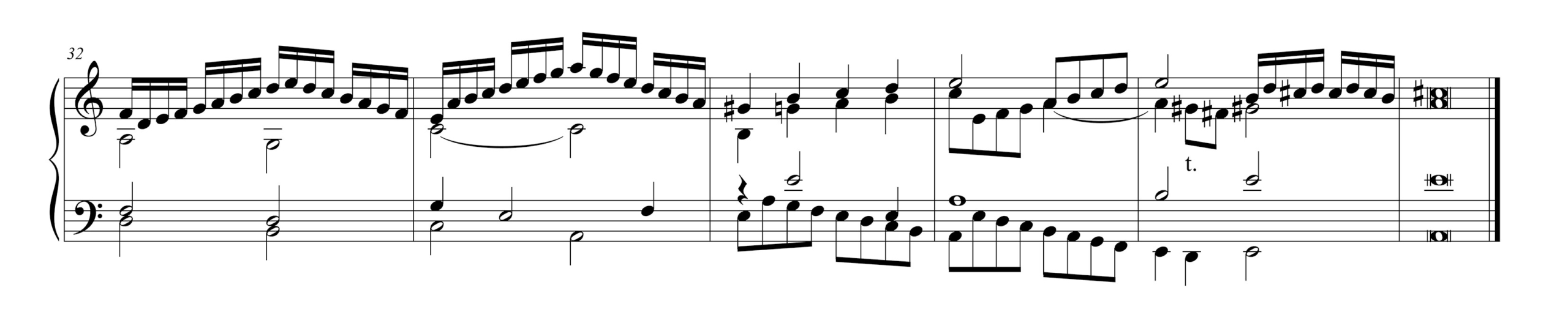
a) The passage for which Mencoboni used his nose in performance: Giovanni Maria Trabaci, ‘Toccata Prima à Quattro’, mm. 32–37, transcribed from Trabaci, Il secondo libro de ricercate, & altri varij capricci (Naples, 1615), facs. repr. (Florence, 1984), 82–4.
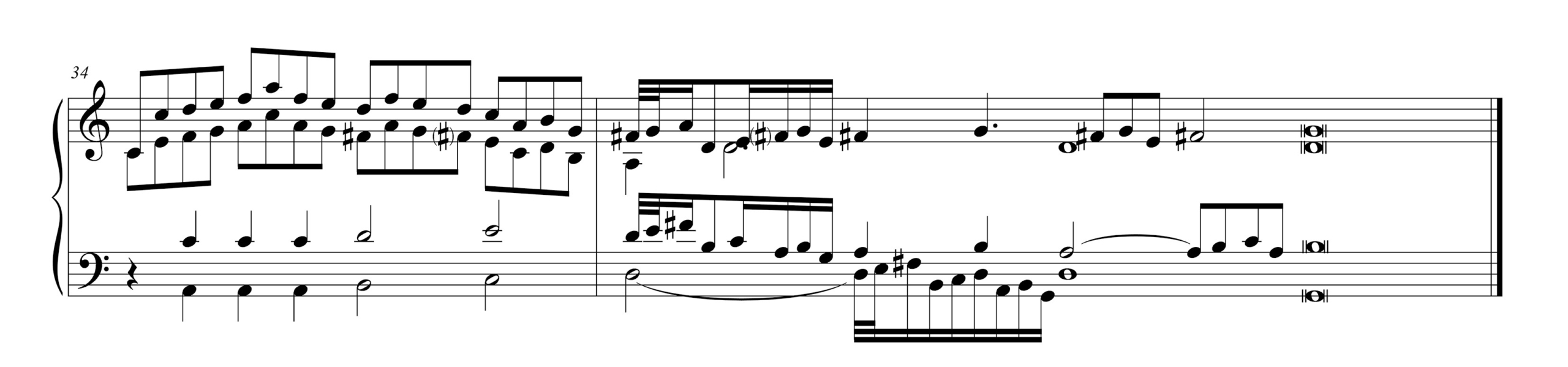
b) Ascanio Mayone, ‘Canzon Francese terza’, mm. 34–35, transcribed from Mayone, Primo libro di diversi capricci per sonare (Naples: Constantino Vitale, 1603), 22–6, https://imslp.org/wiki/Special:ReverseLookup/501050 (accessed on 31 Oct. 2024).

c) Giovanni de Macque, ‘Partite sopra Ruggiero di Gio. Macque’, mm. 68–74, transcribed from GB-Lbl Add. 30491, fol. 4v-6v.
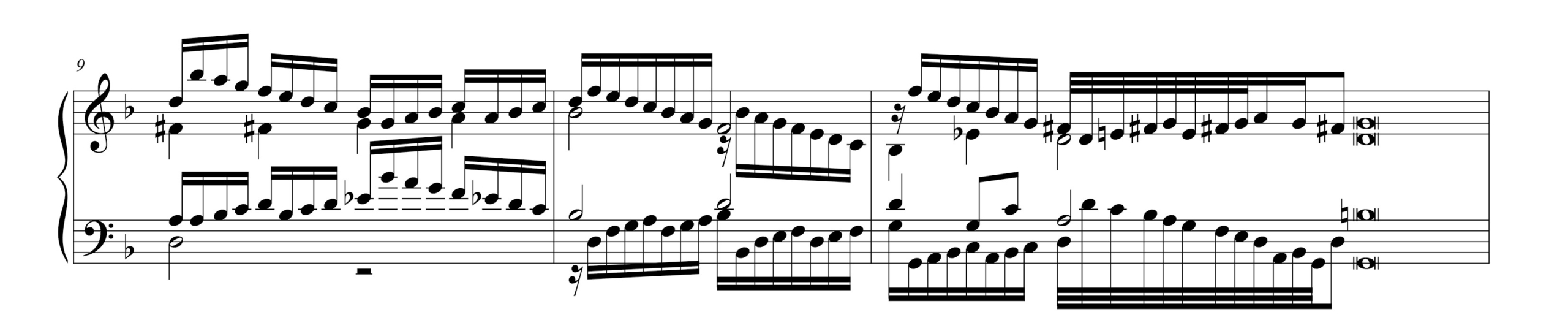
d) Ascanio Mayone et al., ‘lo mi son giovinetta del Ferabosco diminuito per sonare da Scipione Stella, Gio. Dom. Montella, Ascanio Mayone’, mm. 9–11, transcribed from Mayone, Secondo libro di diversi capricci per sonare (Naples: Giovanni Battista Gargano & Lucretio Nucci, 1609), 68–78, https://imslp.org/wiki/Special:ReverseLookup/462582 (accessed on 31 Oct. 2024).
Awkward sustained notes, which if actually held in performance make passage-work in other voices impossible to execute, are usually the primary culprits, but other elements include an overall density of texture (largely created by active inner voices that fully participate in the contrapuntal fabric), large intervals between parts that are at best awkward – or at worst impossible – to execute (unless, of course, the performer uses their nose), and dense polyphony generated through highly-elaborate passaggi and the close imitation of diminution figures. In general, the music often seems to depart from the stylistic ‘norms’ of 16th-century Italian keyboard music, norms that I will identify in this article as ‘idiomatic’, as opposed to the unidiomatic style of the Neapolitans (as demonstrated in Ex. 1). These are closely linked to the experiential act of playing, what Leon Chisholm has described as ‘the haptic sensation of the fingers on the keyboard’, and, of course, the broader unwritten traditions of 16th-century keyboardists in Italy.3 Much of this music betrays a polar attraction to the upper and lower ends of the texture – the treble and bass – and therefore foreshadows the soon-nascent Baroque style. In contrast, in the music of the Neapolitan school the middle parts (the parti di mezzo) often assume equal importance to the outer ones.
While the musical features that I just highlighted can be seen to be purely stylistic concerns, I wonder if the printing format the Neapolitans used might have also encouraged some of the difficulties in their music. Instead of using intavolatura – the most common format used for keyboard music by publishers and scribes on the Italian peninsula in the 16th and 17th centuries – Trabaci and colleagues largely published (and copied) their music in full open score.4 As I have argued elsewhere, the notational conventions of Italian intavolatura directly influence aspects of the music on the page; describing intabulation more broadly, Victor Coelho portrays the intabulation process as a kind of translation, analogous to literary translation.5 I will here argue that the open score formatmight have a similar translative effect, or rather an opposite one, leading composers to adopt less idiomatic textures as well as compositional styles that foreground contrapuntal complexity.6
A relationship between contrapuntal complexity and printed open scores around 1600 was the focus of a recent article by Anthony Newcomb.7 Newcomb highlights several volumes published in the decades around 1600 – including Trabaci’s 1615 Capricci – as foreshadowing a much later concept of the musical ‘work’, one in which ‘the notation on the page is complete and prescriptive, representing the essence of a piece’.8 These scores are therefore demonstrative of a shift, both in function and in reception, from practice to object.9 In Newcomb’s formulation, the open-score format and the level of musical complexity aid and abet each other; the open-score format ‘stimulated the increasing complexity of contrapuntal artifice that can be read from the page […]. This complexity in turn affects the prescriptive authority of the musical elements presented in readable form by the notation on each page.’10 Newcomb intertwines his argument using three threads, the first that these prints were intended for a particular mode of reception, a kind of ‘silent reading’ practiced by the part of the ‘cultural and social elite of the late 16th and early 17th centuries’, the second that the music was representative of the very height of an esoteric and highly artificioso compositional style,and the third that the prints were a remarkably early manifestation of the ‘autonomous’ musical ‘work’.11 This would fly in the face of normally-understood conceptions regarding the ontological status of early modern scores.12 Crucially, any alteration of the music would ‘destroy’ the ‘very identity of the piece’:
I propose as a corollary of this complexity that the pitches and rhythms of the individual voices specified in the notation of such pieces were for the time unusually fixed and prescriptive. One could not and did not vary these elements in performance by such procedures as conflation or subtractions of voices, extraction of individual voices and/or revisions of the contrapuntal complex without destroying this structure, the very identity of this piece. One would not do this to this kind of piece, any more than one would fiddle with the mechanism of a complicated time-piece in a sophisticated patron’s Kunstkammer. On the other hand, the looser and less artificioso the counterpoint, and the more flexible the attitude toward the inner parts, the more amenable other sorts of pieces would be to various performing versions.13
The printed volumes that form the nucleus of Newcomb’s argument are in two genres, the madrigal and the instrumental ricercar. Ricercars were, of course, in the domain of the keyboardist, and with this we return to Trabaci’s music and its performance challenges.14 Performing Trabaci’s music would be all the more difficult if one ‘could not and did not vary these elements [i.e. the notation] in performance by such procedures as conflation or subtractions of voices, extraction of individual voices and/or revisions of the contrapuntal complex’. And logically, Newcomb’s formulation should not only apply to Trabaci’s volume and the other instrumental music in open score that he describes, but to the music of the entire post-Macque Neapolitan school – the majority of which was notated in open score – including that of Trabaci’s colleague Ascanio Mayone, that of their probable maestro Giovanni de Macque, and that of the other Neapolitan composers found in sources such as Gb-Lbl Add. 30491, all of which is notably difficult to play exactly as written.
The unidiomatic textures and performance difficulties would therefore seem to go hand in hand with Newcomb’s ‘notions of notation’: that this music was on some level not intended for performance, but to be contemplated or silently read. However, it is also of course well accepted that open scores were a common notational format used by keyboard players in the 16th and 17th centuries.15 That this is the case would imply a kind of dual functionality held by these scores: they serve as practical scores for keyboardists to play from, but they also facilitate ‘silent reading’, to ‘recognize and appreciate unusual examples of musical artifice in the notation on the page.’16 This is made explicit by the title page of Gardano’s well-known print of Rore’s four-part madrigals ‘spartiti et accommodati’ to play on perfect instruments such as keyboards (‘sonar d’ogni sorte d’Istrumento perfetto’), which is also indicated for the study of the counterpoint (’per Qualunque studioso di Contrapunti.’).17 This volume, which presents a collection of Rore’s madrigals without text and in open score, is indicated as an early example of the ‘objectified score’ by Newcomb.18 In addition to being evidence of this sort of ‘objectification’, however, Trabaci’s 1615 Capricci also carries clear practical performance indications.19 Many of the genres in this volume – and, for that matter, in Trabaci’s other volume of keyboard music, the Ricercate canzone francese capricci […] libro primo (1603)20 and the two volumes by his colleague Ascanio Mayone – contain music in genres with clear functional roles, most notably the ‘cento’ liturgical versets. Trabaci’s 1615 print, cited by Newcomb for its distance from performance with its famous Tavola dei passi et delle cose piu notabile (and accompanying signs in the musical text, to highlight the specific instances of complexity and cleverness), is also filled with performance indications such as allarga la battuta,preciseindication for dynamics (in the harp pieces), and lengthy instructions on how to execute particular ornamental figures.
Intabulation as Performance
It would therefore seem clear that volumes like Trabaci’s (or Gardano’s Rore madrigal print) indicated dual functions. On the one hand, they fit Newcomb’s ideal of the ‘objectified score’ around 1600; on the other hand, they also have a more practical, performance orientation. For Italian keyboard music in the 16th century, much data regarding the latter consideration can be found in the extant keyboard intabulations in organ or harpsichord intavolatura, which reflect performances practices recorded by the intabulation process itself. A handful of intabulations of works that were originally published in open score, and which meet Newcomb’s criteria of the ‘presentation of complex polyphony as a visually readable object on the page using the format of the open score’,21 are extant; these include an intabulation of one of Trabaci’s versets from the Secondo libro (Tab. 1). To partially expand upon this small list, in Tab. 2 I list intabulations of music found in printed or manuscript open scores, that date after their original publication in part-book format (for these, a direct relationship between open score and intabulation cannot be assumed).
|
Source of Intabulation |
Composer |
Work Intabulated |
Original Printed Source (in Open Score) |
Publishing Information for Original Source |
Comments |
|---|---|---|---|---|---|
|
I-Nc Ms. Mus. st. 48, fol. 33v |
Trabaci |
Verso nono, Sesto tono |
Il secondo libro de ricercate, & altri varij capricci |
Naples: Giovanni Giacomo Carlino, 1615 |
|
|
V-CVbav Chig.Q.IV.29, fol. 50v |
Frescobaldi |
Ricercar terzo |
Recercari, et canzoni franzese […] libro primo |
Rome: Bartolomeo Zannetti, 1615 |
Four-bar fragment |
|
I-RAc MS Classense 545, fol. 27r–30v |
Frescobaldi |
Capriccio sopra un soggetto |
Il primo libro di capricci […] in partitura |
Rome: Luca Antonio Soldi, 1624 |
|
|
I-RAc MS Classense 545, fol. 22v–26v |
Frescobaldi |
Capriccio sopra Il Cucho |
Il primo libro di capricci […] in partitura |
Rome: Luca Antonio Soldi, 1624 |
Table 1: Intabulations of pieces originally printed in open scores that meet the criteria of Newcomb’s framing of the ‘presentation of complex polyphony as a visually readable object on the page using the format of the open score’.
| Source of Intabulation | I-Fmba Ms. 967 (‘Bardini Codex’)22, fol. 81v–88r, 105r–109v |
| Composer | Cipriano de Rore |
| Works Intabulated | ‘A la dolc’ombra’, ‘Non vide’l mondo’, ‘Un lauro mi difese’, ‘Però più ferm’ogn’hor’, ‘Selve sassi’, ‘Carita de Signore’, ‘La giustizia immortale’, ‘Amor ben mi credevo’ |
| Original Printed Source | Rore, Il primo libro de madrigali a quatro voci (Ferrara: Giovanni De Buglhat & Antonio Hucher, 1550) |
| Later Full Score Version | Rore, Tutti i madrigali a quattro voci (Venice, 1577) |
| Comment | Gardano’s famous print issue of Rore’s madrigals in open score might not fulfill Newcomb’s notion of ‘complex polyphony’, but he cites it as an example of full-score being used for the study of counterpoint.23 |
| Sources of Intabulation | I-CARcc fasc. 4a, 14; I-Fl Ms. Acquisti e Doni 641, 6v–7v; D-Mbs Mus. Ms. 9437, 18v; I-TRmp [n.s.], 69v–72r; Andrea Gabrieli, Il terzo libro de ricercari (Venice: Angelo Gardano, 1596), fol. 32r-34r |
| Composer | Cipriano de Rore |
| Work Intabulated | ‘Anchor che co’l partire’ |
| Original Printed Source | Rore, Il primo libro de madrigali a quatro voci (Ferrara, 1550) |
| Later Full Score Version | Rore, Tutti i madrigali a quattro voci (Venice, 1577) |
| Source of Intabulation | I-CARcc fasc. 10 |
| Composer | Florentio Maschera |
| Works Intabulated | 17 canzonas |
| Original Printed Source | Maschera, Libro primo de canzoni da sonare, a quattro voci (Brescia: Vincenzo Sabbio, 1584) |
| Later Full Score Versions | B-Bc ms 26660; I-Bc ms 2208; US-Wc M1490.M39, <https://lccn.loc.gov/2011560474> |
| Comment | Maschera’s collection – which was extremely popular – exists in no fewer than three manuscript copies in open score.24 |
| Source of Intabulation | Sperindio Bertoldo, Toccate, ricercari et canzoni francese intavolate per sonar d’organo (Venice: Giacomo Vincenti, 1591), 15–9, 20–3, <https://imslp.org/wiki/Special:ReverseLookup/263347> (accessed on 30 Sept. 2024) |
| Composer | Annibale Padovano |
| Works Intabulated | ‘Ricercar del Primo Tono’, ‘Ricercar del Terzo Tono’ |
| Original Printed Source | Padovano, Il primo libro de ricercari a quattro voci (Venice: Antonio Gardano, 1556), <https://imslp.org/wiki/Special:ReverseLookup/676174> (accessed on 30 Sept. 2024) |
| Later Full Score Version | B-Bc ms 26661 |
| Comment | Bertoldo’s two intabulations of ricercars from Padavano’s 1556 publication are truncated. |
Table 2: Intabulations of pieces not originally published in open score – and, for which, therefore, a direct relationship between original source and intabulation cannot be inferred – but that also appear in later sources in open score.
Intabulation in any particular format entailed following a set of guiding notational conventions as well as specific transcriptive processes; together, these reflect the actions and traditions of keyboard performance.25 The notational conventions were rooted in performance practices, and the overall effect was one of musical-stylistic translation, from ‘polyphonisch’ to keyboardian. Crucially, not only does Italian keyboard intavolatura hide polyphonic detail in its process of ‘translation’, but the intabulation process itself often entailed the possibility of altering the musical text, both in order to make the music playable on the keyboard and to sit more idiomatically on the instrument. In Italian keyboard intavolatura, these alterations – more commonly but certainly not exclusively made to the inner voices, the parti di mezzo – not only ‘fix’ issues such as overly wide intervals between voices, but also create textures closer to the cinquecento stylistic norms described earlier. This process is clearly described in Diruta’s well-known section on intabulation in Il Transilvano, but it is also observable in extant intabulations; in fact, many of the intabulations show that Diruta was quite conservative in his advice, at least as stated in his text.26 In addition to changing notes, it was equally possible – perhaps more common – to simply remove them when necessary.27
This is perhaps most observable in what I will identify as elaborate intabulations, intabulations that are highly ornamented and that seem to be intended for solo performance. Elaborate intabulations entailed the addition of highly extensive passaggi, and substantial alterations were often employed to accommodate them (see Ex. 2). The alterations could go beyond small momentary changes (such as removing wide intervals between individual voices) to outright recomposition; for example, to accompany a passaggio, the other voices were often completely reworked to create chords. Therefore, elaborate intabulations often ‘default’ to idiomatic keyboard textures seen in ‘free’ (i.e., ostensibly model-less) genres like toccatas and dances, in which simple chordal figuration in one hand accompanies elaborate diminutions in the other. The overlap between these intabulations and free genres links the intabulation process to the broader unwritten practices of cinquecento keyboard players.
2a–b: Two excerpts demonstrating the extent of alteration in elaborate intabulations.
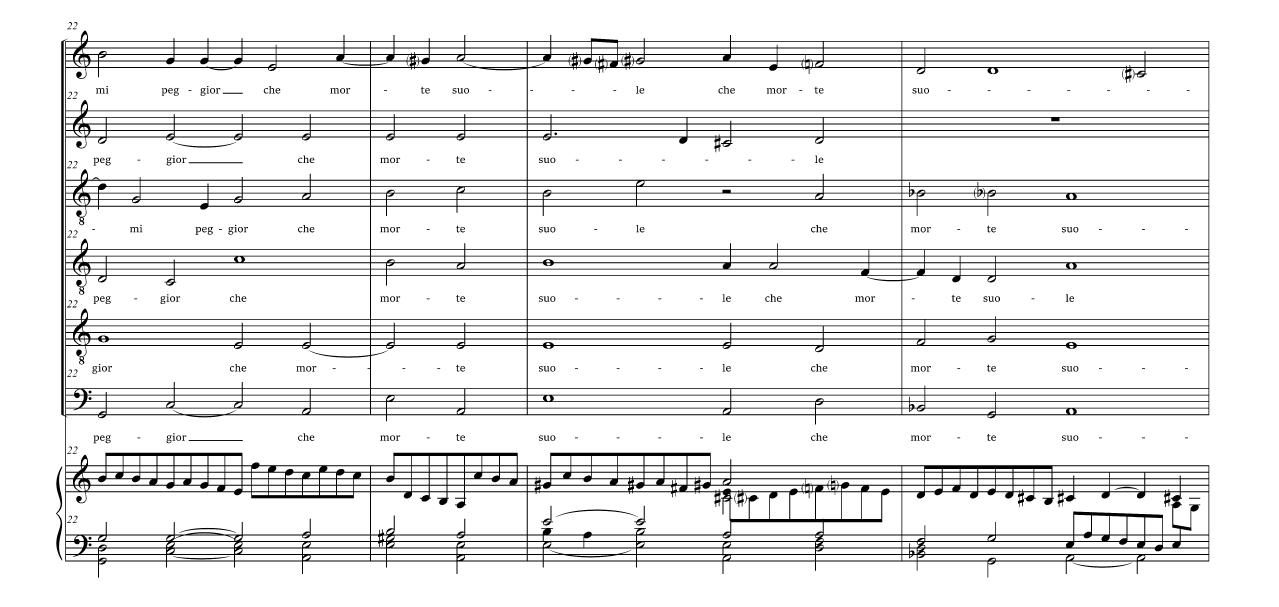
a) Anon. intabulation (bottom staves) of Alessandro Striggio’s ‘Nasce la pena mia’ (top staves), mm. 22–25, in: I-Fl Ms. Acquisti e Doni 641, fol. 25v–28v.
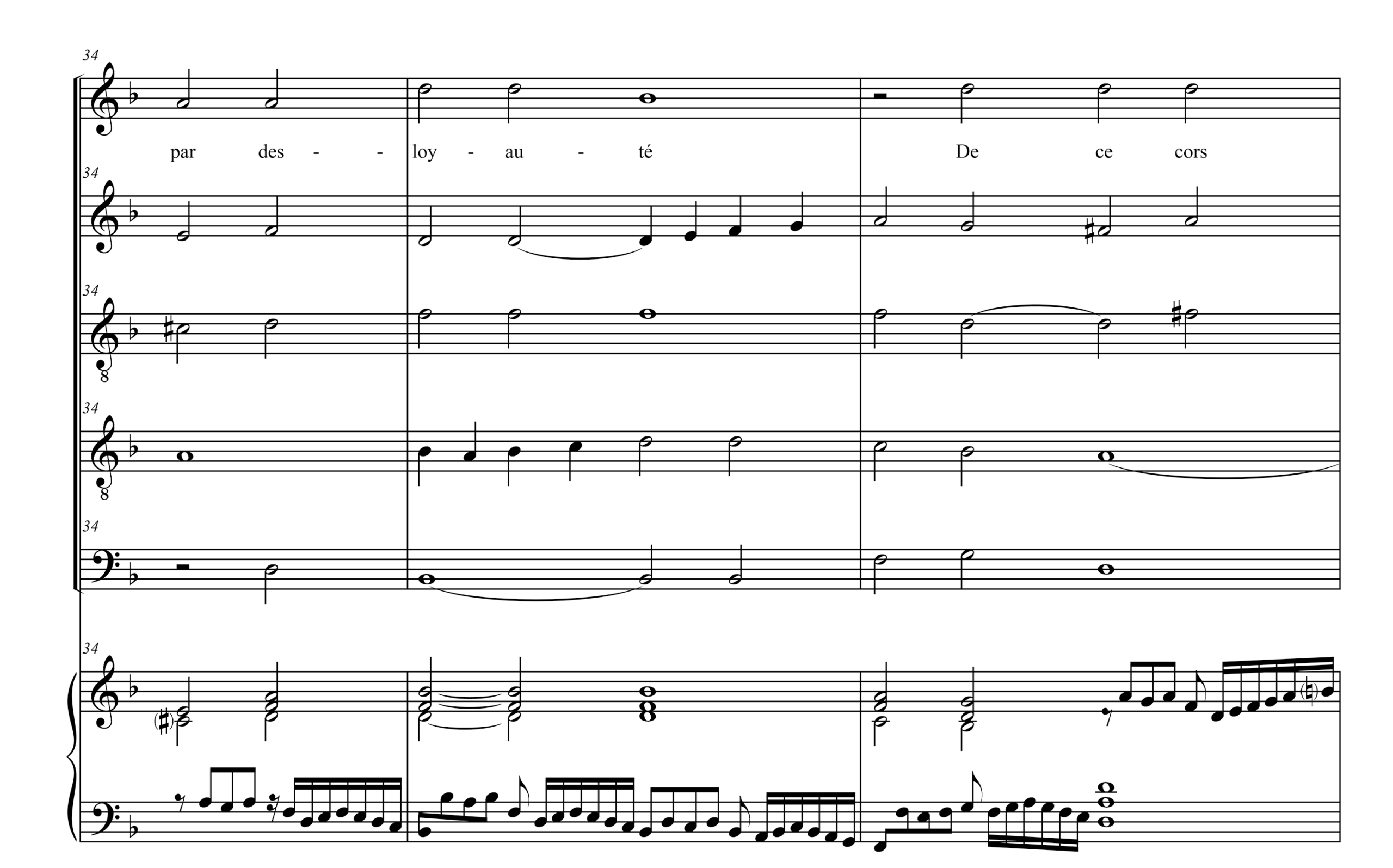
b) Anon. intabulation of Lassus’ ‘Susanne un jour’ (Susanna), mm. 34–36, in: I-TRmp [n.s.] (‘Feininger manuscript’), fol. 39v–44r.
An Aside: Considerations of Performers in the Present-Day
Elaborate ornamentation – extreme and often avant-garde – was a hallmark of the Neapolitan style, and is certainly a factor in making the music difficult to play. A modern player performing the music might consider intabulating it, either materially on paper, or by the following the same processes spontaneously and without paper – a kind of hypothetical intavolatura alla mente.28 Following the model given by extant intabulations, intabulating this music would entail altering and reworking the counterpoint as necessary in a fairly bold manner, prioritizing the soggetti (in imitative genres) and the passaggi over the accompanying voices. ‘Reworking’ accompanying voices could entail either changing the notes to create friendlier intervals, as Diruta suggests, or omitting them entirely, as commonly seen in extant elaborate intabulations. This is challenging, however, given that one must choose which notes to keep and which to recompose or omit. One might again turn to Diruta for advice, who clearly prioritizes the fuga or subject in an imitative work, advising to preserve the fuga and alter the accompanying voices.29 In elaborate intabulations, the passaggi take precedence over the accompanying voices (or chords), echoing the hierarchy of musical elements implied by Diruta (fuga versus non-imitative material), and the intabulator would be wise to prioritize both fuge and passaggi over ‘accompanimental’ material. While I suspect that many modern performers on early keyboard instruments do indeed quietly alter the musical text when performing the music of Mayone or Trabaci – in particular, releasing sustained notes earlier than notated, which naturally decay on a plucked keyboard instrument – I would argue that they are, broadly speaking, far too conservative in their willingness to do so. Ironically, this speaks to the power of the 19th-century concepts of a musical work that Newcomb identifies these prints as foreshadowing.
Literal Intabulations
The intabulations listed in Tab. 1 – extant intabulations of pieces from volumes discussed in Newcomb’s article – are largely what we might call ‘simple’ or ‘literal’ intabulations, in that they transcribe their material without the addition of passaggi. They also strive to maintain the musical texts of their models.30 They therefore don’t seem particularly useful as models for the would-be intabulator of Newcomb’s open-score keyboard music, but seem to reinforce Newcomb’s notion regarding the prescriptive nature of their open-score texts – one would not be ‘allowed’to alter these texts in intabulating or performing them. However, even in a literal intabulation the intabulation process automatically exerts a sort of translative effect. As I discussed extensively in my article for the previous volume of this series, the conventions of intavolatura, working in tandem with the intabulation process, would visually obscure voice leading automatically (I use the analogy of the algorithm in popular concepts of computing) as a byproduct of the intabulator following the conventions of the notation.31
Therefore, even if the notes are technically shared between an intabulation and a version of a piece in open score (or partbooks), the intabulation still implies an alternate polyphonic construction. This can be seen in an intabulation of one of Trabaci’s versets found in I-Nc 4832 (Ex. 3). While largely preserving the polyphony of the original verset (not withstanding a few errors), the algorithmic processes obscure voice leading; this is largely driven by the fact that the two staves of the tablature prescribed the notes to be played by each hand, and by the fact that stem direction is dictated by a note’s vertical placement in the staff, not by virtue of belonging to a specific polyphonic voice. As the processes of intabulation overlap with the conventions that define the notational system, the voice-leading is obscured. This is clearly observable in mm. 4–6, when tracing the contour of the alto part, which migrates from the bottom staff to the top. The choice of which notes go in which staff is largely dictated by what is playable; thus, the soprano, alto, and tenor are all moved to the top staff in m. 6. The process of intabulation – here without altering any notes in the original score – can be viewed as a window upon the keyboardist’s mental image of the polyphony actively being translated.
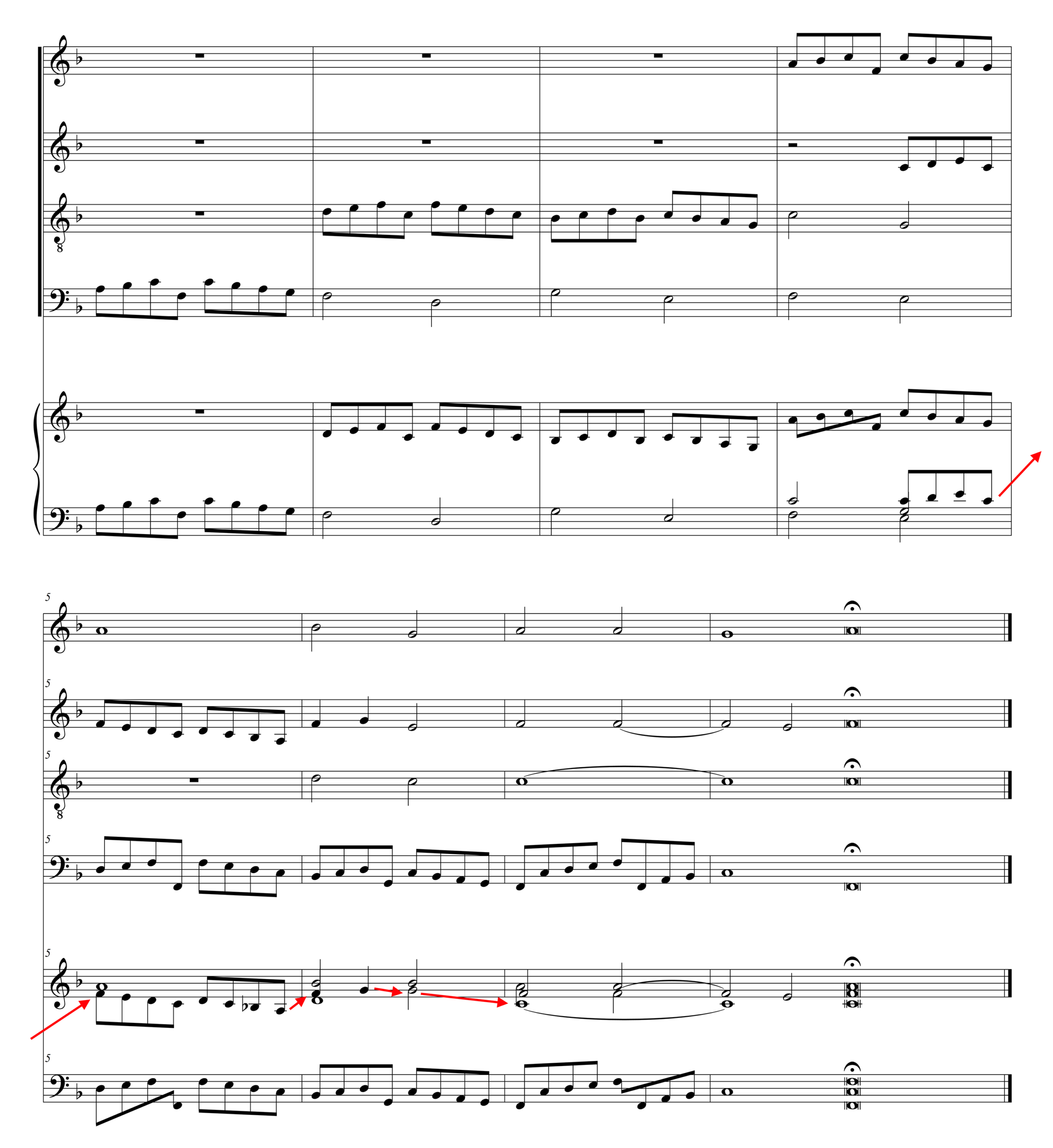
Example 3: Anon. intabulation, entitled ‘Verso 6 tuono d. Trabace’, of the ‘Verso Nono, Sesto Tono’, mm. 1–8,from Trabaci, Il secondo libro de ricercate, & altri varij capricci (Naples, 1615), 69. Intabulation (bottom staves), transcribed from I-Nc Ms. Mus. st. 48, fol. 33v. Red arrows show the contour of the original voice leading in instances in which the intavolatura obscures it. The upper staves are transcribed from Trabaci, Il secondo libro de ricercate, & altri varij capricci (Naples, 1615), facs. repr. (Florence, 1984), 69.
Two extant intabulations from Frescobaldi’s 1624 Il primo libro di capricci fatti sopra diversi soggetti, et arie in partitura in I-Rac MS Classense 545 show similar tendencies. Ex. 4 shows four instances extracted from the Capriccio sopra un soggetto. The rule that any note’s stem is determined by its vertical placement routinely gives the false impression of alternative voices and voice leading (creating what I call, after Alexander Silbiger’s concept of ‘fictitious rests’, fictitious voices); notes are distributed between the two staves in a way that reflects the way they fall comfortably under the hand; rests and unisons are omitted (Ex. 4b, m. 54; see especially Ex. 4d).33 Without having recourse to Frescobaldi’s print with its open score format, some of the voice-leading would need to be inferred. And, although the intabulator again strives to preserve the musical text, the line between visual realignment of voice leading through fictitious tablature voices and actual alteration of the musical text is occasionally blurred.
Example 4a–d: Anon. intabulation of Frescobaldi’s Capriccio sopra un soggetto (1624), transcribed from I-RAc MS Classense 545 (bottom staves), fol. 27r–30v. Top staves transcribed from Frescobaldi, II primo libro di capricci […] in partitura (Rome: Luca Antonio Soldi, 1624), 69–77, https://www.museibologna.it/musica/viewschedatwbca/&path=/images/ripro/gaspari/_Z/Z170/ (accessed on 10 Oct. 2025).
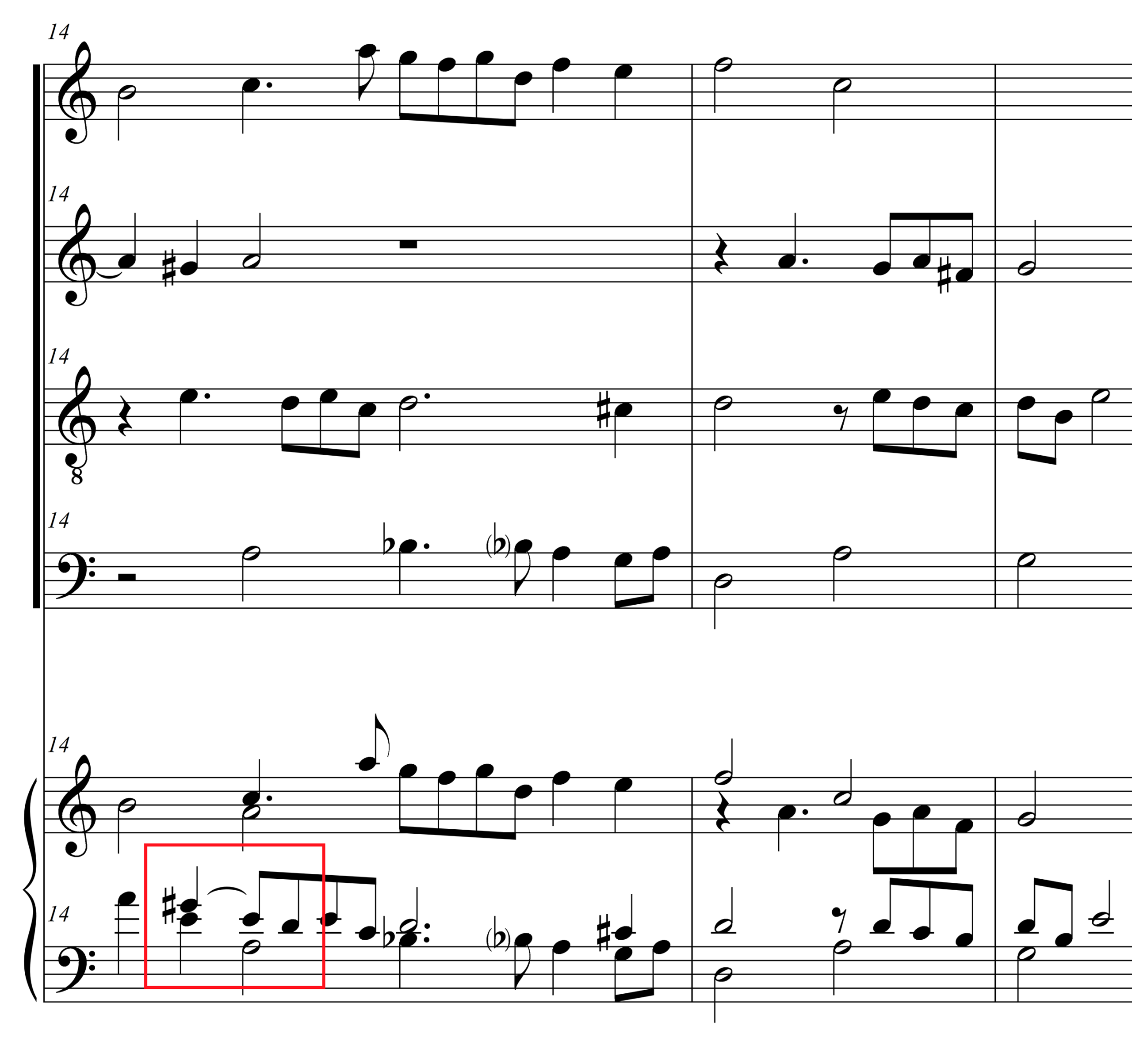
a) mm. 14–15. The red box highlights the use of a tie to clarify voice leading, which is ordinarily hidden by intavolatura practice.
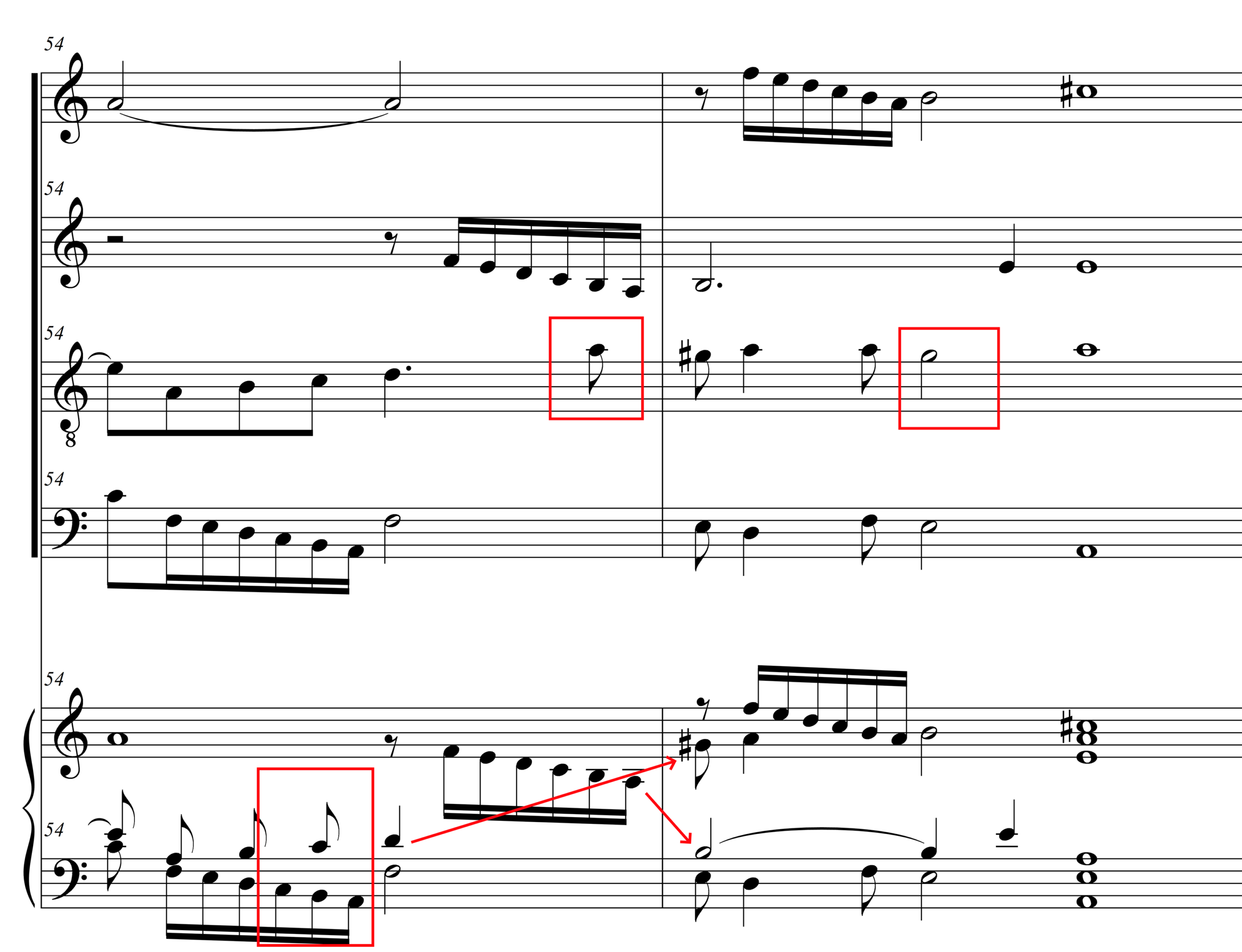
b) mm. 54–55. The bottom box highlights a large interval in one hand, wider than usually seen in intavolatura practice; arrows show the contour of the original voices. The upper boxes show notes removed from the tablature.
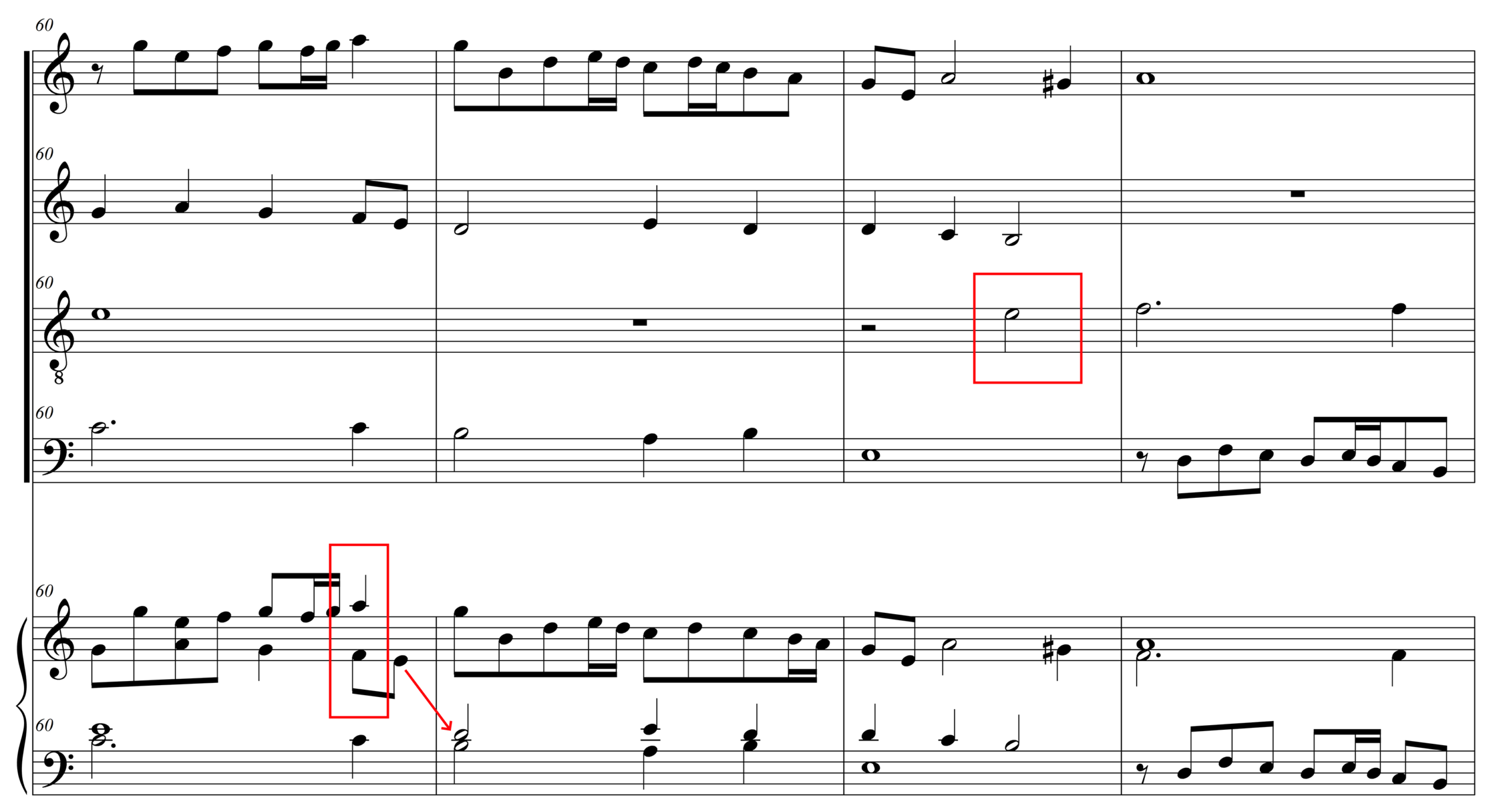
c) mm. 60–63. The red arrow shows the contour of the original voice leading as it moves between the hands; note how the stem direction obscures the motion of the original voices. The tenor e1 (red box) is the opening note of the soggetto, which is omitted in the intabulation.
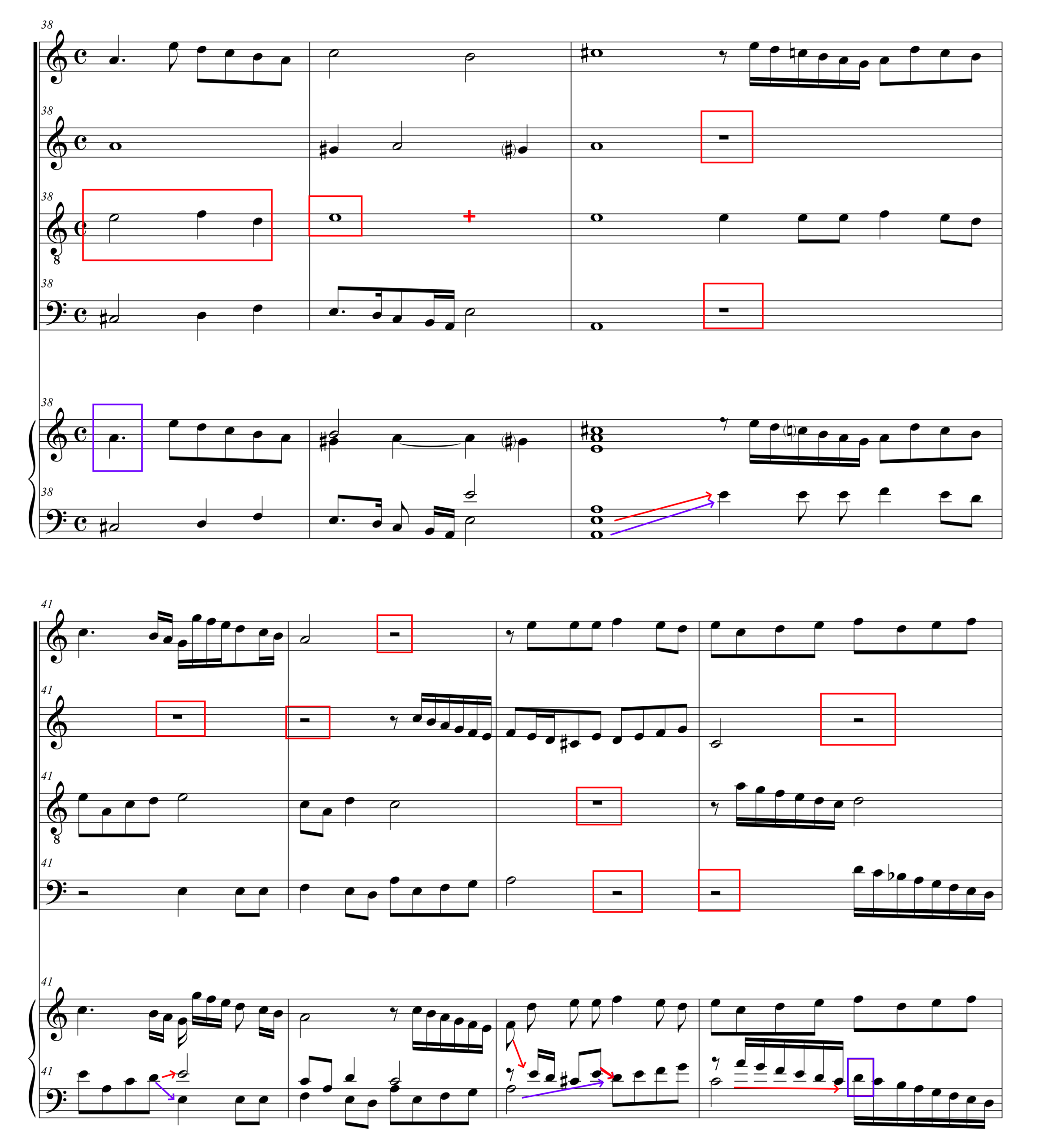
d) mm. 38–44. The purple boxes show unisons hidden by intavolatura convention. Red boxes show rests removed in the intabulation process. The red arrows show the original voice leading, again obscured by the conventions of intavolatura, while the purple arrows highlight the ‘fictitious’ tablature parts.
In general, however, these intabulations largely preserve the original voice leading, pushing back against the rules of intavolatura to do so. In Ex. 4a, m. 14, a tie is added in the tenor e1, to flag the continuation of the tenor, even as the stem directions give a ‘fictitious’ impression of the voice leading. In other instances beaming is used to clarify voice leading. Sometimes the original polyphony is preserved at the expense of playability, with awkward stretches that are difficult to perform as written – see Ex. 4b, m. 54, Ex. 4c, m. 60, and Ex. 4d, m. 70. Again, the tendency to preserve Frescobaldi’s musical text would seem to amplify Newcomb’s point that the fundamental ‘need’ to preserve the particularities of these texts is part of their function as musical objects. However, there is a fundamentally Janus-faced quality of intavolatura; as I explored in my previous article for this series, the fact that intavolatura uses mensural notation means that its rules can be bent to show details of voice-leading, turning intavolatura into a kind of open score.34 It is noticeable that the tendency to preserve musical text in the Frescobaldi intabulations in I-RAc MS Classense 545, which dates from the middle of the 17th century, goes against what one often sees in intabulations from the 16th century.35 In fact, in two intabulations of ricercars by Padovano (originally published in part-books) by Sperindio Bertoldo (Ex. 5; see Tab. 2), the intabulator has no qualms with allowing the intabulation process to not only obscure voice leading but to essentially rework the polyphonic fabric, altering the original text as extensively as seen in elaborate intabulations. In fact, the integrity of the subject – in a ‘learned’ ricercar no less – is sometimes completely omitted in an effort to adapt the music for keyboard performance.36 In Ex. 5a, notes from the soggetto are removed to avoid awkward stretches, and in Ex. 5b, for diminution in the right hand.
Example 5a–b:Intabulations by Bertoldo, of ricercars by Padovano.
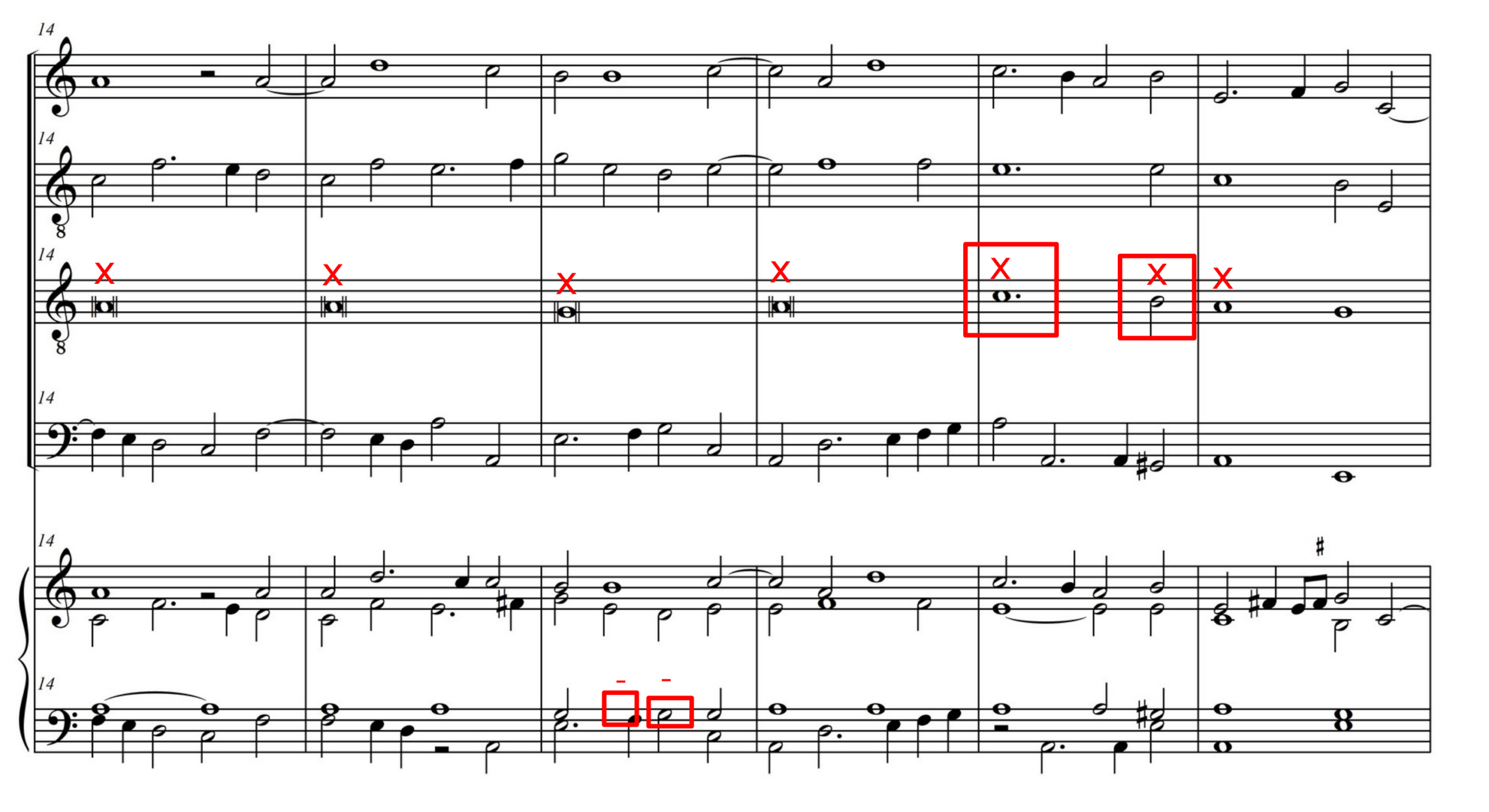
a) Bottom staves transcribed from Sperindio Bertoldo, Ricercar del Primo Tuono, mm. 14–19,in: Bertoldo, Toccate, ricercari et canzoni francese (Venice, 1591), 15–9. Top staves transcribed from Annibale Padovano, Il primo libro de ricercari a quattro voci (Venice, 1556).
b) Bottom staves transcribed from Sperindio Bertoldo, Ricercar del Terzo Tuono, mm. 12–13,in: Bertoldo, Toccate, ricercari et canzoni francese (Venice, 1591), 20–3. Top staves transcribed from Annibale Padovano, Il primo libro de ricercari a quattro voci (Venice, 1556).
Newcomb’s response would surely be to argue that these ricercars, representative of the Venetian school, are less contrapuntally rigorous and artificioso than the Ferrarese-Roman-Neapolitan works that are the object of his study.37 However, I am not sure if this entirely fair to the Venetians: not only do many of their works hint at the same ‘advanced’ level of artificioso composition as do the ricercars that Newcomb highlights (witness the c.f. treatment of the soggetto in the Padovano ricercar just cited), but, as Newcomb himself points out, these works come to us not in open score, but in intavolatura; in this case, the notational format has a material influence on the music style itself.38 That is, the notation has a sort of agency that we would normally consider to belong completely to the composer, imposing a direct influence on musical style. In other words, the complex and artificioso tendencies of the works he cites are that way precisely because they are in full score, not intavolatura, just as the Venetian ricercars appear to be less complex because they are in intavolatura, and not in full score.
Intavolatura and Open Scores: a Comparison of Notational Influence
One can get a further sense of this ‘notational influence’ by comparing ‘free’ (that is, model-less) keyboard works in both formats. Gb-Lbl Add. 30491, a major source of Neapolitan keyboard music ca. 1600, contains a sole piece in intavolatura,Macque’s Capriccio sopra re fa mi sol; the remaining keyboard works in the manuscript are notated inopen score. In mm. 16–23 of Macque’s Capriccio (Ex. 6), a thoroughly contrapuntal texture is implied, but the counterpoint isloose and not particularly well-defined; witness the disappearance of the alto part in m. 20. I would suggest that this texture has to be seen as a by-product of intavolatura and its conventions: resting voices are not given rests that would clearly indicate their contour (and continued existence), and stem directions hide the specifics of voice leading. Sustained notes tend to evaporate in a way reflective of the decay of a plucked string – see the soprano in m. 22, for example. The intabulation is an image of an improvised performance.
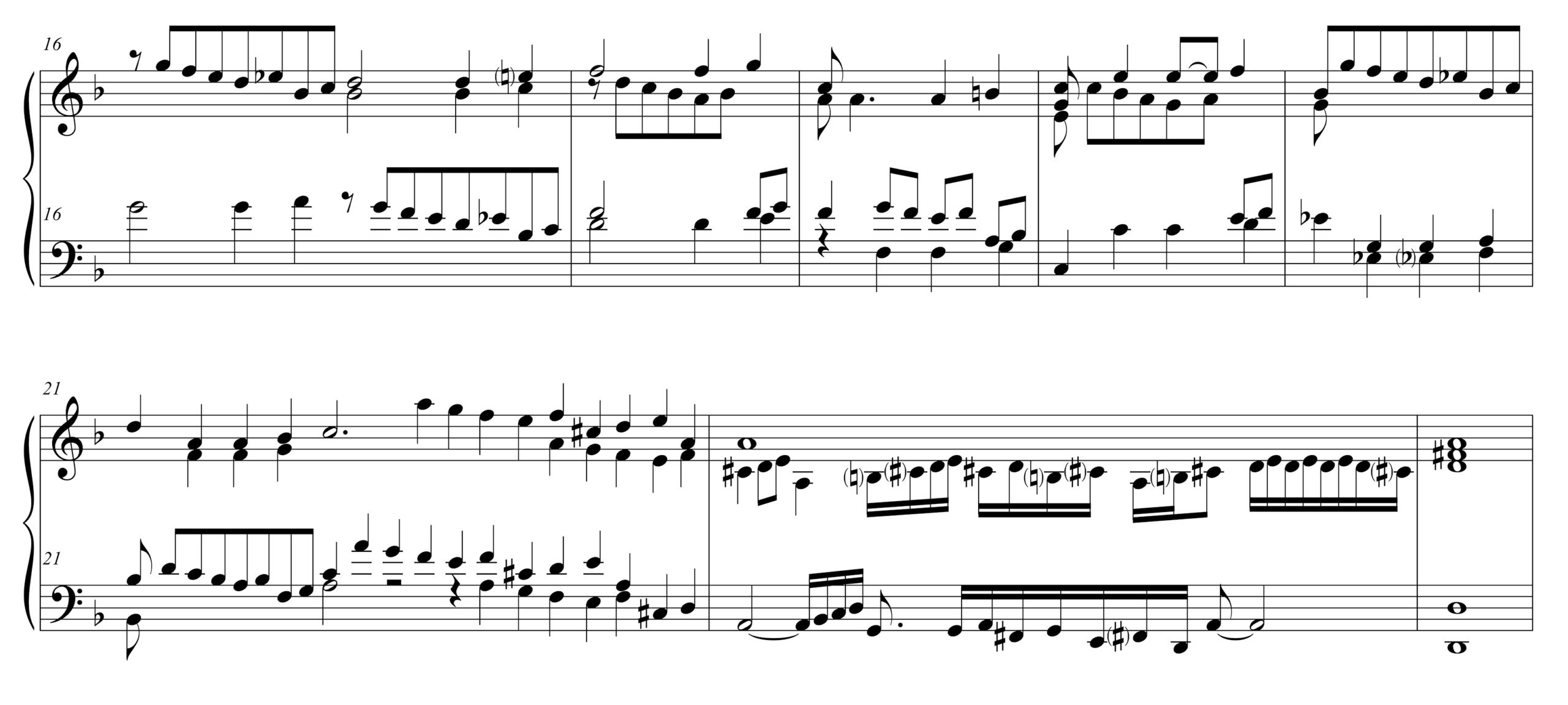
Example 6 Giovanni de Macque, ‘Capriccio di Gio. De Macque, sopra rè fà mi sol’, mm. 16–23, transcribed from Gb-LB Add 30491, fol. 23v.
However, would the piece have had the same casualness in counterpoint if it were notated in open score? To start, the contrapuntal fabric would be cast fully in relief, each voice having its predefined physical space on the page. As we have seen, the intabulation process tends to create a hierarchy of elements that mirror the aural perception and the physical actions of performance, with the ‘primary’ voices containing elements, such as a soggetto orpassaggi, that are more ‘important’ than the ‘accompanying’ voices. This is at least partly enabled by the fact that the intavolatura is a kind of open canvas – the voices are not given any sort of predefined physical space. In contrast, the predetermined space that receives each part in an open score would seem to encourage contrapuntal completeness. The notation need not capitulate to the practicalities of performance at all. I wonder if Macque might have been tempted – or rather, spurred on – to increase the complexity level if he had used open score, adding say, sustained notes to accompany a polyphonic complex (the kind that often give performers headaches today), or perhaps doubling one of the voices in thirds. In Ex. 7a, I created, following the advice of Alexander Silbiger, a detabulation of the passage in Ex. 6; in Ex. 7b, I ‘filled the gaps’ of my literal detabulation, in a speculative exercise to show how the music might have been written in open score: the evaporating long notes are left in, and I have added slight figuration to maintain a full four-voice texture (see brackets).39
Example 7a–b Detabulations of Macque’s Capriccio from Example 6
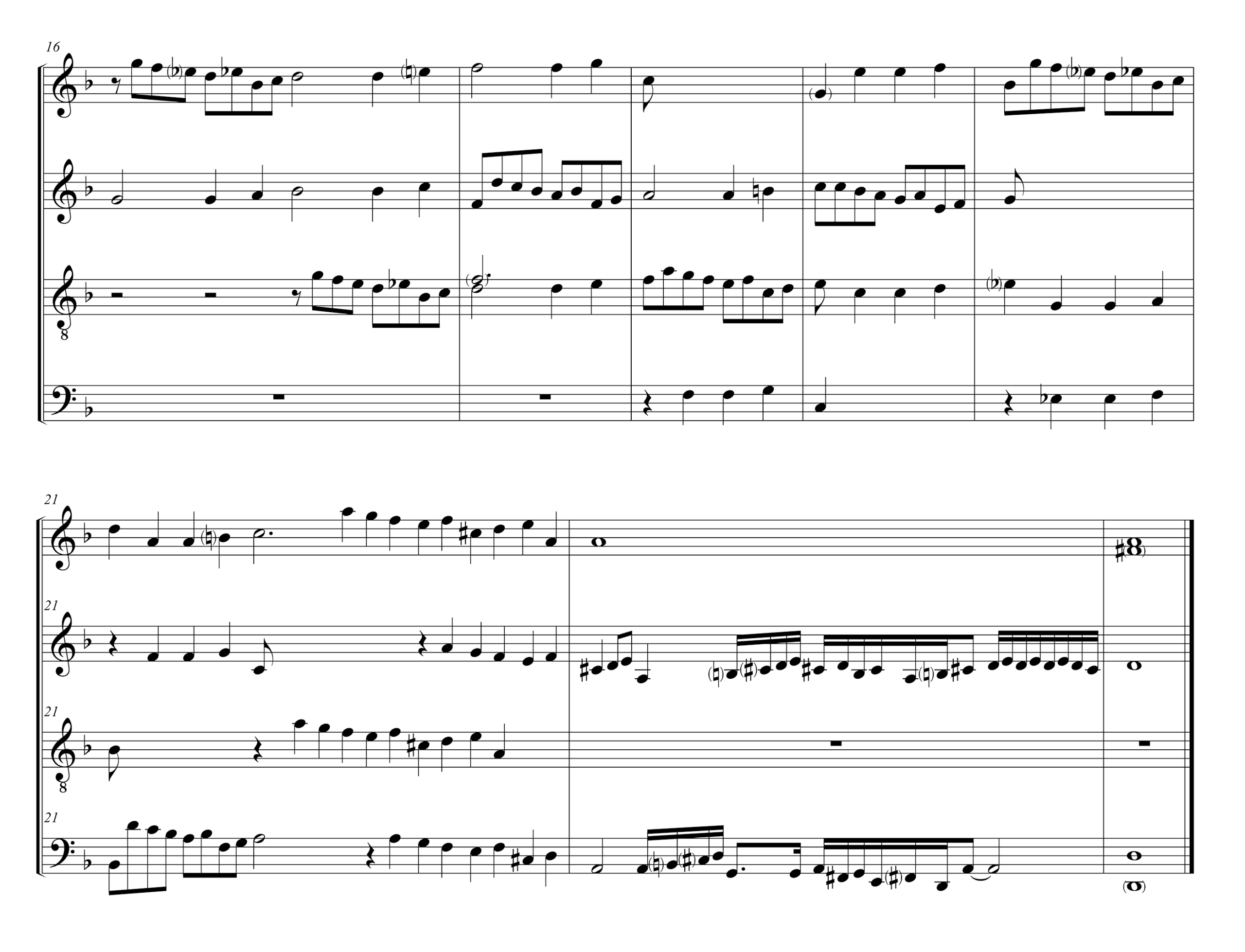
Example 7a A literal detabulation of Macque’s Capriccio, from Ex. 6. Due to the conventions of intavolatura, the two soggetti appear to be in separate voices; in detabulating, I have made sure that a given instance of a soggetto remained in the same voice. Apart from that concession, I have transcribed the parts literally from the tablature.
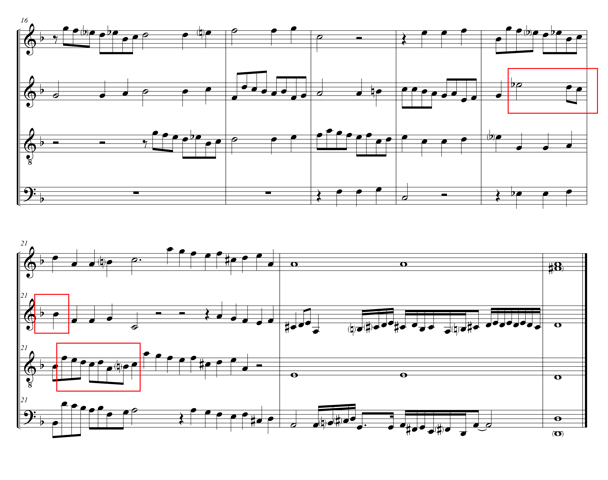
Example 7b I have now added material to the detabulation, largely by sustaining the implied long notes. In addition, I have added contrapuntal material in two instances (brackets).
A fruitful comparison can be made with Trabaci’s Capriccio sopra la, fa, sol, la from the Libro primo (1603). As noted by Silbiger, it is similar enough to Macque’s Capriccio to warrant being identified as a kind of parody.40 In parallel passages to the two just shown, we can see what Macque’s ‘missing’ parts might have contained (Ex. 8); notable is the tendency to consistently add material in the fourth voice incontrapuntal complexes that are essentially in three voices; in comparable moments in Macque’s Capriccio, the fourth voice often isn’t present – one gets the impression that material is added only as it is possible to play (for example, the faster-moving imitative section from mm. 16–22 remains a 3 until the soggetto enters in all voices in augmentation, after which the texture is again reduced to three voices). It must also be noted that Trabaci’s piece is considerably more difficult to perform as exactly written, precisely due to these ancillary parts.
Example 8a-b: Trabaci, ‘Capriccio sopra la, fa, sol, la’, transcribed from Trabaci, Ricercate canzone francese capricci […] libro primo (Naples, 1603), 63–6. The music, originally printed in open score, has again been transcribed into modern keyboard notation, with stem directions reflective of the parts in the open score.
![Musical examples with excerpts transcribed from Giovanni Maria Trabaci’s Ricercate, canzone francese, capricci […] libro primo (Naples, 1603), pages 63–66. The music, originally printed in open score, is here presented in modern keyboard notation.](https://www.mdw.ac.at/mdwpress/wp-content/uploads/example-8a-scaled.png)
a) mm. 20–26
![Musical examples with excerpts transcribed from Giovanni Maria Trabaci’s Ricercate, canzone francese, capricci […] libro primo (Naples, 1603), pages 63–66. The music, originally printed in open score, is here presented in modern keyboard notation.](https://www.mdw.ac.at/mdwpress/wp-content/uploads/example-8b-scaled.png)
b) mm. 53–55
Following the same logic as the algorithmic conversion of polyphony to intavolatura, I wonder if the open-score formatcan be seen to have the opposite effect, at the very least encouraging – or perhaps even ‘demanding’ – additional notational detail, therefore possessing a degree of agency over musical style in exactly the opposite way that intavolatura does. Put another way, keyboard music in open score – at least around 1600 in Italy – represented a kind of objectification of intavolatura, with a parallel set of algorithmic processes at work. This is particularly the case if we assume that works such as Trabaci’s and Macque’s were likely ‘composed’ at the keyboard as a product of improvisation. In this case, the intavolatura is a kind of tabula compositoria.To the extent that the intabulated version of Macque’s Capriccio is the res facta to the improvisation, notation in open score format would be the next step up the ladder of ‘composedness’ – or rather, the top rung.
Another comparison of works in each format is illustrative. Ex. 9a shows a passage from the Toccata terza from Ascanio Mayone’s Secondo libro di diversi capricci per sonare, published in open score, and Ex. 9b a passage from an anonymous toccata-like piece in I-TRmp [n.s.] (commonly known as the ‘Feininger’ manuscript).41 In the passage from the anonymous toccata, imitation of a figure (a)creates a move towards a cadence. Again, as would be expected in a work notated in intavolatura, the counterpoint is a sketch rather than fully fleshed-out. The texture thins out in m. 5, moving to an a 3 texture on the second beat, with the bass truncated on c1,evaporating on beat 4. This is presumably to facilitate the stretch between the bass and tenor on this beat, and is again an image of the physical actions (and aural reality) of performance on a plucked keyboard instrument. The passage sits easily under the hands. In contrast, the Mayone toccata (mm. 67–73), while almost identical in concept (imitation of a motive as a drive towards a cadence), has a quite different effect: wide intervals (such as seen in the last beat of m. 67 and 68) are awkward and sit unidiomatically on the keyboard, and the texture is considerably more dense overall. Conceptually, the musical kernel behind each excerpt is the same: two voices participate in an imitative complex of a motive, while the other two voices accompany this a 2 complex with accompanying contrapuntal material. However, in the anonymous toccata, this accompanying material is minimal, or even non-existent, whereas in the Mayone, it consists of long notes or ‘extra’ material that moves with the same note values as the motive, creating busy and highly unidiomatic textures (see, for example, m. 73). The point is highlighted further in Ex. 9c, an excerpt from another toccata by Mayone from his Primo libro, and an anonymous Toccata piena from the Feininger manuscript; the anonymous toccata fits the stylistic ‘norm’ of passaggi and chords to a tee, whereas the sustained notes in Mayone’s toccata simply get in the way in performance – but also give the piece a sense of contrapuntal completeness (and added complexity).
Example 9a–c: Mayone, Toccatas
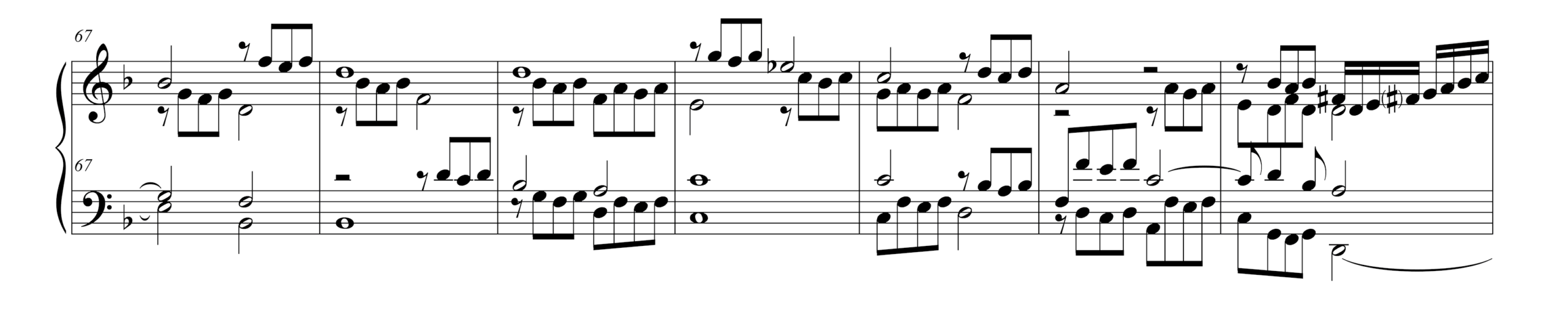 Example 9a: Ascanio Mayone, ‘Toccata terza’, mm. 67–73, transcribed from Mayone, Secondo libro di diversi capricci per sonare (Naples, 1609), facs. repr. (Florence, 1984), 99–110. The music, originally printed in open score, has been transcribed into modern keyboard notation, with stem directions once again reflective of the parts in the open score, to facilitate comparison with the works in intavolatura.
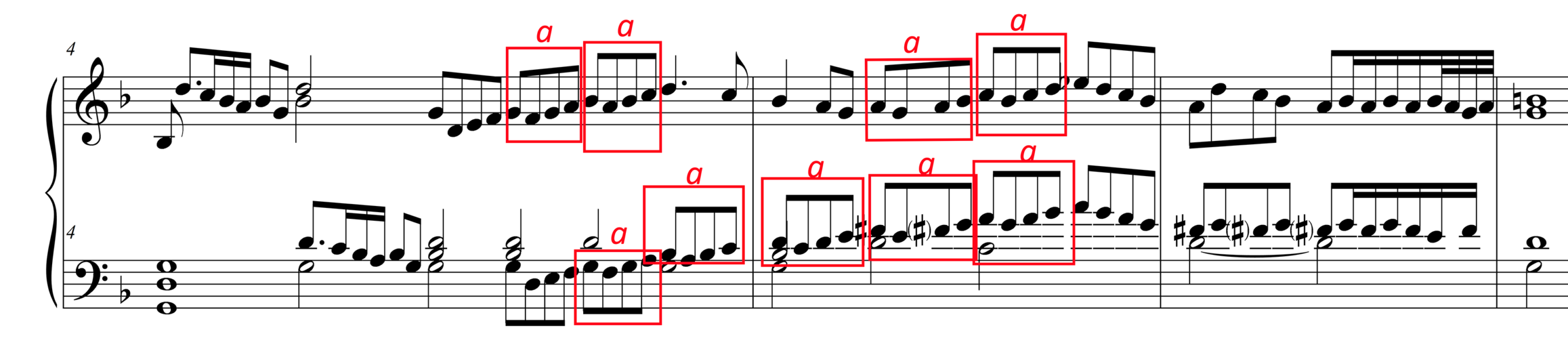
Example 9b: Anon., [Toccata], mm. 4–8, in: I-TRmp [n.s.], fol. 45v-46r. Transcribed from Italian keyboard intavolatura.
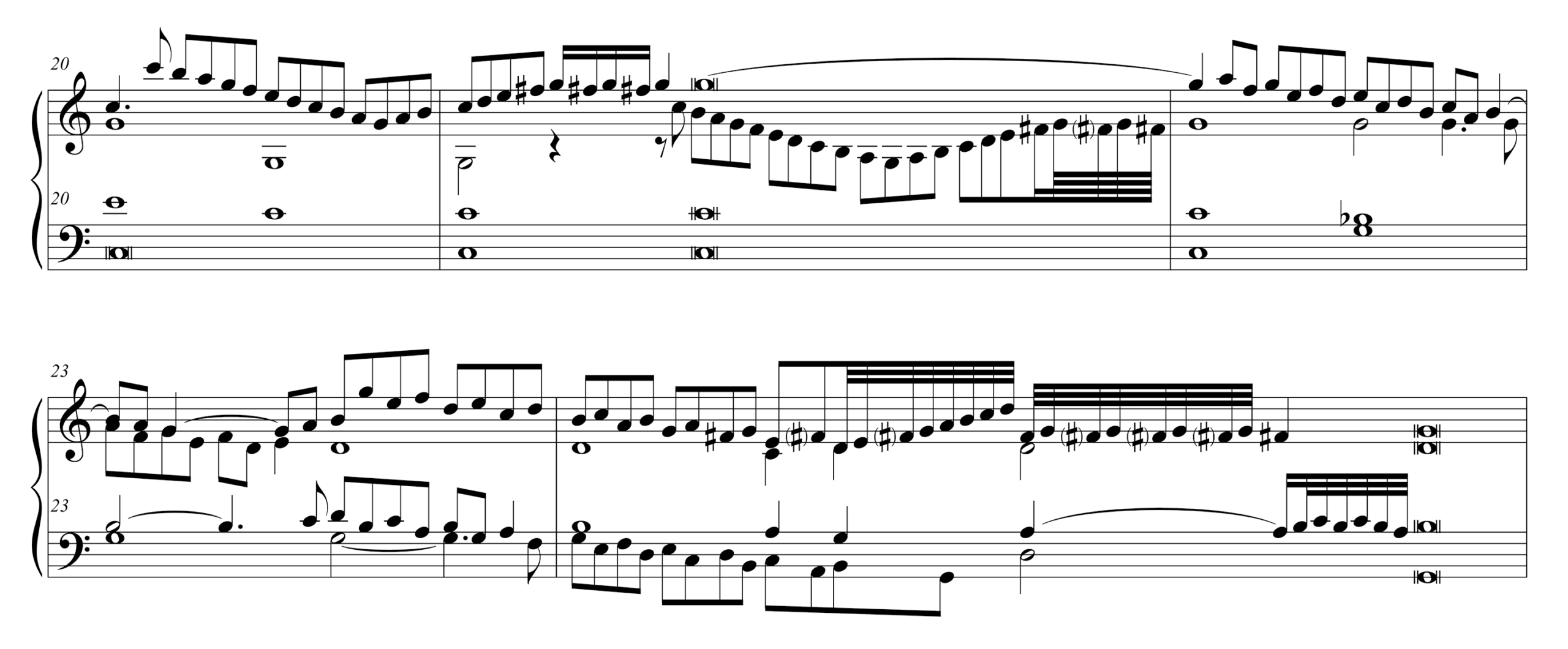
Example 9c: Ascanio Mayone, ‘Toccata prima’, mm. 20–24, transcribed from Mayone, Primo libro di diversi capricci per sonare (Naples, 1603), 39–43. Transcribed into modern keyboard notation from open score.
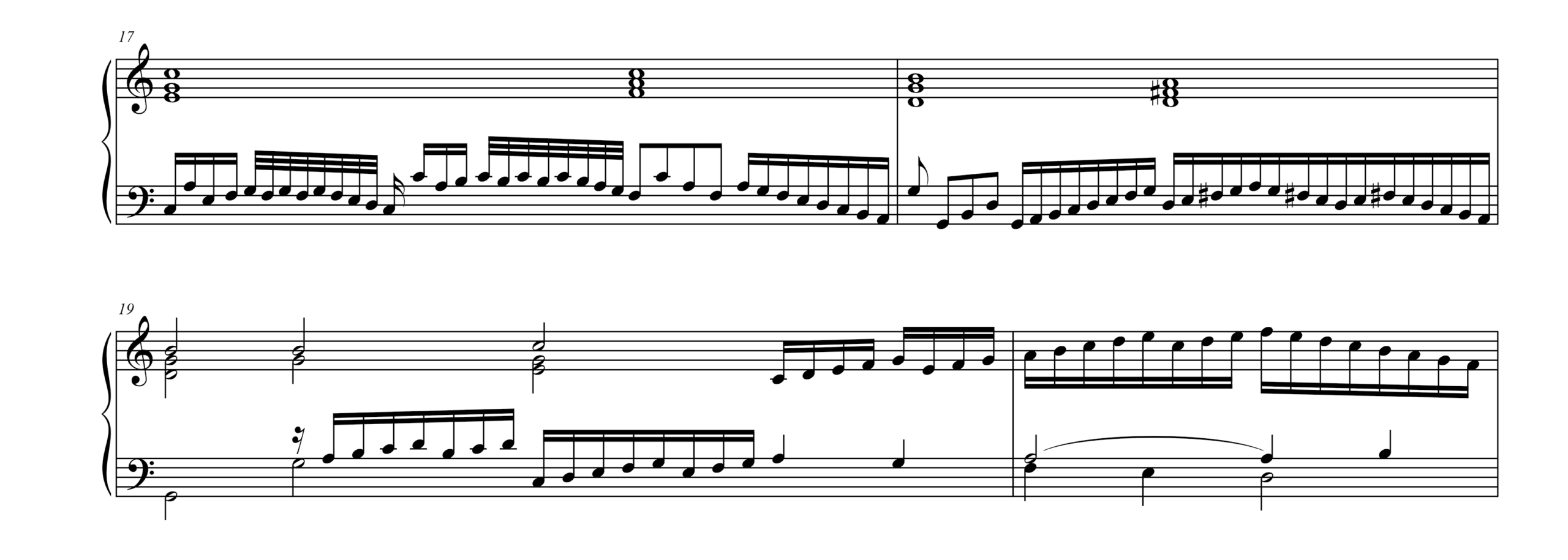
Example 9d: Anon., ‘Toccata piena’, mm. 17–20, in: I-TRmp [n.s.], fol. 11v-13r. Transcribed from Italian keyboard intavolatura.
Again, one can interrogate the degree to which these elements are, in fact, influenced by the notational format itself. The difficult elements in the music of the Neapolitan school described earlier are encouraged (or required?) by the use of open score. Mayone’s toccata would appear on the page to be much more like the anonymous Trent toccata if it were notated in intavolatura, and the Trent toccata would have been more fully fleshed out, objectified in a way that leads to increased contrapuntal complexity, if it were written in open score. Giving a degree of agency to the notational format itself may certainly have radical implications for considerations of notions of ‘workhood’, and how these notions are theorized in music ca. 1600.
Notating the Neapolitan Madrigale Passaggiato
These issues of notation, performance, and composition are aptly illustrated by the four madrigal arrangements in the published volumes of Trabaci and Mayone (one arrangement per volume). Although these are for all intents and purposes very similar to elaborate intabulations, they technically cannot be considered to be intabulations at all, as they are not notated in intavolatura.42 While this definitional quibble may seem on the surface rather semantic, the arrangements contain the same difficult tendencies in performance, and overall level of complexity, as the other works in the volumes. Trabaci’s own terminology, used on the title page of his 1603 Libro primo, ‘madrigale passeggiato’,might imply a process in which diminution was applied to each voice of the madrigal, but a closer examination reveals a process of arrangement akin to intabulation. In fact, these works can be seen as particularly exemplary of the kind of abstraction or objectification of an intabulation; ironically, their difficulty in performance once again suggests the need to intabulate them in order to perform them.
At the same time, that the madrigale passaggiato is fundamentally related to the intabulation (while not being an actual intabulation) is obvious, at least superficially.43 In Trabaci’s intabulation of Ferrabosco’s ‘Io mi son giovinetto’ in the Libro primo (1603) (Ex. 10), there are sections that strongly imply broken chords – highly idiomatic for a plucked instrument – and, generally speaking, the style of diminution is comparable to that seen in elaborate intabulations; in fact, the intabulations of Lassus’s ‘Susanne un jour’ in the Feininger manuscript, and Striggio’s ‘Nasce la pena mia’ in I-Fl Ms. Acquisti e Doni 641 contain particular diminution figures shared with pieces from the Neapolitan school.44 (Ex. 11 shows a characteristic diminution figure, based on a series of falling thirds.) In the Neapolitan madrigali passaggiati and in the ‘Susanne un jour’ and ‘Nasce la pena mia’ intabulations alike, notonly is the ornamentation extensive, but there is a notable tendency for the diminutions to take on a life of their own, forming superstructures in which specific surface figures are subject to contrapuntal manipulation and development. This manipulation includes the use of learned contrapuntal devices such as inversion, diminution, and augmentation. In addition, all of these intabulations show the clear influence of bastarda-style ornamentation, with frequent leaps between vocal parts and ranges.45
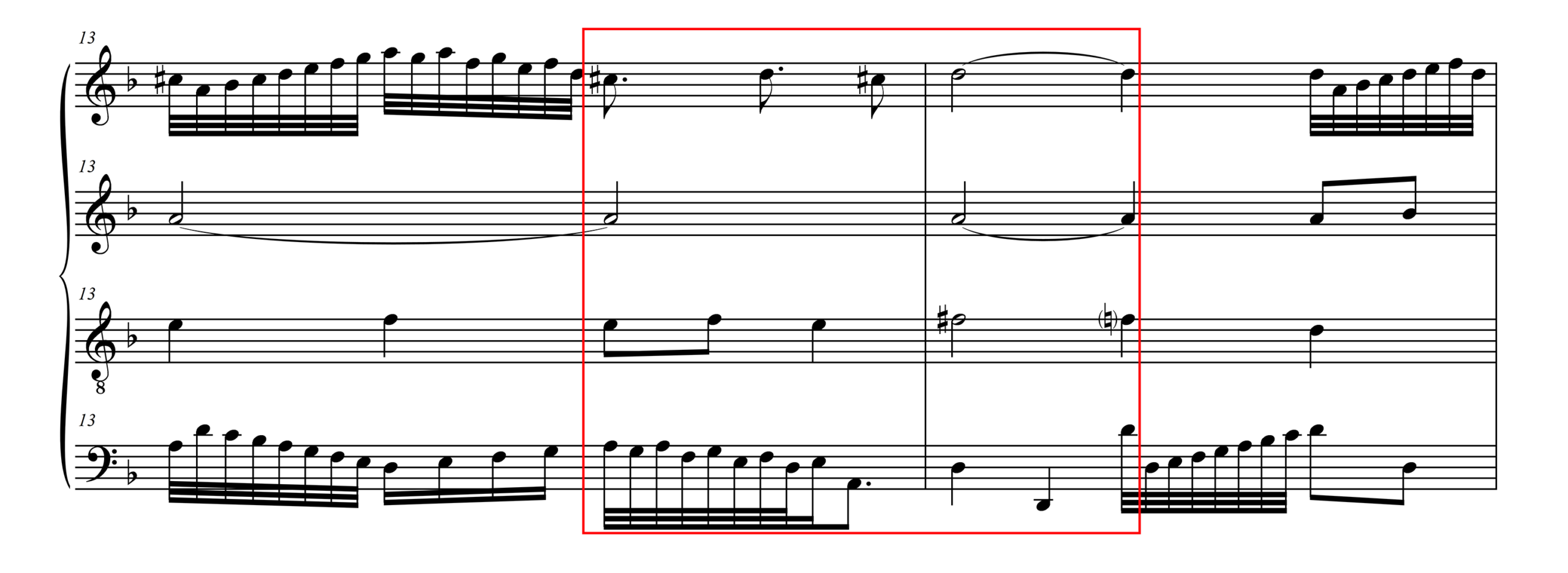
Example 10: Broken-chord figuration in Giovanni Maria Trabaci, ‘lo mi son giovinetto’, mm. 13–14, transcribed from Trabaci, Ricercate canzone francese capricci […] libro primo (Naples, 1603), 117–22.
Example 11a–c: A common falling-third diminution figure seen in ltalian intabulations and arrangements ca. 1600. Also, see previous example.
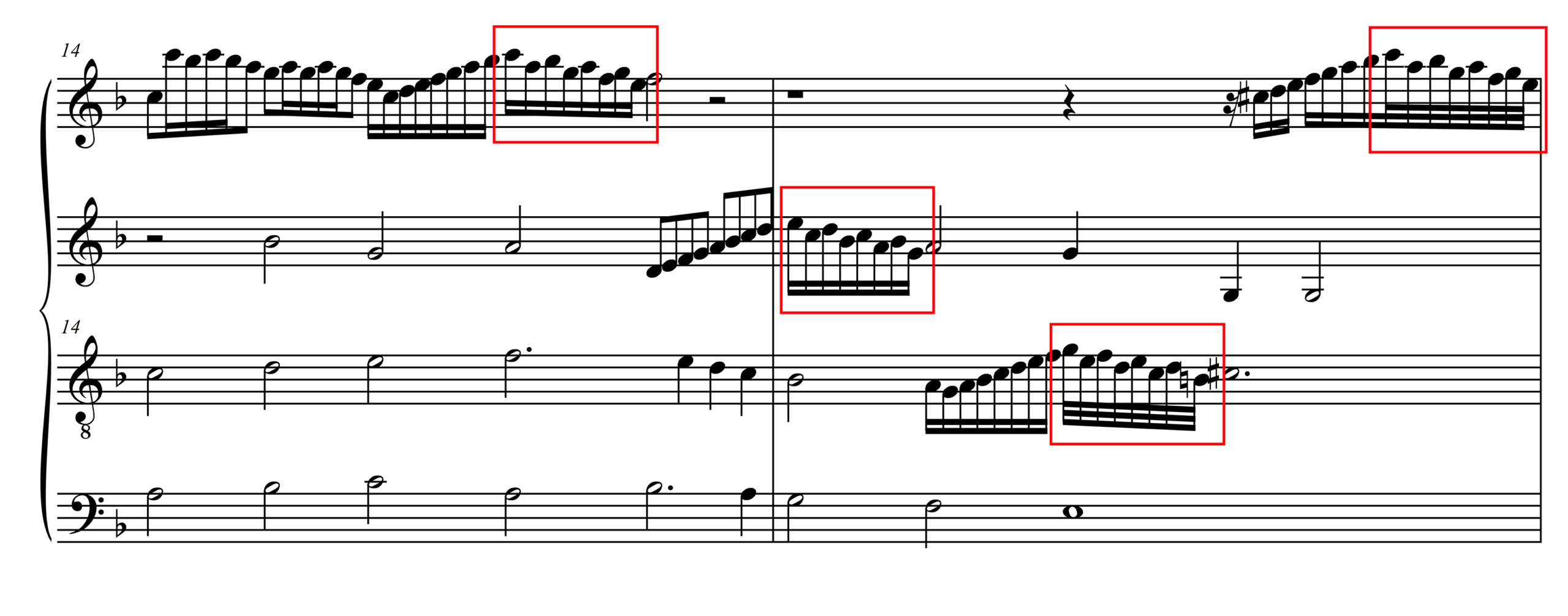
a) Ascanio Mayone, ‘Ancidetemi pur’, mm. 14–15, transcribed from Mayone, Primo libro di diversi capricci per sonare (Naples, 1603), 31–8.

b) Anon., ‘Nasce la pena mia’, m. 34, transcribed from I-FI Ms. Acquisti e Doni 641, fol. 25v–28v.
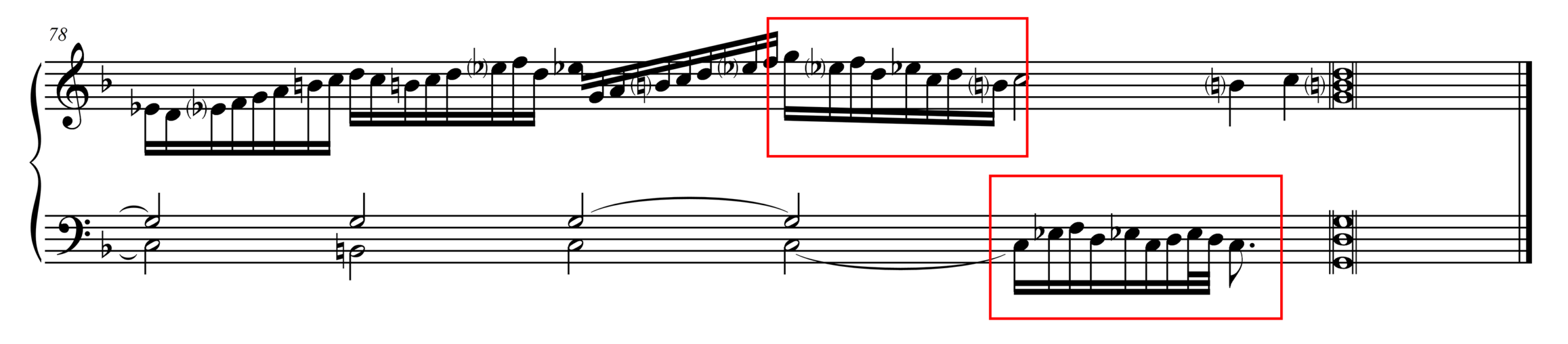
c) Anon., ‘Susanna’, m. 39, transcribed from I-TRmp [n.s.], fol. 39v–44r.
In addition to these superficial details, affinities with the intabulation process can be observed structurally as well. In particular, a close analysis reveals not so much a part-by-part strategy of diminution (as if one were, for example, applying diminutions to a single part), but a holistic approach in which all parts are considered at the same time. In many instances, Trabaci and Mayone employ the same sort of alteration to the voice-leading of the model as suggested by Diruta and as seen in elaborate intabulations. Often, alterations are undertaken in order to accommodate the logical contour of an ornamental figure. In Ex. 12a, the natural movement of the soprano passaggio towards f#1 necessitates the recomposition of the alto. In other instances, entire ornamental complexes involving multiple voices lead to the extensive reworking of the model’s polyphony, as can be seen in Ex. 12b. These moments of alteration align with Diruta’s advice to briefly alter inner voices to accommodate large intervals – and even more so with the procedures seen in elaborate intabulations.
12a–c Giovanni Maria Trabaci, ‘lo mi son giovinetto’, transcribed from Trabaci, Ricercate canzone francese capricci […] libro primo (Naples, 1603), facs. repr. (Florence, 1984), 63–6.
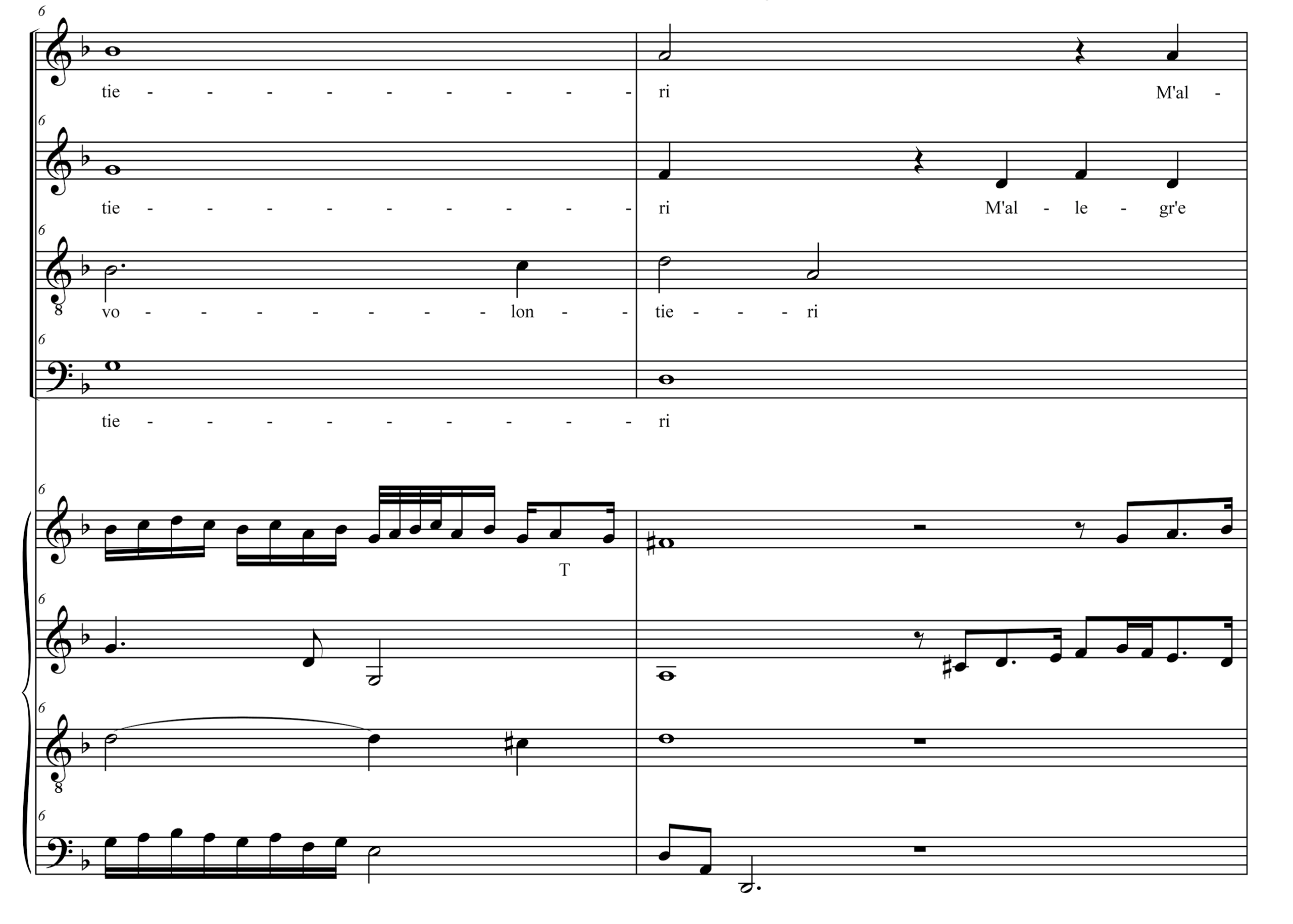
a) mm. 6–7
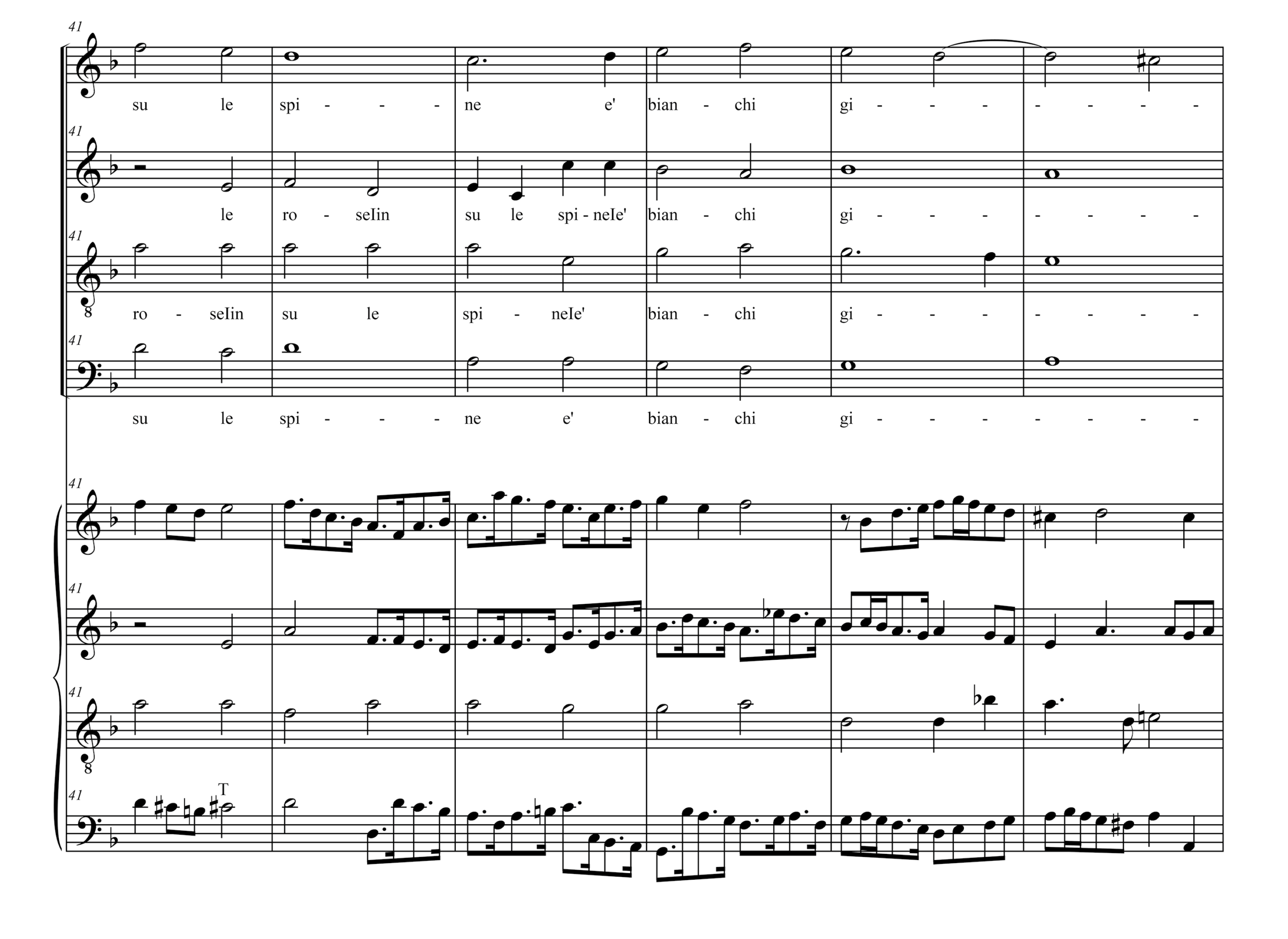
b) mm. 41–46
In addition, the Neapolitan arrangements show instances of voice exchange that are strongly suggestive of intavolatura’s fictitious voices. In Mayone’s arrangement of ‘Ancidetemi pur’, (Ex. 13a), the tenor part in m. 6 is placed in the soprano part in the arrangement; this makes sense as it is the highest-sounding part in this instance and would, of course, be placed in the upper staff of an intavolatura (with stems pointing up if sharing the staff with the next highest voice, the alto). Interestingly enough, a similar procedure is seen in the same place in Trabaci’s arrangement of the same madrigal (Ex. 13b, m. 10); here the alto gets the material of the original tenor part (which in turn gets the material previously given to the alto part). The logic behind the voice exchanges and the alterations are both clearly influenced by intavolatura.
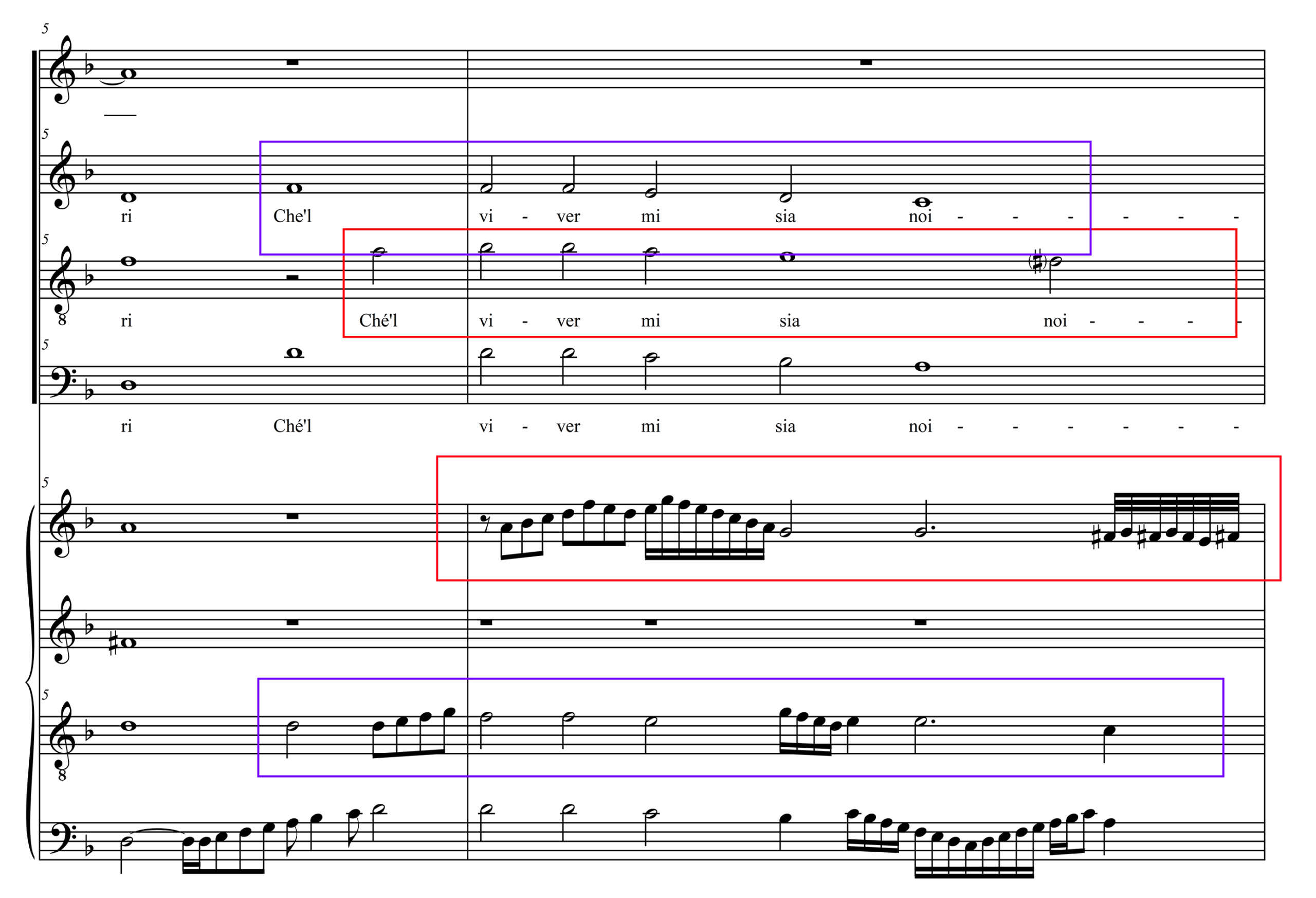
Example 13a: Ascanio Mayone, ‘Ancidetemi pur’, mm. 5–6, (bottom staves), transcribed from Mayone, Primo libro di diversi capricci per sonare (Naples, 1603), 31–8. Colored rectangles show the rearrangement of material between parts.
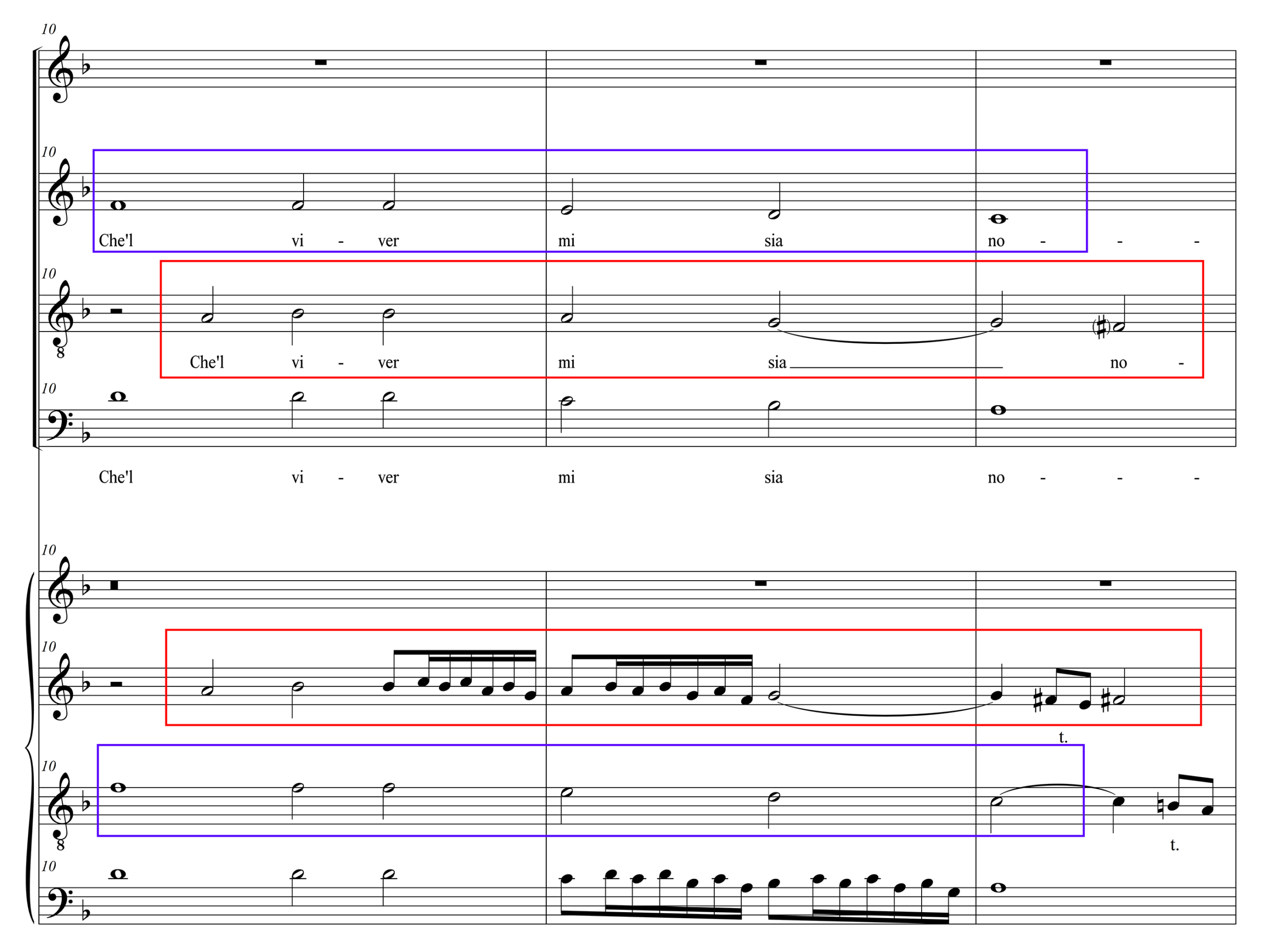
Example 13b: Giovanni Maria Trabaci, ‘Ancidetemi pur, Per l’Arpa’, mm. 10–12, (bottom staves), transcribed from Trabaci, Il secondo libro de ricercate, & altri varij capricci (Naples, 1615), facs. repr. (Florence, 1984), 126–132.
At the same time, however, many of the difficulties in performance cited above are still observed – there are many passages that are very unidiomatic for the keyboard and almost impossible to perform as written. (See Ex. 1a at the top of the article, for example). Once again, it is relevant to inquire as to whether the notational format itself can at least partly explain these aspects, with the open-score notation ‘exerting’ its agency to influence musical style. At the same time, the processes of arrangement show obvious affinity to those seen in intabulation; it is almost as if these arrangements are the result of a detabulatory process, in which an actual ‘intabulation’ – again either a real one on paper or an intavolatura alla mente – was objectified in open score. The format allows for a highly ‘rationalized’ portrayal of the virtuosic and skilled art of the intabulator/performer, including improvising passaggi and the concomitant reworking of the original voice leading.
Sounding Objects and Improvisation
In my 2018 study of intavolatura, I pointed out how certain published intabulations functioned as sounding objects.46 These sounding objects act as imagined performances; the reader could either recreate a performance by playing the intabulation, executing the ‘instructions’ to reproduce the ‘encoded’ performance, or engage with the prints, highly intricate in notational and ornamental detail and very expensive to produce, as a kind of ‘hearing with the eyes’ – not at all dissimilar to the function advocated by Newcomb.47 However, in the form of hearing with the eyes that I am proposing, the open score allows the reader to form a mental image of a virtuosic performance, not necessarily by literally recreating the performance in their head, but by forming a mental impression of it. This can be read as a kind of extreme objectification of the performance, with the patron not only appreciating the artificioso and the complex elements on the page, but also the imagined skills of the virtuoso. In elaborate intabulations, not only do the techniques of arrangement highlight the intabulator as author, but they elevate his status socially and culturally, particularly in the eyes of patrons.48 The madrigale passaggiato is in a sense an elaborate intabulation on steriods: not only does it show off the complexity of diminution, but it does so in a way that borrows from and evokes the kind of artificioso ricercar that are the focus in Newcomb’s article, using its open-score format to reveal detail through its clear delineation of the fictitious tablature voices and voice-leading, which are squarely in the agency of the intabulator/performer, not the original composer.
In fact, other aspects of the madrigali passaggiati point strongly to performance, and specifically to a culture of improvisers. For example, the focus on a relatively minor Arcadelt madrigal (‘Ancidetemi pur’) is notable. Despite its presence in a well-known and often-reprinted collection, it was not a common choice for intabulation prior to the Neapolitans.49 Interestingly enough, an arrangement – or a set of bastarda diminutions (the music itself is no longer extant) – by Giovanni de Macque is listed on the title page of Gb-Lbl Add. 30491. As Macque was the probably teacher of both Trabaci and Mayone, is it possible that ‘Ancidetemi pur’ was used pedagogically? The use of vocal models as vehicles for keyboard improvisation was certainly common in the 16th century. In fact, the intabulation of ‘Susanne un jour’ in the Feininger manuscript, mentioned earlier, contains a rather unique feature: the final section of Lassus’s chanson spirituelle, the sequence beginning on the text ‘Que d’offenser’, is repeated a total of no less than three times, each time with completely new figuration. One gets the sense that this section was being used as practice for creating new diminutions, not dissimilar to the fragmentary harmonic patterns on the ciaccona and other bass lines that one sees in early Baroque sources.50
The specter of improvisation is also supported by the presence of strikingly similar figuration between the various arrangements; see, for example, the openings of ‘Io mi son giovinetta’ by Trabaci, and the later version Mayone and colleagues.51 This latter arrangement – certainly one of the more unusual works in 17th-century music – features no less than three arrangers, each one taking a phrase in turn, and each turn clearly marked in the score. Each section develops strikingly diverse figuration, giving the distinct impression of a 17th-century jam session. Is it reflective of the keyboard practices of this school of Neapolitan composers ca. 1600 – a glimpse into a Macque studio class? In any event, by abstracting and objectifying their art in open score,the precise details of elaboration are displayed, creating an objectified and highly rationalized image of a performance, with a clear impression of the technical processes at work.
Notational Ironies
I have suggested that, in approaching the performance of keyboard works in open score, a 16th-century player would have intabulated them, either literally on paper or alla mente.
Intabulating the madrigali passaggiati of the Neapolitans would be somewhat ironic, however: if improvisatory practices – and specifically those reflected by intabulation – were at the root of the creation of the madrigale passaggiato, and if the madrigale passaggiato was a result of a kind of detabulation, re-intabulating these works would be making an intabulation of a detabulation that is in turn the product of an intabulation. The irony once again speaks, I think, to the fundamentally Janus-faced nature of these scores, a quality created by but also facilitated by their notational format. They are not solely musical objects to be studied or appreciated or scripts by which to execute a performance – nor something in between – but both, capable of fulfilling two functions simultaneously. While Newcomb argues for object over performance, it is impossible to view prints such as Trabaci’s 1615 Capricci exclusively through this lens – object and performance are too intrinsically connected in this case, and the definition of ‘the work’ is too hard to determine. However, if we accept a degree of agency on the part of the notational system itself, then the ‘core’ of the work has to be seen as existing in a fluid state, with details – not only notational but the ‘music itself’ – materially influenced by the notational format.
Endnotes
-
Giovanni Maria Trabaci, Il secondo libro de ricercate, & altri varij capricci (Naples: Giovanni Giacomo Carlino, 1615), facs. repr. (Florence, 1984), 117, <https://imslp.org/wiki/Special:ReverseLookup/421259> (accessed on 17 Sept. 2024). English translation by the author.↩︎
-
<https://www.youtube.com/watch?v=m9nRxm8SnFw> (accessed on 17 July 2024).↩︎
-
Leon Chisholm, ‘Keyboard Playing and the Mechanization of Polyphony in Italian Music, Circa 1600’, PhD diss., University of California, Berkeley, 2015, 58, <https://escholarship.org/uc/item/950881g4> (accessed on 1 Nov. 2024). Many of the commonly-seen textures in 16th-century Italian keyboard music, such as those based on passaggi in one hand and accompanying chords in the other, can certainly be seen to be derived from improvisation.↩︎
-
For a list of Italian printed sources of keyboard music in the 16th and 17th centuries, see Tab. 3.3 in Robert Floyd Judd, ‘The Use of Notational Formats at the Keyboard: A Study of Printed Sources of Keyboard Music in Spain and Italy c. 1500–1700, Selected Manuscript Sources Including Music by Claudio Merulo, and Contemporary Writings Concerning Notations’, 2 vols., PhD diss., University of Oxford, 1989, i, 89, <https://www.academia.edu/attachments/50221810/download_file?st=MTcyMjY5NDI1Miw4MC4xMDkuMjM4LjIwMCwxMzcxNjE5&s=profile> (accessed on 1 Nov. 2024). ↩︎
-
Victor Coelho and Keith Polk, Instrumentalists and Renaissance Culture, 1420–1600 (Cambridge, 2016), 217–20. ↩︎
-
Although commonly known as partitura, I will use the term open score. As Campagne and Rotem point out, the term partiture – and several related terms – could refer to various species of ‘short scores’ in addition to full scores. The overlap speaks to the role for open scores for accompaniment. Augusta Campagne and Elam Rotem, Keyboard Accompaniment in Italy around 1600: Intabulations, Scores and Basso Continuo (Basel, 2022), <https://forschung.schola-cantorum-basiliensis.ch/en/forschung/keyboard-accompaniment-1600.html> (accessed on 21 Sept. 2024), 14. ↩︎
-
Anthony Newcomb, ‘Notions of Notations’, in: Il saggiatore musicale 22 (2015), 5–31.↩︎
-
Ibid., 6. ↩︎
-
Ibid.↩︎
-
Ibid., 11–12. ↩︎
-
This is my own framing of Newcomb’s arguments. In the introduction to his essay, Newcomb also describes three preliminary ‘steps’, premises upon which his theories are erected. These are (1) that a 16th-century concept of a musical work existed; (2) that certain works and genres became increasingly ‘composer-centered’ due to the influence of print culture; and (3) the artificioso style of the late 16th-century led to an increasing ‘prescriptive authority of notation’. See ibid., 7–8. ↩︎
-
Interestingly, the status of the intabulation – arguably much more prescriptive than descriptive – raises similar ontological issues. ↩︎
-
Ibid., 13. ↩︎
-
Trabaci’s two volumes feature a diversity of genres, but place ricercars front and center: each volume begins with a set of twelve ricercars, one for each tone. ↩︎
-
See James Ladewig, ‘The Use of Open Score as a Solo Keyboard Notation in Italy ca. 1530–1714’, in: Essays in Honor of John F. Ohl: A Compendium of American Musicology, ed. Enrique Alberto Arias et al.(Evanston, 2001), 75–91.↩︎
-
Newcomb, ‘Notions of Notation’ (see n. 7), 7.↩︎
-
Cipriano de Rore, Tutti i madrigali a quattro voci spartiti et accommodati […](Venice: Angelo Gardano, 1577), see the title page, <https://imslp.org/wiki/Special:ReverseLookup/111823> (accessed on 29 Sept. 2024). A companion piece of sorts, published in the same year, consists of a compilation of chansons – notably, many of which are seen commonly as lute or keyboard intabulations – also printed in open score without text. This collection is only indicated for players of perfect instruments, with no mention of the study of counterpoint. See Antonio Gardano, Musica de diversi autori (Venice: Angelo Gardano, 1577), facs. repr. (Bologna, 1971).↩︎
-
Newcomb, ‘Notions of Notation’ (see n. 7), 19.↩︎
-
It is also worth noting that all four Neapolitan prints are designated ‘da sonare’, and Trabaci goes further in designating his music specifically for ‘ogni strumento; ma inspecialmente per I Cimbali, e gli organi.’↩︎
-
Naples: Costantino Vitale, 1603, <https://imslp.org/wiki/Special:ReverseLookup/421258> (accessed on 29 Sept. 2024).↩︎
-
Newcomb, ‘Notions of Notation’ (see n. 7), 9.↩︎
-
Craig Monson, ‘Elena Malvezzi’s Keyboard Manuscript: A New Sixteenth-Century Source’, in: EMH 9 (1990), 73–128.↩︎
-
Newcomb, ‘Notions of Notation’ (see n. 7), 9–10.↩︎
-
For an overview of the publication history as well as manuscript scores of Maschera’s print, see the preface in Florentio Maschera, Libro primo de canzoni … a quattro voci (Brescia, 1584), ed. Robert Judd, Italian Instrumental Music of the Sixteenth and Early Seventeenth Centuries9 (New York/London, 1995), xi–xvi.↩︎
-
In a now somewhat legendary statement, Howard Mayer Brown pointed out that intabulations are the closest thing we have to Renaissance audio recordings. Howard Mayer Brown, Embellishing Sixteenth Century Music (London, 1976),xiii.↩︎
-
To be fair, Diruta does advise the student to consult Merulo’s published intabulations, ‘il quale più de ogn’altro si è affaticato in questa bell’arte d’intavolare diminuito come si vede in diverse sue Opera stampate.’ Girolamo Diruta, Seconda parte del Transilvano Dialogo diviso in quattro libri (Venice: Giacomo Vincenti, 1609), i, 10, <http://www.bibliotecamusica.it/cmbm/viewschedatwbca.asp?path=/cmbm/images/ripro/gaspari/_D/D019/>. Augusta Campagne points out (private correspondence) that Merulo’s intabulations of canzonas – with faster-moving note negre – have fewer diminutions than the intabulations of chansons in the Terzo libro. This echoes Diruta’s advice – and musical examples – in that his intabulation of Gabrieli’s La Spiritata, with note negre, does not have added diminution, but the intabulation of Mortaro’s L’Albergona, with generally slower-moving notes, is used as a test-case for the addition of extensive diminution. ↩︎
-
Diruta, Seconda parte. I would be remiss not to mention that Diruta describes open scores as a key step in his intabulation method: the intabulator is instructed to make an open score on a cartella – presumablyan erasable tablet or paper – that includes the two staves of the intavolatura. This format can be seen in his own examples (see ibid., i, 3). After the ostensible ‘preparatory’ step of extracting the parts from the part-books onto the score, the student intabulates from the score on to the two staves of the intavolatura. The use of open score is particularly interesting as intavolatura notation obscures voice leading by giving the highest sounding note on a staff an upward stem and the lowest-sounding note a downward stem, even if the original parts cross, creating a set of ‘fictitious’ or tablature voices. See Augusta Campagne’s article in the present volume, Ian Pritchard, ‘Hacking the System: Italian Keyboard Intavolatura and Scribal Habit’, in: ‘Universum rei harmonicae concentum absolvunt’: The Harpsichord in the Sixteenth Century, ed. Augusta Campagne and Markus Grassl (Vienna, 2024), 42–65, <https://www.mdw.ac.at/mdwpress/en/mdwp003-hacking-the-system/> (accessed on 1 August 2024), and Ian Pritchard, ‘Keyboard Thinking: Intersections of Notation, Composition, Improvisation and Intabulation in Sixteenth-Century Italy’, PhD diss., University of Southern California, 2018, <https://ianpritchardearlykeyboards.com/wp-content/uploads/2020/09/ian_pritchard_dissertation.pdf> (accessed on 1 Nov. 2024). Strangely enough, Diruta does not describe this phenomenon explicitly, but having all of the parts visible in an open score would facilitate the process of creating fictitious voices. It is also interesting to consider Gardano’s two open-score prints in this light (see n. 16), as they are ostensibly exactly the kind of ‘prep score’ that Diruta describes. ↩︎
-
Thanks to Augusta Campagne for the phrase intavolatura alla mente. ↩︎
-
Diruta writes, ‘Nel intavolare à più di quattro, si osserva l’istesso ordine; ma si trovano le compositioni à cinque, & à sei con due Tenori, over con due Contralti, & anco con due Soprani, & due Bassi. Trà quelle parti simili, ci nascono delli unisoni, bisogna avertire di non lasciar la parte, che ha la fuga, & che la fuga si faccia intendere più, che sia possibile. Un’altro avertimento vi voglio dare; alcune volte travarete il Soprano, & il Basso tanto estremi, che non potrete arrivare nè con l’una nè con l’altra mano à far le consonanze. Quando una delle parti estreme facesse la fuga, in modo alcuno no si deve lasciare. Quando poi vi sarà accompagnamento di consonanze, potrete accomodarsi à vostro modo, pur che non lasciate l’Armonia priva di Consonanze; come per essempio: Se il Soprano sarà tanto estremo con il Basso, che non si possa arrivare a le parti di mezo, potrete fare altri accompagnamenti, & il simile farete quando le parti di mezo faranno la fuga.’ Diruta, Seconda parte(see n. 26), 10. ↩︎
-
Ibid. Extant intabulations in Italian keyboard intavolatura run the gamut from ‘simple’ transcriptions to elaborate solo vehicles, mirroring the distinction established by Diruta between a simple intabulation process and the more ‘advanced’ intavolature diminuite.↩︎
-
Ian Pritchard, ‘Hacking the System’ (see n. 27). ↩︎
-
For full versions of the intabulation models in this essay, please see the author’s database online: https://ianpritchardearlykeyboards.com/intavolatura-projects/.↩︎
-
Silbiger describes the particular use of rests in intavolatura; these reflect the logic of the intabulation but not the logic of the underlying polyphony. He calls these ‘fictitious rests’. Through its application of stem directions and other notational elements, intavolatura oftentimes gives the impression of an alternate set of voices; I have elsewhere described these as ‘fictitious’ or tablature voices (see n. 27 above). For a full description of this phenomenon see Pritchard, ‘Hacking the System’ (see n. 27). Also see Alexander Silbiger, ‘Is the Italian Keyboard Intavolatura a Tablature?’, in: Recercare 3 (1991), 81–103.↩︎
-
Ian Pritchard, ‘Hacking the System’ (see n. 27).↩︎
-
Silbiger estimates that the manuscript dates from 1630–1640 or later; see preface to facs. ed., Ravenna, Biblioteca comunale Classense, MS Classense 545, Alexander Silbiger, ed. and introduction (New York/London, 1987), viii. This dating is echoed by Barbara Cipollone, who provides some fascinating context for the collection. See ‘The Libro di Fra Gioseffo da Ravenna: A Little Light on a Seventeenth-Century Italian Keyboard Collection’, in: Interpreting Historical Keyboard Music, ed. Andrew Wooley and John Kitchen (London, 2013), 83–96. ↩︎
-
While it is impossible to directly link the two sources, it is notable that Padovano’s ricercars appear as intabulations in Bertoldo’s print, and also in a manuscript open score (B-Bc 26661); therefore, they are listed in the second part of Tab. 2. Bertoldo’s intabulations are truncated versions of the original works; see Sperindio Bertoldo, Toccate, ricercari et canzoni francese intavolate (Venice, 1591).↩︎
-
Newcomb writes, ‘One should note also that the less contrapuntally rigorous and artificioso ricercars of the Venetian school – those of Claudio Merulo, Andrea Gabrieli, Sperindio Bertoldo – come down to us in Italian keyboard tablature, often with substantial written-out diminution, especially at cadences.’ Newcomb, ‘Notions of Notation’ (see n. 7), 17. ↩︎
-
One might reasonably push back against my challenge to Newcomb’s characterisation of Venetian ricercars; surely the ricercars of the Ferrarese-Neapolitan school – with their use of inganni and the subtle manipulation of multiple subjects – reach the height of artificioso counterpoint. However, some Venetian ricercars show a tendency towards the extreme development of a single subject, saturating the texture with devices such as inversion, stretto, diminution, and augmentation. To give two examples, see Andrea Gabrieli’s Ricercar del Primo Tono Alla Quarta alta (1595) or Annibale Padovano’s Ricercar del Sesto Tono (1556). See Andrea Gabrieli, Ricercari di Andrea Gabrieli […] libro secondo (Venice: Angelo Gardano, 1595), fol. 4r–6v, <https://doi.org/10.3931/e-rara-56111> (accessed on 30 Sept. 2024). Annibale Padovano, Il primo libro de ricercari a quattro voci (Venice: Antonio Gardano, 1556). For a further discussion of Trabaci’s ‘new’ manner of developing inganni, see Massimiliano Guido, ‘Giovanni Maria Trabaci and the New Manner of Inganni: A Musical Mockery in the The Early Seicento Ricercar’ in: Interpreting Historical Keyboard Music, ed. Andrew Wooley and John Kitchen (London, 2013), 43–64.↩︎
-
Silbiger, ‘Is the Italian Keyboard Intavolatura a Tablature?’ (see n. 33), 81.↩︎
-
Alexander Silbiger, Italian Manuscript Sources of 17th Century Keyboard Music (Ann Arbor, 1980), 167.↩︎
-
The latter is a major source for the works of Ercole Pasquini. Both intabulations share figuration with music from the Neapolitan school. The extent to which the works of Macque and Trabaci et al. constitute a distinct ‘school’, and to what extent one can speak of a broader Ferrarese-Neapolitan style, has been the subject of scholarly debate; see for example an earlier article by Newcomb, ‘Frescobaldi’s Toccatas and Their Stylistic Ancestry’, in: PRMA 111 (1984/85), 28–44.↩︎
-
Scholars do not typically draw a distinction; see, for example, Giovanni Michelini, ‘Ascanio Mayones und Girolamo Frescobaldis Ancidetemi pur’, in: ZGMTH 20/1 (2023), 91–100. Also see the discussion of the pieces in Frederick Hammond’s ‘extended’ web-hosted biography of Frescobaldi: Girolamo Fresocbaldi: An Extended Biography (2023), <https://girolamofrescobaldi.com/19-the-performance-of-frescobaldis-keyboard-music/> (accessed on 21 Sept. 2024).↩︎
-
The style of diminution is very much akin to that found in the elaborate intabulations mentioned earlier, even as Trabaci’s 1615 arrangement of ‘Ancidetemi pur’ is specified as being for the harp (one must remember Trabaci’s assertion that it, along with all of the other harp music in the collection, can be performed on the harpsichord).↩︎
-
See also the canzoni of Merulo, or the intabulations found in manuscripts such as I-TRmp [n.s.]. ↩︎
-
The use of bastarda style ornamentation – in whichthe passaggi migrate and often leap from part to part in a polyphonic model – are commonplace in late 16th-century keyboard intabulations. Rognoni notes that ‘questo modo di passeggiare alla Bastarda, serve per Organi, Luiti, Arpe & simili.’ Francesco Rognoni Taeggio, Selva de varii passaggi (Milan: Filippo Lomazzo, 1620), facs. ed. (Bologna, 2012), ii, 2. ↩︎
-
See Pritchard, ‘Keyboard Thinking’ (see n. 27), 224–331. ↩︎
-
The term ‘hearing with the eyes’ was first coined by Cristle Collin Judd; see Judd, Reading Renaissance Music Theory: Hearing with the Eyes (Cambridge, 2000), 5. In describing his use of Judd’s conception, Newcomb writes, ‘Judd contrasts this version with “the very different visual and atemporal possibilities offered by notational representations in which [readers] could »see« relationships that they often were not capable of perceiving aurally.” It is this latter activity that I am proposing: the ability to recognize and appreciate unusual examples of musical artifice in the notation on the page.’ Newcomb, ‘Notions of Notation’ (see n. 7), 7.↩︎
-
The notion reflects a kind of self-fashioning on the part of the intabulator-performer, and aligns with more recent views of patronage as described by writers such as Claudio Annibaldi and Andrew dell’Antonio, which also posit a sort of self-fashioning on the part of the patrons – or at least the use of their patronage as a kind of social currency. See for example, Andrew Dell’Antonio, Listening as Spiritual Practice in Early Modern Italy (Berkeley/Los Angeles/London, 2011). Annibaldi’s ideas unfolded over a series of articles; see, for example, ‘Frescobaldi’s Primo libro delle fantasie a quattro (1608): A Case Study on the Interplay between Commission, Production and Reception in Early Modern Music’, in: Recercare 14 (2002), 31–63. For a more recent study on authorship in 16th-century keyboard music, see Cristina Cassia, ‘Authorship in Sixteenth-Century Italian Printed Keyboard Music’, in: Studies on Authorship in Historical Keyboard Music, ed. Andrew Wooley (Abingdon/New York, 2024), 32–56.↩︎
-
Originally appearing in Jacques Arcadelt, Il primo libro di madrigali d’Archadelt a quattro voci (Venice: Girolamo Scotto [?], 1546), the madrigal is arguably best-known as a vehicle for keyboard arrangements; in addition to Frescobaldi’s well-known intabulation (cited by Alexander Silbiger as a sort of Rosetta stone for the idea that improvising diminutions on madrigals were the key for the creation of the Frescobaldian toccata; see Alexander Silbiger, ‘From Madrigal to Toccata: Frescobaldi and the seconda prattica’, in: Critica musica: Essays in honor of Paul Brainard, ed. John Knowles, Musicology 18 [Amsterdam, 1996], 403–28), an arrangement was also included in Gregorio Strozzi’s 1687 Capricci da sonare cembali et organi (Naples: Novello de Bonis, 1687). The madrigal appears as an earlier lute intabulation (Francesco Vindella, Intavolatura di liuto [Venice: Antonio Gardane, 1546], <https://mdz-nbn-resolving.de/details:bsb00071963> [accessed on 10 Oct. 2025]), and in a parody bicinium in Adriano Banchieri’s Il principiante fanciullo (Venice: Bartolomeo Magni, 1625). ↩︎
-
See, for example, sources such as the Instructio nova by Spiridion a Monte Carmelo (modern edition: Spiridionis a Monte Carmelo Nova instructio pro pulsandis organis, spinettis, manuchordiis etc., ed. Edoardo Bellotti, Tastature 11 [Colledara, 2003]), or V-CVbav Chig.Q.IV.27.↩︎
-
Interestingly, there is also similar figuration to be found in Andrea Gabrieli’s intabulation, found in his Il terzo libro de ricercari (Venice: Angelo Gardano, 1596).↩︎
Bibliography
Claudio Annibaldi, ‘Frescobaldi’s Primo libro delle fantasie a quattro (1608): A Case Study on the Interplay between Commission, Production and Reception in Early Modern Music’, in: Recercare 14 (2002), 31–63
Jacques Arcadelt, Il primo libro di madrigali d’Archadelt a quattro voci (Venice: Girolamo Scotto [?], 1546)
Adriano Banchieri’s Il principiante fanciullo (Venice: Bartolomeo Magni, 1625)
Sperindio Bertoldo, Toccate, ricercari et canzoni francese intavolate per sonar d’organo (Venice: Giacomo Vincenti, 1591), <https://imslp.org/wiki/Special:ReverseLookup/263347>
Augusta Campagne and Elam Rotem, Keyboard Accompaniment in Italy around 1600: Intabulations, Scores and Basso Continuo (Basel, 2022), <https://forschung.schola-cantorum-basiliensis.ch/en/forschung/keyboard-accompaniment-1600.html>
Cristina Cassia, ‘Authorship in Sixteenth-Century Italian Printed Keyboard Music’, in: Studies on Authorship in Historical Keyboard Music, ed. Andrew Wooley (Abingdon/New York, 2024)
Leon Chisholm, ‘Keyboard Playing and the Mechanization of Polyphony in Italian Music, Circa 1600’, PhD diss., University of California, Berkeley, 2015, <https://escholarship.org/uc/item/950881g4>
Barbara Cipollone, ‘The Libro di Fra Gioseffo da Ravenna: A Little Light on a Seventeenth-Century Italian Keyboard Collection’, in: Interpreting Historical Keyboard Music, ed. Andrew Wooley and John Kitchen (London, 2013), 83–96
Victor Coelho and Keith Polk, Instrumentalists and Renaissance Culture, 1420–1600 (Cambridge, 2016)
Andrew Dell’Antonio, Listening as Spiritual Practice in Early Modern Italy (Berkeley/Los Angeles/London, 2011)
Girolamo Diruta, Seconda parte del Transilvano Dialogo diviso in quattro libri (Venice: Giacomo Vincenti, 1609), <http://www.bibliotecamusica.it/cmbm/viewschedatwbca.asp?path=/cmbm/images/ripro/gaspari/_D/D019/>
Girolamo Frescobaldi, II primo libro di capricci […] in partitura (Rome: Luca Antonio Soldi, 1624), <https://www.museibologna.it/musica/viewschedatwbca/&path=/images/ripro/gaspari/_Z/Z170/>
Andrea Gabrieli, Ricercari di Andrea Gabrieli […] libro secondo (Venice: Angelo Gardano, 1595), <https://doi.org/10.3931/e-rara-56111>
Antonio Gardano, Musica de diversi autori (Venice: Angelo Gardano, 1577), facs. repr. (Bologna, 1971)
Massimiliano Guido, ‘Giovanni Maria Trabaci and the New Manner of Inganni:A Musical Mockery in the The Early Seicento Ricercar’ in: Interpreting Historical Keyboard Music, ed. Andrew Wooley and John Kitchen (London, 2013), 43–64
Frederick Hammond, Girolamo Fresocbaldi: An Extended Biography (2023), <https://girolamofrescobaldi.com/19-the-performance-of-frescobaldis-keyboard-music/>
Cristle Collin Judd, Reading Renaissance Music Theory: Hearing with the Eyes (Cambridge, 2000)
Robert Floyd Judd, ‘The Use of Notational Formats at the Keyboard: A Study of Printed Sources of Keyboard Music in Spain and Italy c. 1500–1700, Selected Manuscript Sources Including Music by Claudio Merulo, and Contemporary Writings Concerning Notations’, 2 vols., PhD diss., University of Oxford, 1989, <https://www.academia.edu/attachments/50221810/download_file?st=MTcyMjY5NDI1Miw4MC4xMDkuMjM4LjIwMCwxMzcxNjE5&s=profile>
James Ladewig, ‘The Use of Open Score as a Solo Keyboard Notation in Italy ca. 1530–1714’, in: Essays in Honor of John F. Ohl: A Compendium of American Musicology, ed. Enrique Alberto Arias et al.(Evanston, 2001), 75–91
Giovanni de Macque, Opere per tastiera: Capricci, Stravaganze, Canzoni etc., ed. Liuwe Tamminga (Colledara, 2002)
Florentio Maschera, Libro primo de canzoni … a quattro voci (Brescia, 1584), ed. Robert Judd, Italian Instrumental Music of the Sixteenth and Early Seventeenth Centuries9 (New York/London, 1995)
Howard Mayer Brown, Embellishing Sixteenth Century Music (London, 1976)
Ascanio Mayone, Diversi Capricci a sonare. Libro II, Napoli 1609, ed. Christopher Stembridge (Padua, 1984)
Ascanio Mayone, Primo libro di diversi capricci per sonare (Naples: Costantino Vitale, 1603), <https://imslp.org/wiki/Special:ReverseLookup/501050>
Ascanio Mayone, Secondo libro di diversi capricci per sonare (Naples: Giovanni Battista Gargano & Lucrezio Nucci, 1609), <http://www.bibliotecamusica.it/cmbm/viewschedatwbca.asp?path=/cmbm/images/ripro/gaspari/AA/AA226/>
Giovanni Michelini, ‘Ascanio Mayones und Girolamo Frescobaldis Ancidetemi pur’, in: ZGMTH 20/1 (2023), 91–100
Craig Monson, ‘Elena Malvezzi’s Keyboard Manuscript: A New Sixteenth-Century Source’, in: EMH 9 (1990), 73–128
Anthony Newcomb, ‘Notions of Notations’, in: Il saggiatore musicale 22 (2015), 5–31
Annibale Padovano, Il primo libro de ricercari a quattro voci (Venice: Antonio Gardano, 1556), <https://imslp.org/wiki/Special:ReverseLookup/676174>
Ian Pritchard, ‘Hacking the System: Italian Keyboard Intavolatura and Scribal Habit’, in: ‘Universum rei harmonicae concentum absolvunt’: The Harpsichord in the Sixteenth Century, ed. Augusta Campagne and Markus Grassl (Vienna, 2024), 42–65, <https://www.mdw.ac.at/mdwpress/en/mdwp003-hacking-the-system/>
Ian Pritchard, ‘Keyboard Thinking: Intersections of Notation, Composition, Improvisation and Intabulation in Sixteenth-Century Italy’, PhD diss., University of Southern California, 2018, <https://ianpritchardearlykeyboards.com/wp-content/uploads/2020/09/ian_pritchard_dissertation.pdf>
Ravenna, Biblioteca comunale Classense, MS Classense 545, Alexander Silbiger, ed. and introduction (New York/London, 1987)
Francesco Rognoni Taeggio, Selva de varii passaggi (Milan: Filippo Lomazzo, 1620), facs. ed. (Bologna, 2012)
Cipriano de Rore, Tutti i madrigali a quattro voci spartiti et accommodati […](Venice: Angelo Gardano, 1577), <https://imslp.org/wiki/Special:ReverseLookup/111823>
Alexander Silbiger, ‘From Madrigal to Toccata: Frescobaldi and the seconda prattica’, in: Critica musica: Essays in Honor of Paul Brainard, ed. John Knowles, Musicology 18 (Amsterdam, 1996), 403–28
Alexander Silbiger, ‘Is the Italian Keyboard Intavolatura a Tablature?’, in: Recercare 3 (1991), 81–103
Alexander Silbiger, Italian Manuscript Sources of 17th Century Keyboard Music (Ann Arbor, 1980)
Gregorio Strozzi, Capricci da sonare cembali et organi (Naples: Novello de Bonis, 1687)
Giovanni Maria Trabaci, Ricercate canzone francese capricci […] libro primo (Naples: Costantino Vitale, 1603), <https://imslp.org/wiki/Special:ReverseLookup/421258>
Giovanni Maria Trabaci, Il secondo libro de ricercate, & altri varij capricci (Naples: Giovanni Giacomo Carlino, 1615), facs. repr. (Florence, 1984), <https://imslp.org/wiki/Special:ReverseLookup/421259>
Francesco Vindella, Intavolatura di liuto (Venice: Antonio Gardane, 1546), <https://mdz-nbn-resolving.de/details:bsb00071963>