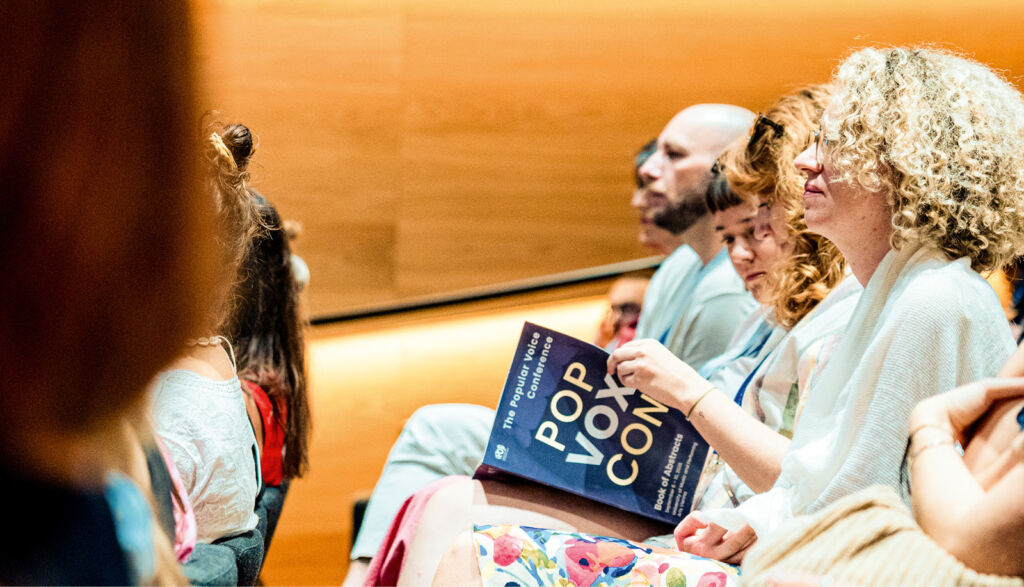
The human voice is so much more than an instrument, and pop is so much more diverse than most people realise. Both of these thoughts were in evidence throughout the three days of PopVoxCon at the mdw in early September, pointing clearly to just how multifaceted the world of the popular singing voice is. Chanda Rule Bernroider’s “Welcoming & Framing” and Patrik Thurner’s “Guided Opening Panel” opened the conference in precisely this vein, introducing those present to its theme and structure while encouraging them to go into the various lectures with open minds and network with their fellow attendees. With an eye to the overarching ideal of lifelong learning, the conference featured opportunities to attend the most varied workshops, keynotes, and concerts—some of which were scheduled in parallel. Offstage and outside the seminar rooms, the sharing of knowledge continued during breaks for coffee and cake that provided abundant opportunities to strike up conversations, exchange experiences, and make new contacts: after all, a room full of people enthusiastic about singing never falls quiet. Chanda Rule’s maxim “talk to somebody new” was also realised in full at the second evening’s PopVoxCon After Hour, with the conversations then giving way to karaoke as the night drew on. A thoroughly successful conclusion of a day devoted fully to the human singing voice. For numerous participants, this conference was a big reunion and/or an initial meeting that transcended national borders—and those who came together here included students, teachers, researchers, and artists.
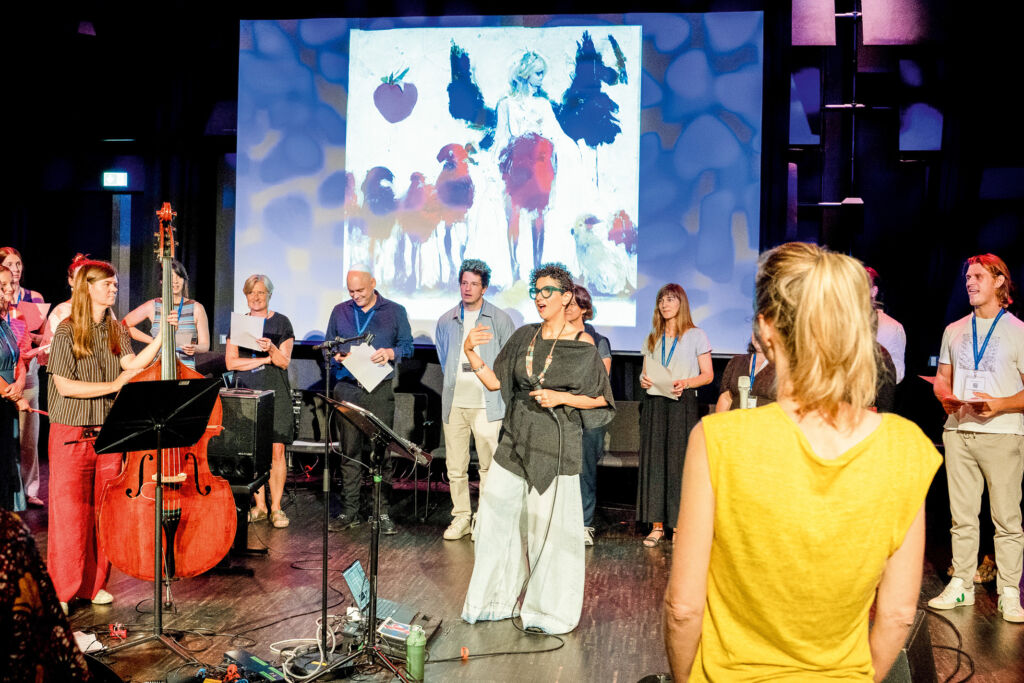
Just how varied the demands made of voice teaching actually are came out clearly in Patrik Thurner’s keynote, as well. His question of just what makes a good pedagogue shone a spotlight on the breadth covered by the necessary knowledge and capabilities. For one thing, a high degree of pedagogical and didactic skill is important. A frequent additional expectation is that teachers themselves be artistically active on a broad basis and thus able to support pupils focused on various styles. And furthermore, the imperative of prioritising pupils’ vocal health entails a need for specialised anatomical knowledge of the voice.
As mentioned, numerous workshops took place simultaneously—and choosing which to attend was accordingly difficult. On the first day, Dena DeRose led the workshop “Phrasing, Interpretation, and Vocal Musicianship in Jazz Singing”. She conveyed approaches to vocal improvisation and highlighted ways to achieve more deliberate phrasing. And in “Belting für Anfänger_innen” [Belting for Beginners], the principle “happy, healthy, yelling” guided an entire roomful of singers as they loudly looked forward to Santa Claus—a playful opportunity to explore one way of building a healthy and sustainable foundation for belting. The workshops were followed by a concert and subsequent artists’ talk given by the duo of Efrat Alony and Beate Wiesinger, who combined their inspiring and fascinating sounds with videos by the artist Carola Schmidt to round out this first day. An especially magical moment here was the two singers’ improvisation together at the end of their concert. The next morning, group singing got the conference back in swing and set the stage for a keynote delivered by Trineice Robinson Martin. Combined with the attendant exchange among colleagues, her keynote was a highlight of the conference.
Wonderful and touching moments were offered by the concert and workshop “Voice as a Tradition, Technique, and Expression: Hindustani Classical Vocal Music Recital” by Ankita Deole Damle (with Keshava Kaarthikeyan accompanying on the tabla). She provided us with insights into ragas’ characteristics and the rules by which they’re governed, going beyond merely explaining traditions, techniques, and expressivity to allow them to be directly heard and experienced.
Day two was topped off by Birte Dalbauer Stokkebæk’s workshop “Mindfulness for Musicians: A Singer’s Story”. Birte told of challenges she has experienced as a singer—experiences that sparked a desire to pass on something positive to other musicians. She then presented content from her book Upbeat! Mindfulness for Musicians. Between themes such as the “inner critic”, she repeatedly introduced self-care exercises—giving rise to a space where mindfulness was not just discussed but also put into immediate practice.
The third and final day opened with a look inward by Louise Traser (interview here), who provided a new perspective on modern voice production techniques from belting to growl. Her keynote offered intriguing medical insights and abundant material for a session of questions and conversation. Sara Simionato demonstrated in her workshop how artificial intelligence can be employed as a tool for vocal improvisation and exploration. By contrast, it was an entirely analogue and direct mode of work that featured in the workshop on “Vocal Painting” led by Lina Kristengård. Here, participants learned the gestures and hand motions of “VOPA” and applied them right away in small groups. They were soon composing, creating, arranging, and conducting music without words and in the moment.
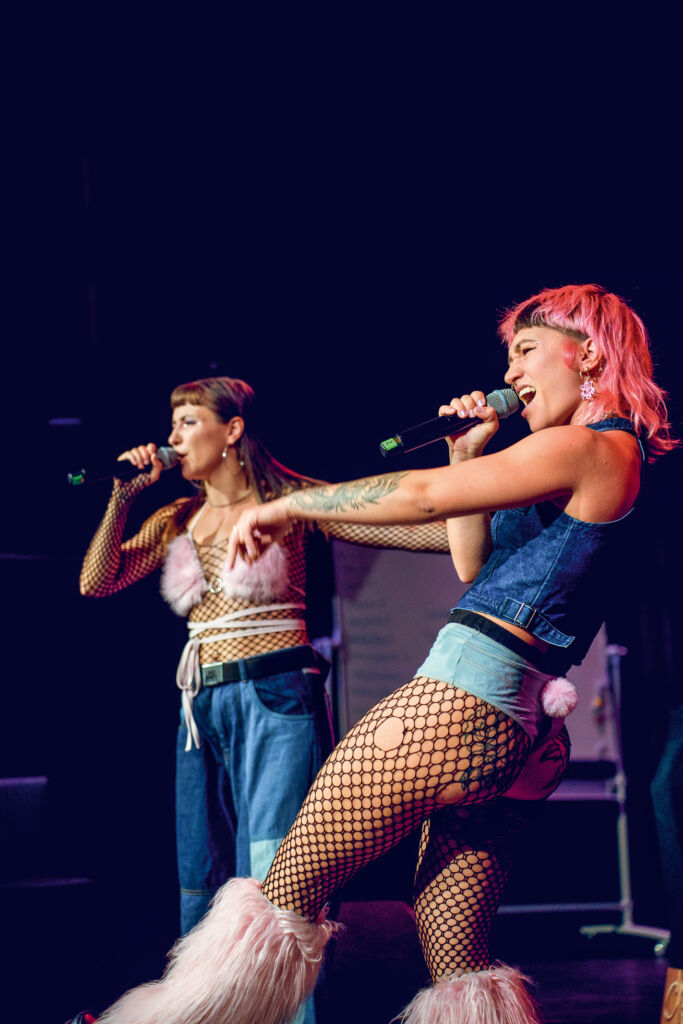
Thereafter, a deep dive into “Rhythm in Motion: Indian Rhythm, Groove & Vocal Expression through the Perspective of Kathak Dance” was offered by Kaveri Sageder in collaboration with Vaishali Panwar and Hemant Panwar. Here, the participants chanted rhythms as well as danced and played them. The resulting performance married various art forms to produce a fascinating overall experience that captivated the participants in an immediate way. Of note here was a special balance between energy and calm and between movement and sound. The final concert was given by the singer and rapper Miss BunPun together with RawCat. Miss BunPun presented songs from her new, self-produced album Cheeky Girl. The duo planted a clearly visible flag for the LGBTQ+ community and FLINTA* persons, with strong hooks and beats as strong symbols of women who don’t back off but instead employ their voices consciously—not just for themselves but for others, as well. A powerful message for a conference that vividly affirmed just how much the voice can be: sound, expression, convergence, resistance, and empowerment.
The conference concluded with creative presentations in small groups that summarised its most important aspects and resulted in something like an outlook on popular voice pedagogy going forward. Space was provided here to exchange, ask questions, and listen—demonstrating once more just what all is possible for music and the voice. Even so, many questions still hung in the air—prominent among them: When’s the next PopVoxCon?