Breath-timed phonation (BTP): three words for an approach that has shaped work with the breath, the voice, and speech for decades and remains a key element of speech training at the Max Reinhardt Seminar.
The voice is among actors’ principal instruments—on stages large and small, on camera, in audio dramas, and in other modes of speaking and performing. But how to develop a free, expressive voice that’s capable of projection? And how can the breath, the body, thoughts, emotions, and language be made to truly mesh? An answer to these questions was searched for around 50 years ago by Professor Horst Coblenzer (who taught voice and speech at the Max Reinhardt Seminar from 1961 to 1995) and the Viennese pulmonologist Franz Muhar. Their collaborative work and scientific studies gave birth to the concept of “breath-timed phonation”, an approach that couples sound production by the human voice with the natural rhythm of the breath.
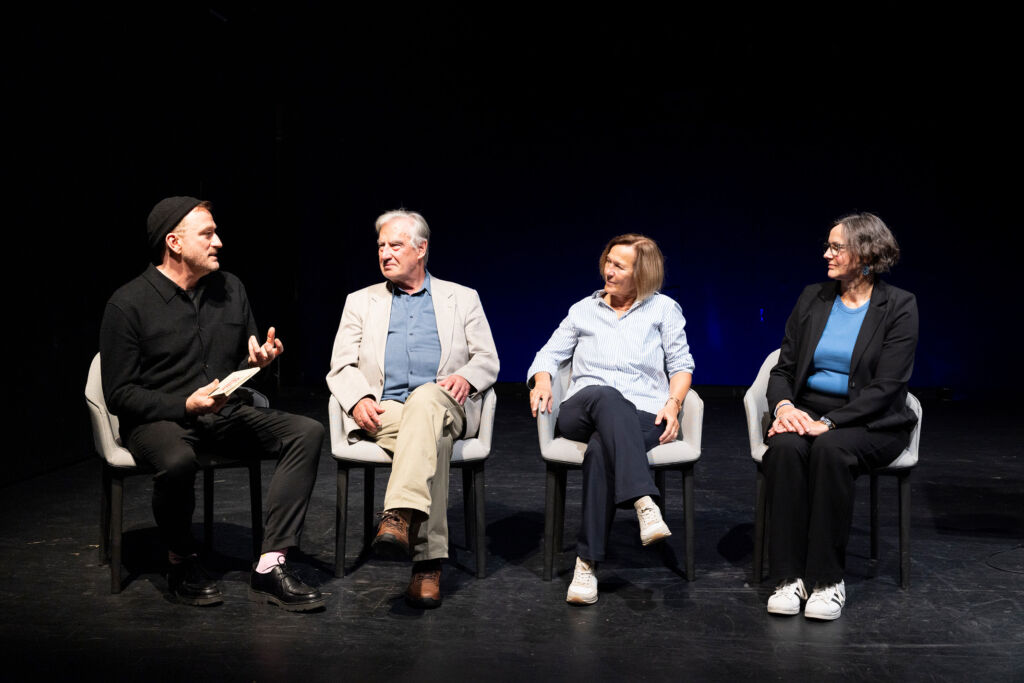
Just how diverse the ways are in which people encounter BTP is demonstrated by four individuals whose biographies as artists and pedagogues it has influenced in an integral way: Franz Muhar’s daughter Sabine Muhar, herself an actor and a long-time professor of speech and speech work; Gerhard Doss, a music and voice teacher at the Private University of Education, Diocese of Linz and a long-time close colleague of Horst Coblenzer; Christa Heilmann, a speech scientist; and Florian Reiners, a professor of voice and speech work at the Max Reinhardt Seminar. To mark the 50th anniversary of Coblenzer and Muhar’s standard work Atem und Stimme [Breath and Voice], Annett Matzke—herself a voice and speech work professor at the Max Reinhardt Seminar—spoke with this group.
Sabine Muhar encountered BTP long before it had a name: “I was still a child back when Horst Coblenzer and my father started collaborating. So I tried out their breath and body exercises in a playful way and learned to interpret the contours of the breath very early on. Lots of it simply went without saying for me. It was only much later that I began to understand the true dimensions of their work.” Gerhard Doss first met Horst Coblenzer at a course given by the latter: “His work immediately drew me into the topic. His way of speaking, most of all, was an object of direct fascination to me. The result was a connection that would last for decades.” Speech scientist Christa Heilmann had not had any access to Coblenzer’s work back when she studied in Halle from 1965 to 1970. “That was the GDR, and the different speech training traditions of the East and the West were largely separate from each other at the time. Only at the end of the 1980s, when I went to work in Marburg, did I encounter Coblenzer’s work in a bigger way—and I found his concept convincing.” Florian Reiners got to know BTP as part of his own training as an actor at the Max Reinhardt Seminar in the early 1990s. “An especially influential factor, in my case, was experiencing Horst Coblenzer himself. Ever since, BTP has been a constant companion: first in my studies, then in my work in theatre and on cinematic productions, and now in my own teaching as a professor of voice and speech work,” says Reiners.
Four biographies, four approaches: one grew up in an environment where this knowledge went virtually without saying, while the other encountered his teacher and mentor; the third discovered the approach coming from a different speech science tradition, and the fourth learned BTP where it first arose as a teaching method: at the Max Reinhardt Seminar. The spoken word, the sung note is carried by the breath. But breathing is not just the physical basis of phonation: it’s also part of physiological, communicative, and emotional processes.
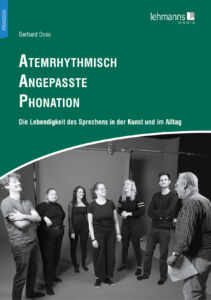
So what exactly is BTP? “To my mind, BTP embodies something like an instinctive programme. Something you can explain anatomically and also experience directly as part of simple experiences with your own body. There’s a linkage between vocal utterances and unconsciously regulated breathing movements,” says Doss. Sabine Muhar adds: “The crucial thing, to my mind, is that this method has succeeded in allowing natural processes involving the breath and the voice to be seen and experienced. Artists have gained a direct understanding of these relationships and become able to apply this understanding in their work.” To Christa Heilmann, the explanation can be found in the name itself: “I orient myself toward the breath and put phonation on top of that. And to my mind, what’s especially important here is the relaxation Coblenzer repeatedly emphasised—because that’s what gives rise to the reflexive replenishing breath. It’s about not deliberately produced, contrived breathing, but an automatic physiological occurrence.” Reiners approaches this issue from the practice of acting: “It’s gestural speech: BTP connects the breath, the voice, the body, thought, and contact. The crucial thing is reflexive breath replenishment. Breath isn’t produced but instead arises from a coherent acting and speaking situation.”
In this, BTP zeros in on a critical aspect of actors’ training—namely, that the voice and language are not viewed separately from acting itself. Breath doesn’t precede thought or stand alongside emotion. It’s part of the process of thinking, perceiving, and communicating.
In Sabine Muhar’s case, its effects are most directly evident in her own artistic practice. As an actor, she’s been able to rely on her voice even in challenging situations. And when she started teaching, she had to translate this knowledge—which she’d acquired quite early in life at an intuitive level—into didactic content that she could convey. In her work with actors and singers, she experiences the connection of thoughts, the arc traced by the breath, and musical phrasing as something essential. To Doss, the method’s effects even go beyond this. He describes BTP as a holistic approach where heightened sensory perception influences the breath, the voice, and language. Art and nature aren’t thought of here as contradictory, he says. Heilmann views the BP concept as very well structured. However, she emphasises one particular aspect that would seem crucial particularly in present-day university teaching: “Students shouldn’t just carry out or imitate exercises. They need to understand just why they’re doing something.” Heilmann remembers how Coblenzer placed the exercises themselves at the centre of his workshops and didn’t necessarily seek to elicit questions as to physiological explanations. Her own students, on the other hand, were used to simultaneously reflecting on their practical doings: What’s happening in a physiological sense? Why does an exercise work? What does it aim to accomplish? These questions are important, she says—because keeping a method alive doesn’t mean preserving it unchanged. “In my teaching,” says Florian Reiners, “BTP has become a foundational principle. It helps put spoken thoughts out into the space without pressure or interference with your interpretation of a role. And that’s something I consider essential: BTP doesn’t dictate a particular aesthetic. It doesn’t say how a person should act or speak. What it does do is provide an instrument that makes possible a highly varied range of aesthetic decisions,” he explains.
Particularly in a drama department whose present-day students are confronted with wildly divergent types of theatre, film, performance, and media formats, all this just might be possessed of a special currency: it’s not a particular sound but the availability of the voice that’s the objective.
BTP is practiced at the Max Reinhardt Seminar as part of a living pedagogical tradition, which begs the question of whether BTP needs to be rethought for the present day. To Doss, BTP stands for achieving and maintaining balance—in art as in everyday life. To Muhar, it’s part of a body of knowledge around natural breathing and vocalisation processes. To Heilmann, it’s a convincing basic concept that needs new empirical and physiological support so as to not disappear. And Reiners, as well, voices his support for continued efforts to research, verify, and convey BTP, in the process associating it with present-day findings from the realms of voice science, medicine, and acting pedagogy.
Fifty years after BTP’s development, the question is less one of whether it should be preserved than about how it can be carried forward. And against this backdrop, the enduring importance of BTP perhaps lies in how it brings together things that are inseparable in acting to begin with: the body, thought, the breath, the voice, emotion, perception, and contact.