In recent issues of mdw Magazine, we’ve introduced the areas of Music Education (as a school teaching subject) and Music Education for Voice and Instruments at the mdw’s Department of Music Education Research and Practice (IMP). We now turn our attention to Elemental Music Education (EMp), which seeks first and foremost to interlink various forms of expression and various art forms in shared music-making situations—hence reaching into diverse areas of musical and creative activity.
Overture
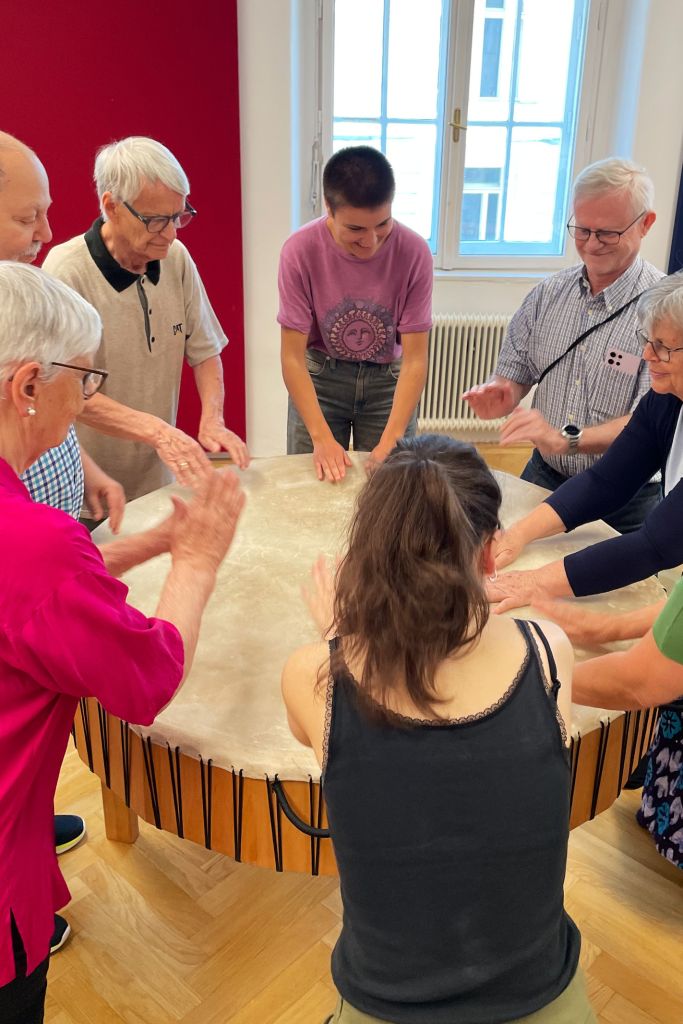
At the mdw, EMp can look back upon over 40 years of history as an artistic and pedagogical discipline. Particularly in recent years, the relevant practice and research have expanded thanks to dialogue with various groups. The associated range of activities extends from courses for seniors and band offerings for adolescents to child-parent courses, instrumental courses focused on violin, guitar, piano, and wind instruments, and the inclusive band project “Young All Stars” as well as cooperative efforts between EMp teachers and schools and music-making courses for professionals—to mention just a few of the practical teaching formats offered by the mdw’s “Viennese EMp” team. These areas of activity were demonstrated in all their abundance by the symposium held to mark “40 Years of EMp at the mdw” in 2024. Moreover, a poster exhibition centred on Lothringerstraße and extending onto the mdw Campus featured a wide range of practical work and research projects.
EMp at the Interface between Art, Practice, and Research
Practice-based experiential knowledge is a frequent focus of EMp. Where empirical research is concerned, measurability and operationalisation prove to be complex in a field that favours body-oriented strategies, multi-sensory approaches, individual experience, learning in the creative arena of the group, and independent searches for and exploration of sound. Numerous colleagues have taken on this challenge, engaging with processes of musical development and maturation. Veronika Kinsky devotes herself to formats including picture book hours, in which context she examines picture books’ potentials in terms of instructional dramaturgy. The empirical and qualitative dissertation project of Katharina Ruf deals with improvisatory approaches in musical work with people of advanced age. Julia Auer pursues research themed on “What remains after the lesson”, including exploration of free musical play by primary school children following elemental music-making sessions. Werner Rohrer, in an empirical and quantitative study on Elemental Musical Abilities, has investigated the effects of EMp interventions on children’s levels of musical achievement. He finds that even a small number of interventions by experienced and qualified elemental music educators can lead to significant increases in such achievement. His own dissertation, which underlines the significance of creative musical enrichment at preschools and primary schools, is available via pub.mdw as an open access publication. Ruth Schneidewind’s engagement with The Reality of Elemental Music-Making now numbers among the standard works on the topic within the scientific community and is being continually elaborated upon by colleagues from the field. What’s more, multiple faculty members are currently investigating the employment of language in the teaching processes that play out in child-parent courses.
#FutureEMp at the mdw
The past two decades have seen EMp, as an established practical artistic and pedagogical area of study, be perceived increasingly in terms of its research component within the context of the mdw’s music education programmes. In this spirit, the mdw also recently created a tenure-track professorship that facilitates relevant research projects in this specific discipline. Going forward, the emphasis here will be on the question of what rewarding approaches to practicing can be derived from elementary music-making to the benefit of musical and instrumental instruction at large.
The EMp team’s active involvement in the Erasmus+ Cooperation Partnership project CC-ECME (Co-Connecting Early Childhood Music Education) represents a further important research-based contribution. Central here is the shared vision that every child in Europe should receive access to high-quality music education offerings independent of their socioeconomic or cultural backgrounds and regardless of where they grow up.
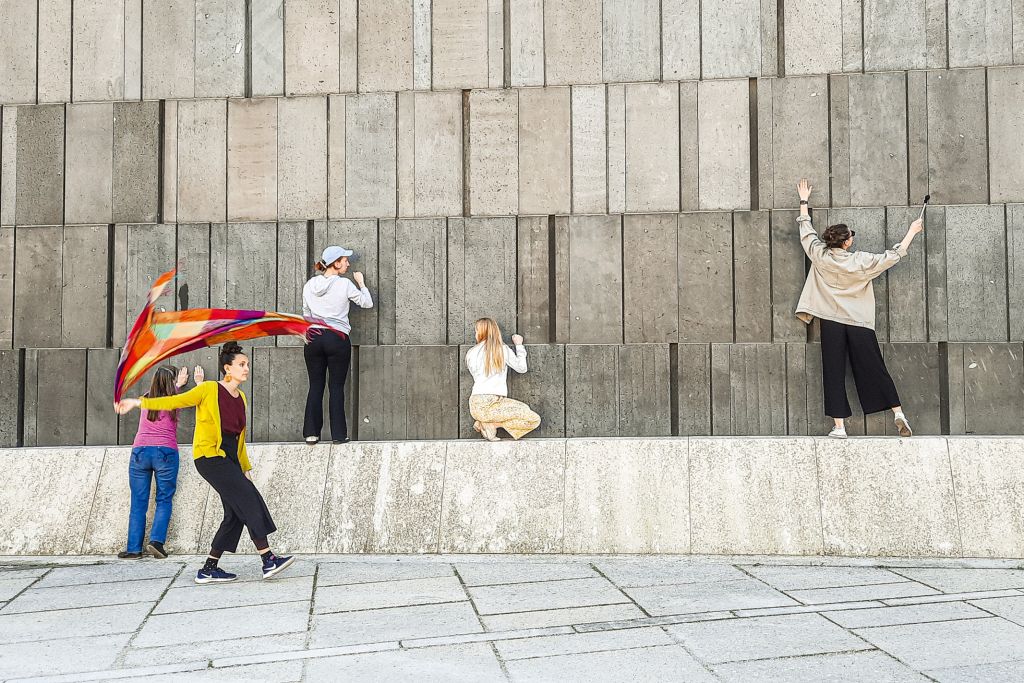
In 2028, we’ll be turning our collective gaze toward the future: an EMp symposium is now being planned that will focus on inter- and transdisciplinary approaches as well as on the connection between music and other arts and forms of expression as “interartistic music practice” in the context of current developments and tendencies.
The Viennese EMp team is now promoting “interartistic music practice” as an internationally comprehensible term that denotes elemental music-making as an artistic approach. At its core is the interdisciplinary interplay between music, movement, language, and forms of expression both dramatic and visual. Such interplay provides a basis upon which to stimulate creative processes and provide artistic developmental opportunities to people of all ages and levels of experience. And against this backdrop, “Interartistic Music Practice/Elemental Music-Making” has been anchored as one of four available profiles in the artistic and academic master’s degree programme Contemporary Arts Practice (CAP).
Reprise
The mdw’s EMp team aims to connect research findings and artistic practice, in the process pioneering concepts for inclusive, participative, and societally relevant practices of music-making. And together with the other areas of study situated at IMP, other mdw departments, and collaborations that reach beyond our institution, we’re helping to further develop the potential of innovative music education.