Elemental Music Education (EMp) head Veronika Kinsky and rhythmist Monika Mayr, a senior lecturer at the Department of Music and Movement Education/Rhythmics and Music Physiology, discuss the relevance of music and movement at every age and the impulses that the mdw can offer in this respect.
Music and movement as lifelong companions. What’s the significance of this idea to each of you?
Veronika Kinsky (VK): The combination of music and movement—at all ages—embodies something that I feel is vital in many respects. I view it as part of our right to free artistic expression, but also as an enrichment of life in terms of our bodies, souls, and minds. With music and movement, lifelong learning is possible, makes sense, and has meaning.
Monika Mayr (MM): To me, the right to music and movement is a highly significant point in our lives. Music supports us in our emotional, physical, and psychological existence and nourishes our individual and collective identities.
VK: Unfortunately, these realms of experience are becoming impoverished amidst the digitalisation we see in our present-day reality. It’s now frequently the case that even very young children spend too much time in front of phones instead of moving around in nature or singing together with their parents. And with the cuts to educational and movement-related offerings that we’re also seeing, our job is to make sure these areas don’t get neglected.
The combination of music and movement—at all ages—embodies something that I feel is vital in many respects.
Veronika Kinsky
How do you think elemental music education and music and movement education can counter this development?
VK: Both music and movement education/rhythmics and elemental music education work with the close connection between music and movement while also nourishing the ability to perceive things by way of the senses. This approach needs to form the foundation of young people’s learning, which will ideally equip them to handle digital media later on.
MM: Media are all around us, and we need to try to use them in ways that make sense. As a rhythmist, I can create synergies with media competence content and associate the overall theme with people’s own bodily and sensory experiences.
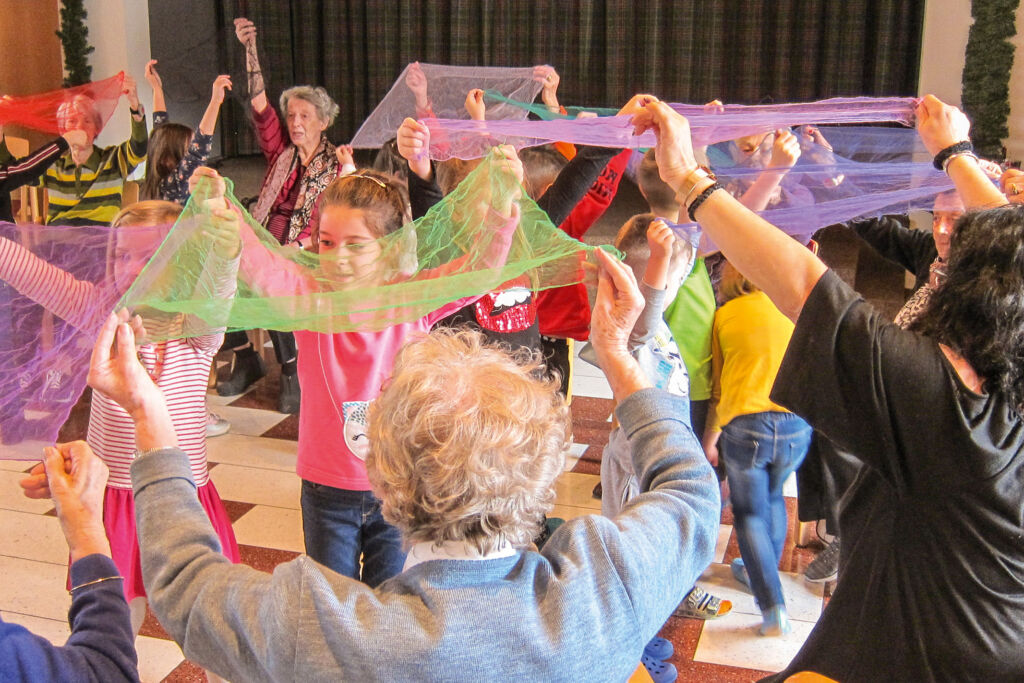
How can children be introduced to such offerings?
VK: Possible ways include through elemental music educators at music schools and through early childhood educators. And in this light, it’s especially important that the latter group be schooled thoroughly in these areas as part of their studies so that they’ll be able to incorporate what they’ve learned into their everyday teaching.
MM: In our fields, we have multipliers who do valuable work in this regard and share their special expertise through projects and professional development offerings. Moreover, rhythmics is now a compulsory subject at institutions that train early childhood educators—which is something that sets Austria apart.
What training does the mdw offer in this area?
VK: Students can choose elemental music education as a specialisation and take advantage of practice teaching, other artistic and pedagogical coursework, and scholarly courses to gather experience that they can bring to bear later on in their own fields of activity. Another avenue is that of professional development opportunities for people who already work in educational and social fields—people like early childhood educators and primary school teachers as well as elder care professionals and youth workers. And those who do our Contemporary Arts Practice (CAP) MA programme can choose the profile “Interartistic Music Practice/Elemental Music-Making” in order to enhance their own artistic, artistically integrative, and mediatory competencies.
MM: Once you’ve completed the BA in Rhythmics, you hold teaching certification as a music and movement educator. What’s important in light of this profession’s broad orientation is the diverse range of practical courses oriented toward engaging with all age groups—courses that put students in a position to pursue high-quality work in the various areas later on.
Creativity doesn’t grow old, and emotions don’t develop dementia.
Monika Mayr
You mentioned practice teaching. In what areas can students obtain teaching experience?
MM: For our practice teaching, we’ve set up a learning model that has students step out of the high culture of higher education and encounter other societal groups. The groups at issue are ones that we’re unable to integrate here at the mdw, which is why internships during one’s studies are so very important. We visit centres for seniors, young people, and daytime care as well as women’s groups, and we also do sessions at housing facilities for people with migratory backgrounds. An important aspect here is to provide students with the appropriate support and supervision in our capacity as teachers.
VK: We view it as our responsibility to reach out into societally relevant areas. So we deliberately seek out appropriate cooperating partners, and we also take up suggestions that come from students.
The average age in our society is constantly rising, with new fields of work emerging as a result. How can the mdw react to this demographic shift?
MM: Hardly anyone is thinking about how people at advanced ages have a right to music and movement in the sense of sociocultural participation. I’d therefore like to see even more offerings on this theme at the mdw, above all because we see wonderful professional opportunities for our graduates opening up here. We already have compulsory courses on the topic like “Introduction to Rhythmics in Geragogy” as well as the free elective “Music Geragogy”. For former mdw employees, we’ve developed the mdwPlus format. And we’d also like to set up professional development offerings that are open to people from various other disciplines—like social work with the elderly.
How can music and movement provide enrichment to people from the various age groups?
VK: Art for art’s sake is a human right at any age, and our need for artistic expression has its own intrinsic weight. Moreover, music and movement help us keep physically fit and also train our memories. Even just in terms of fall prevention, their contribution is valuable. And since older people often suffer from loneliness, the sense of community that arises as a result is likewise profoundly beneficial. Singing and dancing together causes an endorphin release that benefits mood, promotes relaxation, and helps relieve pain.
MM: It imbues life with meaning, which is something we desire over our entire lifespan. Creativity doesn’t grow old, and emotions don’t develop dementia. One’s age—be it two or 102—makes no difference. It’s about the powerful resources that human beings can tap into by being present in the here and now, discovering their expressive potentials through music and movement and experiencing joy as they do so.
We view it as our responsibility to reach out into societally relevant areas.
Veronika Kinsky
What traits should one ideally bring to the table if one’s interested in pursuing studies in these areas?
VK: Willingness to grow artistically and as an educator, a fondness for working together with people, and above all openness—not least to relationship-oriented interaction on an equal footing—as well as spontaneity and flexibility.
MM: And some stress tolerance, since our students are confronted with people who have special needs. Another important quality is artistic excellence in terms of music and movement, which our field’s university-level status requires. After all, we send our graduates out into the professional world as qualified specialists. And this is why we also have to keep at our efforts to establish the corresponding professions, because right now—especially, for instance, in the area of music and rhythmics geragogy (music and movement activities involving older people)—lots of work is currently being done on a volunteer basis.
In what professional fields can one work as a graduate?
VK: EMp practitioners still work mainly at music schools, with cooperative arrangements with primary schools being the second most important format. And our graduates also find employment in nursing care and at retirement homes as well as in youth work and leisure pedagogy, inclusion-related work, and further education offerings at places such as adult education centres.
MM: I like to distinguish between institution-based work and freelance activities in the independent scene. What’s more, our graduates are telling us about additional fields of work that are now opening up—like activities at rehabilitation centres or early childhood intervention programmes. And yet another important theme for us is inclusion. We need to address all of these developments in the training we offer and integrate them more strongly. Also, one thing we’re currently observing is how our graduates often burn out after a fairly short period and then go looking for new fields of work. In light of this, we need to think about how we can prepare students even better while they’re studying with us. And our professional field will only become truly broad if we provide additional qualifications that serve to build up new areas. For instance, I did a university-level certificate in music geragogy and now work as a music geragogue, as well—which is how new professional fields get opened up.
We’ve touched on work with children (pedagogy) and seniors (geragogy). So how do things look in adult education?
MM: Adults often find themselves in the midst of stressful working lives—and here, we can create offerings that provide some balance. Things like spaces of artistic creativity where everyone who turns out can express themselves individually. And in our field of rhythmics, the opportunity to come together with people who hail from very different places, cultures, and occupations—differences that become less salient in such moments—represents a special kind of added value.
Our professional field will only become truly broad if we provide additional qualifications that serve to build up new areas.
Monika Mayr
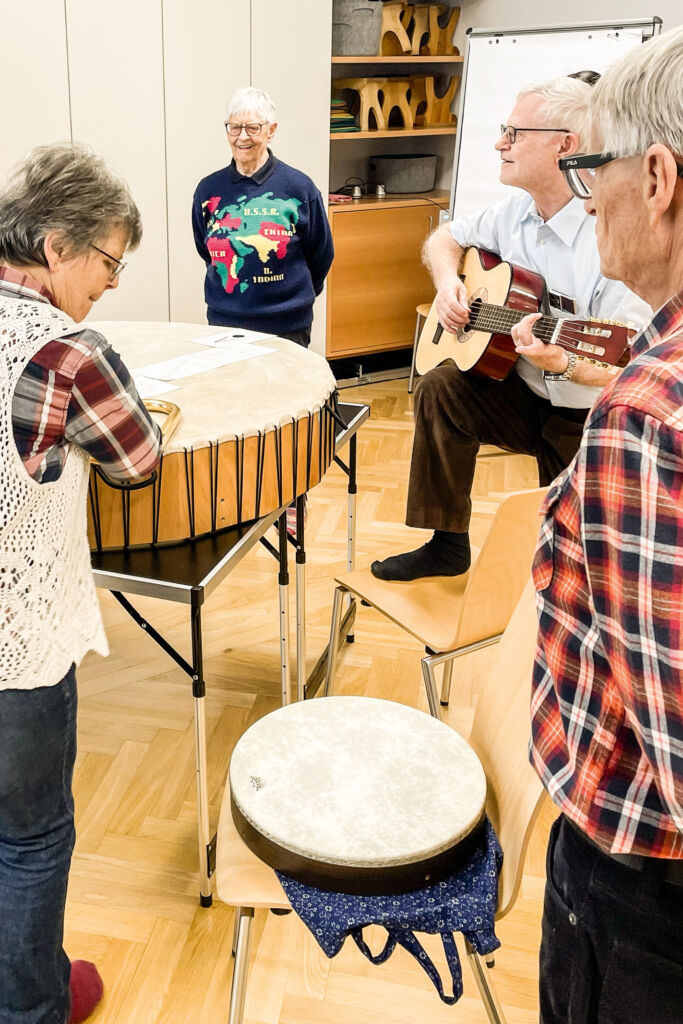
At what kinds of places would I find such offerings for adults?
VK: These tend to be found at publicly run adult education centres, concert venues, and other cultural and educational institutions. Vienna’s music schools, for their part, serve children and adolescents—but we would, of course, like to see them be open to all age groups and for that work to receive public funding like it does in the other provinces. By the same token, some adults might not necessarily want to go to a school, instead preferring an open music-making or dancing venue. And here, collaboratively run cultural centres come to mind: those are wonderful places for all age groups that also make intergenerational formats possible.
For everyone whose curiosity has now been piqued: Can you point to any concrete examples? And where can people get informed?
MM: The Centre for Creative Ageing and Inclusive Arts is a broad-based information portal that lists course offerings as well as various materials and articles on the topic. And a further source of information is the German Society for Music Geragogy, which also reports on new projects in this area.
VK: Above and beyond our own extra-occupational special university programme “Elemental Music-Making”, I’d also mention two courses that we offer here at the mdw’s Center for Elemental Music-Making (Zentrum Elementares Musizieren). “Klangwelt ab 65” [World of Sound, 65 and Up] is for people aged 65 and older and centres on creating and experiencing music and the joy of making music together. “Musik neu erleben – für Erwachsene” [Experiencing Music Anew – For Adults] playfully introduces everyone aged 18 and up to musical adventures—with no pressure to perform. And we also offer courses for families where kids and grown-ups can make music together.