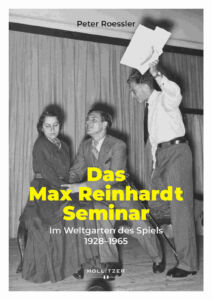
Peter Roessler, Das Max Reinhardt Seminar. Im Weltgarten des Spiels. 1928–1965, Hollitzer Verlag, Vienna 2025, 767 pages.
That a seminar for acting and directing should be named for a founder who was seldom present at his own institution is a truly remarkable circumstance. Just why this is not a contradiction and just how Max Reinhardt managed to make precisely this acting school into one of the German-speaking region’s most illustrious can now be learned—along with numerous other intriguing details—from a new book by Peter Roessler.
To state it upfront: this publication is an enormous boon. On its over 750 pages, the author—who knows this institution first-hand from his work as a professor of dramaturgy—sets out to relate the Max Reinhardt Seminar’s complex history. Such an undertaking is anything but easy. As the author himself notes, it entails “both painting with a broad brush and zeroing in on specific details and occurrences” (p. 13). However, Roessler succeeds in the best possible way!
Between its preface and its concluding outlook, this volume is divided into seven chronologically ordered sections that leave virtually no question unaddressed. Though its structure is determined by the historical framework, Roessler also delves deep into the Seminar’s teaching content and portrays its everyday artistic doings. Each chapter hence contains a description of the respective productions, alongside which informative biographical sketches serve to highlight the most important protagonists. And the book’s appendix, finally, leaves nothing to be desired, with its list of all students up to the present day—extremely valuable for prosopographic research—deserving special note.
Max Reinhardt, who was regarded as one of the foremost theatre-makers of his day, must have evoked an incredible degree of fascination. And indeed, the close interplay between acting and directing that is reflected even in the school’s name represented a true breakthrough vis-à-vis that era’s legacy theatrical training. The very name Reinhardt “could open doors that would have otherwise remained shut” (p. 55). Roessler lays out quite impressively how the Seminar made use of its prominent founder’s aura, especially in its initial phase. But even so, it was threatened with closure just a few years after its establishment in 1928 as part of what is now the mdw—a fate that was avoided by continuing as a private institute.
The fact that, after this brief private intermezzo, the Seminar was reintegrated into the mdw by the National Socialist leadership just as its proscribed founder was forced to flee to American exile (where he would die) is emblematic of its turbulent and dark history. In recounting this sequence of events, Roessler chillingly describes the internal machinations of power—how, for instance, the former student Hans Niederführ rose first to become “seminar warden”, next its secretary, and then its “authorised representative”, after which he assumed its definitive leadership in one fell swoop following Austria’s annexation by Nazi Germany. While the rarity of Reinhardt’s presence at the Seminar had previously given cause for criticism, his role was now framed as having been “purely superficial” and “merely formal” (p. 317). Niederführ would go on to remove numerous artistically impactful personalities of the Seminar’s early years, several of whom subsequently fell victim to the National Socialists’ machinery of annihilation.
Roessler continues with a knowledgeable description of how the Seminar, upon its post-war reopening, conjured up the suggestion of unbroken, harmonious continuity in an attempt to hark back to old times. It was in this spirit that the school’s lenient de-Nazification process played out in keeping with its self-definition as an institution “untouched by the course of time” where political views had never had a place to begin with (p. 513). The name of the founder, now restored to his old glory by Austrian officialdom, was made an official part of the Seminar’s own name in a display of reverence toward his person and his artistic ideals. But for the most part, the return of its displaced teachers ultimately failed to take place.
In 1948, Reinhardt’s widow Helene Thimig was engaged as the Seminar’s new head. However, even her case is indicative of the problematic relationship between artistic and administrative responsibilities. Just how the Seminar’s Nazi-era head Hans Niederführ then succeeded in returning to the Seminar to provide its new head with administrative support under these circumstances is both troubling and baffling—a twist that Roessler recounts in a most fascinating way. Niederführ, who subsequently succeeded in making himself seem indispensable, would once again assume leadership of the Seminar following Thimig’s retirement.
Roessler leaves virtually no aspect unaddressed—and even fresh off the press, his book can already be considered a standard work on the history of the Max Reinhardt Seminar. An absolute pleasure to read!