Katharina Bleier, extended piano techniques. Perspektiven 1981–2018, Dresden: musiconn.publish, 2025
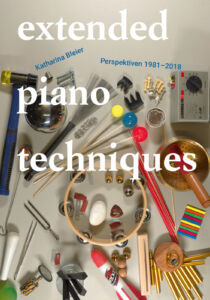
When looking beyond the piano’s 88 keys and approaching the instrument’s interior, which is often overlooked by pianists and traditionally more the domain of tuners and technicians, a rich sonic world opens up. Katharina Bleier’s Extended Piano Techniques is an extensive volume totalling nearly four hundred pages that offers a broad and well-structured reflection on non-conventional pianistic practices.
This book addresses both contemporary music specialists and pianists approaching extended techniques for the first time. Musicological and historical research coexist here with practical performance considerations, a balance made possible by the author’s dual profile as a musicologist and concert pianist. Extended techniques are presented not as mere effects or purely experimental gestures but as intentional compositional practices embedded within a broader historical and stylistic continuity.
This volume’s division into independent chapters is of great advantage to the reader, easing orientation and significantly enhancing its readability. Of particularly note is a dedicated historical section that shows how numerous composers had already engaged with these techniques in earlier centuries—thereby challenging the notion that extended piano techniques represent exclusively 20th- and 21st-century phenomena.
Discussion of specific composers and works focuses primarily on the period between 1981 and 2018 while also consistently pointing to earlier and later repertoire, thus encouraging further exploration. These analyses allow for detailed examination of differing approaches to extended techniques, while an especially practical bonus here is the inclusion of video materials that can be accessed via QR codes.
Alongside its focus on sound and instrumental technique, the book also addresses gestural and performative aspects of execution with an eye to the relationship between the performer’s actions and the sonic perception as part of extended pianistic practice.
The range of composers discussed is stylistically diverse and extends from figures like George Crumb to members of younger generations such as Maurizio Azzan, who explores the piano’s string bed and the audience’s auditory perception by way of non-conventional techniques.
The extensive repertoire list included in the book’s final section deserves special mention. Clearly categorised and based on thorough analysis of the respective scores, it brings together works in which extended techniques see varying degrees of use.
In a constantly evolving field, this volume by Katharina Bleier claims its place as an authoritative reference work—offering both practical orientation and a solid overview of the piano beyond the keyboard.