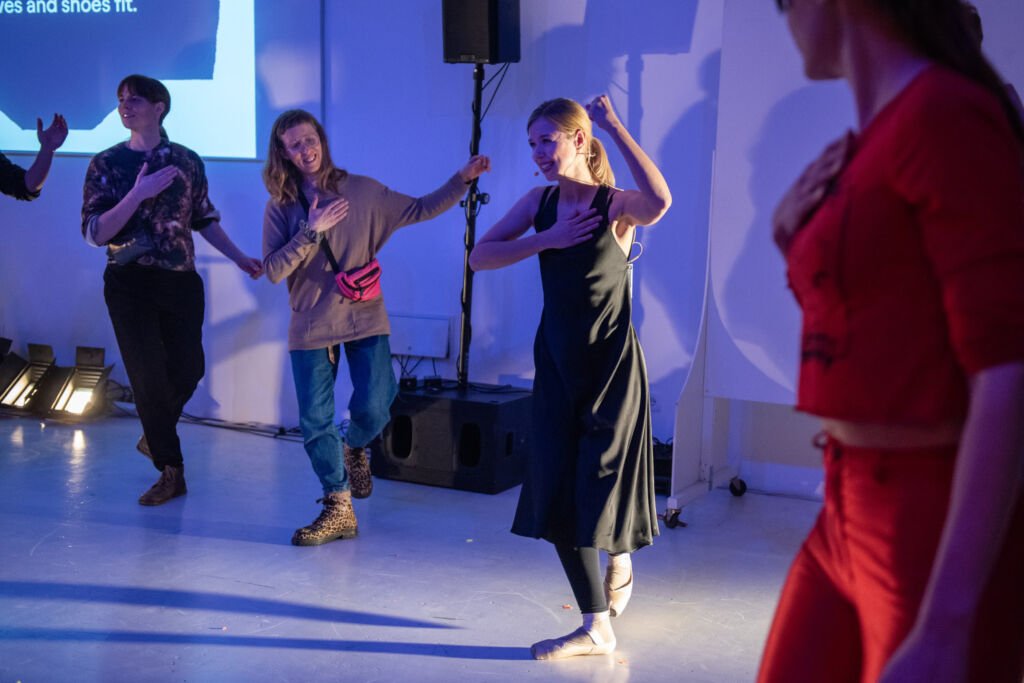
What if questions of social justice could take tangible shape in our own bodies such that we could discuss complex political issues without relying primarily on words? In an era in which disembodied content consumption continues to polarise much of the Western world, my PhD project explores a different mode of collective sense-making: a performative and educational musical theatre practice for adults not necessarily trained in either dance or music. The question here is not whether such a practice is possible, but how it can be systematically observed and understood. How could it function as a form of aesthetic mediation—onstage, in a gymnasium, or at an academic conference? And what conditions would enable such inclusive and embodied co-creation of knowledge? As a dancer and community art choreographer, I’ve had the privilege of accessing musical theatre training at the heart of the genre in New York City. Much like most Broadway musicals, the class “combos” I experienced in the studios there set social theories in motion—conveying histories of resistance and unequal power relations. Through rhythm, voice, gesture, sweat, spatial organisation, and ensemble constellations, everyone in the room appeared to attune to a new sense of normativity.
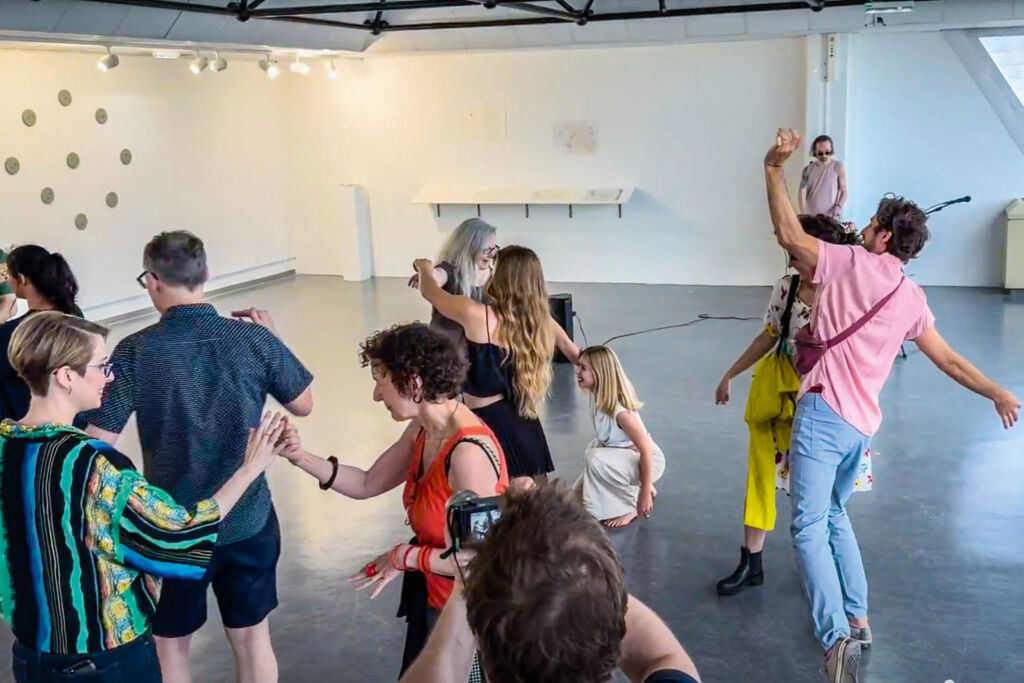
For my dissertation, I am developing the concept of choreomusicking: a choreographic and “choric” (from choir/chorus) expansion of musicking as a social act of civic imagination. Drawing upon interdisciplinary scholarship spanning aesthetic mediation, social cognition, and queer theory, I explore ways in which such practices can mediate how socially critical perceptions are produced and negotiated in an embodied and participatory art setting. What matters to me is queering the performer/audience divide and transposing this experience to public spaces—going beyond healing (or even just “integrating”) already marginalised groups to also create spaces for adults who escape attention while holding the privileges to vote, fund, defund, other, or include. This so-called silent majority often remains a blind spot despite being a decisive terrain for socially transformative mediation practices.
Methodologically, this research is grounded in critical and performative ethnography. It aims not to directly measure participants’ transformation but to understand the practice itself. Musical theatre jazz dance is chosen here not for its razzle-dazzle but for its deep entanglement with histories of oppression and for its heartbeat—the ensemble, the chorus line—which holds space and story together as a collective. I come to this work with a background in both performing arts and strategic communication. From my experience countering pro-Kremlin propaganda, right-wing disinformation, fossil fuel lobbying campaigns, and misogynist manosphere content, I know that more information alone will not do the job. This research is an attempt to think differently about how our humanity is negotiated—not through disembodied knowledge transmission, but through relational, participatory, situated, and ethical aesthetic mediation.
Perhaps it won’t be that difficult after all to deconstruct the patriarchy—one shimmy at a time.