The Music and Minorities Research Center of the University of Music and Performing Arts Vienna is currently hosting the research project “Sounds of Trauma: Naga Song Responses to Political Conflict” led by Christian Poske and funded by an ESPRIT research grant of the Austrian Science Fund. It began in August 2024 and is slated to run through July 2027.
How does music become a vehicle for communicating suppressed political views and for processing traumas from colonial and postcolonial conflicts marked by excessive military violence? And how have songs aided the efforts of an Indigenous people to establish a nation-state whose intended boundaries conflict with those left behind by the British Empire? Examining these questions in light of the example of the Naga people, a cluster of culturally diverse communities inhabiting parts of Northeast India and northern Myanmar, this three-year project is pursuing its inquiry from a novel interdisciplinary perspective that combines ethnomusicology, oral history, trauma studies, and postcolonial studies. Drawing on the theoretical framework of Indigenous historical trauma (Evans-Campbell 2008), the study examines how individuals and social groups from various Naga communities have thematised in their music the cumulative impacts of colonial and postcolonial political and military conflicts in their homelands since the mid-19th century. With its focus on ethnographic fieldwork, content analysis of online sources, and textual and musical analysis of compositions as research methods, this project also includes the Highland Institute (an independent research institute in Nagaland) and the film team TakeOne Nagaland as project partners. Project outputs are to include a monograph, a video documentary, and a collection of field recordings of song performances and interviews, to be preserved at the Department of Folk Music Research and Ethnomusicology of the University of Music and Performing Arts Vienna as well as at the Highland Institute.
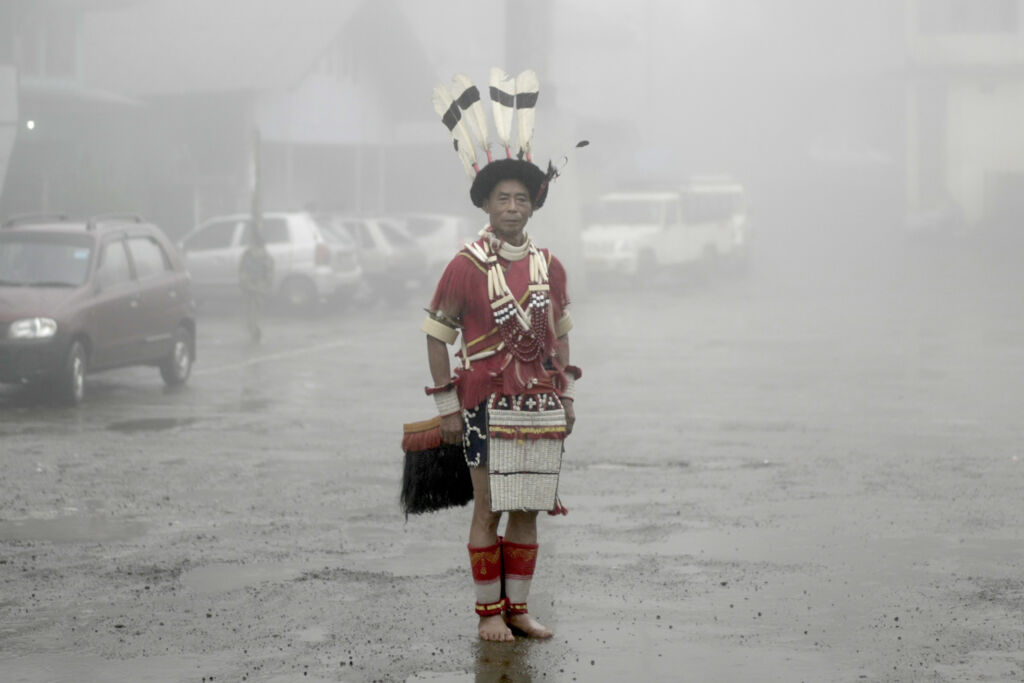
Due to the highly volatile situation in northern Myanmar, where armed conflict between the military regime and various resistance groups is ongoing, the project’s fieldwork is limited to Nagaland and the adjacent states of Manipur, Assam, and Arunachal Pradesh in Northeast India. This region has also seen decades of civil unrest involving various nationalist and separatist factions seeking to establish an independent and sovereign Naga state, but ceasefire and peace agreements have significantly cooled down the conflict on the Indian side of the border over the past 20 years. Nonetheless, conducting ethnographic research remains a challenging task for Western academics—not only because of the difficulties in bridging cultural and language barriers to establish rapport with local interlocutors and resource persons, but also due to increased vigilance by state actors seeking to control flows of information within and beyond international borders. It was thus that the Government of India changed travel regulations for Nagaland and other regions of Northeast India in late 2024, necessitating adjustments to the project’s fieldwork schedule.
The project involves connecting with well-established artists and less-known performers to document their songs pertaining to the political history of Nagaland and surrounding regions as well as the life stories from which they emerged, including direct and indirect experiences of military encounters that have often entailed individual and collective mental suffering as well as intergenerational trauma. Studying such phenomena requires special sensitivity when asking individuals to talk about drastic events and the ways in which they and their communities have responded to prolonged armed conflict psychologically and through their artistic expressions.

In this sense, studying musical responses to political and military conflict is “a kind of applied ethnomusicology because it is about documenting, interpreting, and making ethically accessible experiences and lifeworks that otherwise would pass from the historical record” (Pilzer 2015, 482). It is consequently tempting to regard such research initiatives as a service to the communities whose conflict experiences and musical expressions are being studied. Even so, the approach of trying to listen to and learn from them is more fruitful than attempting to “help” them—which entails the risk of falling into paternalistic thought patterns. This approach also helps bridge the cultural and social divides that inevitably come to the fore when a musicologist of German origin, having received a prestigious research award entailing employment at a privileged Austrian institution of higher education, studies the musical forms of expression of an Indigenous community in a conflict-ridden region of the Global South. Self-reflection and the willingness to reflect upon issues of positionality and privilege are crucial tools when it comes to perceiving and responding to such issues. The Music and Minorities Research Center underscores the need to recognise power imbalances and hidden hegemonies embedded in research design and was hence a natural choice as a home institution at which to base the realisation of this project, where the principal investigator is less concerned with gaining prestige than with making a meaningful contribution to ethnomusicological scholarship and carrying out his research in a socially responsible and culturally sustainable way.
References
Evans-Campbell, Teresa. 2008. “Historical Trauma in American Indian/Native Alaska Communities: A Multilevel Framework for Exploring Impacts on Individuals, Families, and Communities.” Journal of Interpersonal Violence 23 (3): 316–38. https://doi.org/10.1177/0886260507312290.
Pilzer, Joshua D. 2015. “The Study of Survivors’ Music.” In The Oxford Handbook of Applied Ethnomusicology, edited by Svanibor Pettan and Jeff Todd Titon. Oxford University Press. https://doi.org/10.1093/oxfordhb/9780199351701.013.17.