Magdalena Fürnkranz, Juri Giannini (eds.), “Yugoslav Disco. Digging into an ‘Excluded’ Musical Culture of Late Socialism”, vol. 10, nos. 1–2 (2024), TheMA – Open Access Research Journal for Theatre, Music, Arts, 2024.
When one thinks of the popular music of Yugoslavia, it’s frequently that country’s well-researched rock and punk music that come to mind—genres that are ascribed a political and subversive character. Disco, in contrast, has been viewed as apolitical and commercial and hence received commensurately less attention. It is with the comparatively little-researched area of Yugoslav disco that this special issue of the open-access journal TheMA therefore deals. Edited by Magdalena Fürnkranz and Juri Giannini, the issue contains three articles that approach various facets of Yugoslav disco and culture in a transdisciplinary manner.
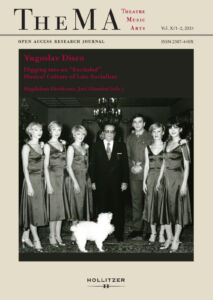
In their own contribution, Fürnkranz and Giannini deal with the transfer and transformation of disco between West and East. Taking three different songs as their examples, they examine how music by models such as Boney M. and Donna Summer as well as from the musical Hair was adopted and transformed by Yugoslav groups. The second article, by Adriana Sabo, features an intriguing examination of the production of sexuality and femininity in the Yugoslav disco scene, taking the band Lokice as an exemplary case. The ways in which feminine corporeality and heterosexuality or “heterosexiness” were produced and portrayed by Lokice adhered to and perpetuated a norm based on what was then the accepted body image in the music market. Sabo also points out in this article just how the female body was perceived in Yugoslav disco culture. In the third contribution, Tanja Petrović devotes critical scrutiny to the concept of “Yugonostalgia”—the nostalgia for socialism in former Yugoslavia. Petrović examines how Yugonostalgia selects fragments of the socialist past and appeals for more reflected engagement therewith. The issue’s three articles are joined by interviews with two important individuals from the disco scene conducted by Marko Zubak.
This collection of writings offers fascinating glimpses into the most varied facets of Yugoslav disco. Thanks to the differing theoretical approaches taken here as well as to the interviews, one attains a wide-ranging impression and understanding of a theme whose appearances in the broader research are rare indeed. Likewise deserving of special praise are the playlists (linked as QR codes) that accompany several of the articles. These provide an easy way for readers to immerse themselves in Yugoslav disco on the auditory level, rounding out what amounts to an eminently worthwhile reading and listening experience.