Impressions from the 2025 Bogotá International Classical Music Festival
Music reflects the environment from which it comes. 19th-century symphonies from the German-speaking region, for instance, are characterised by highly structured forms, rich harmony, and a continuity of musical traditions. 20th-century music from Latin America, on the other hand, grew out of an entirely different reality: vast, untamed landscapes, rapidly growing cities, political conflicts, and identities fed by indigenous, African, and European heritage.
This year’s Bogotá International Classical Music Festival revolved around 20th- and 21st-century music from North, Central, and South America. I was there as an audience member and as a performer—with a solo programme that included works by Paul Desenne, Roberto Sierra, and Leonard Bernstein as well as a composition of my own. Many of the composers from the featured continents trained in Europe—above all in Paris. Once returned home, however, they proceeded to develop their own musical languages: rhythmically complex, harmonically diverse, and often politically charged. The festival’s programme showed impressively how European heritage was transformed in America, with a highlight in this respect being the performance of Villa-Lobos’s Symphony No. 6 by the Orquestra Sinfônica do Estado de São Paulo. This composition, which translates the silhouettes of Brazilian mountains into musical lines, merges geographic forms with musical expressivity. Performed under the baton of Thierry Fischer, this piece seemed not like a historical rarity but rather like a lively masterpiece. Likewise impressive was the festival’s broad variety. The Czech National Symphony Orchestra presented Aaron Copland’s Appalachian Spring—a work whose clear lines and open harmonies conjure up an idealised rural atmosphere. Contrasting with this was Leonard Bernstein’s Symphony no. 2, The Age of Anxiety, performed by the Orquestra Sinfônica do Estado de São Paulo with Marc-André Hamelin at the piano. This work is urban, fragmented, and full of disquiet—music that captures the restlessness and tension of modern life.
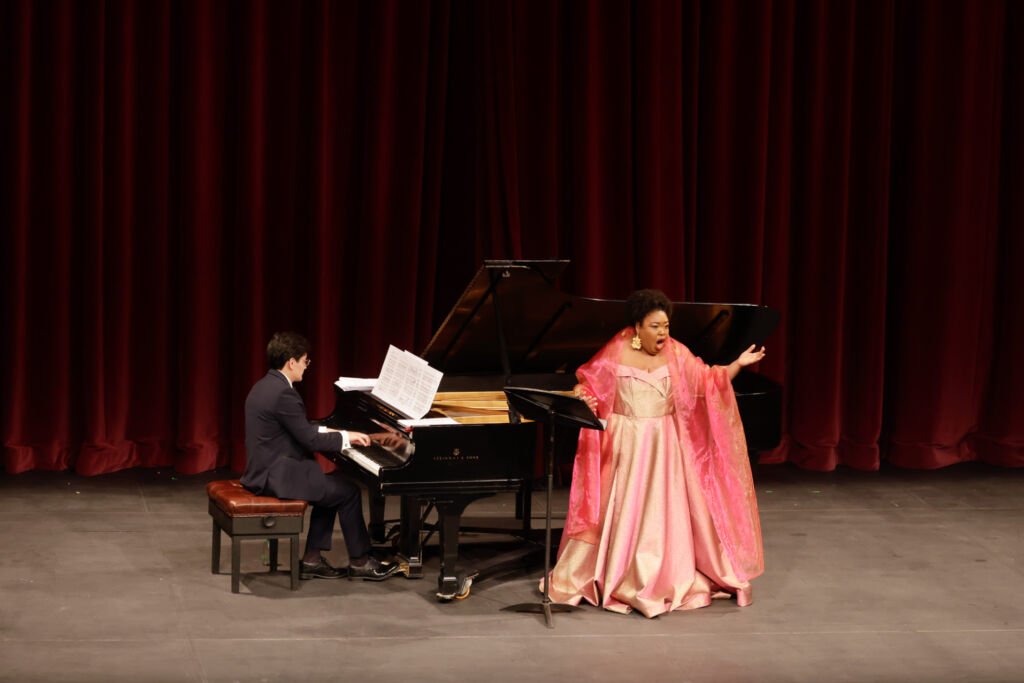
My own piece, Random Acts of Senseless Violence for piano and electronics, thematises violence with a narrative that seems human at first but gradually reveals itself as the product of an artificial intelligence. Inspired by the history of violence in Venezuela and Columbia, this composition develops into a reflection upon violence as an primal element of human existence. A special highlight was the world première of Paul Desenne’s 7 Impresiones de Reverón, inspired by paintings of the Venezuelan artist Armando Reverón. Desenne described this work, with its stylistic alternation between mythical primitivism and lyrical intimacy, as “an exercise in transposition and transformation”. What might seem folkloric and playful at first glance reveals itself as an instance of multilayered engagement with Venezuelan identity.
This festival sets a deliberate counterexample to the cliché according to which Latin American music always sounds either festive or exotic. Works by Gabriela Ortiz, Gabriela Lena Frank, Osvaldo Golijov, and Carolina Noguera showed impressively just how diverse the existing forms of artistic expression actually are. Of particular note, moreover, was the rarely heard opera Kopernicus by Claude Vivier, which was given a most emphatic performance by the Americas Society. This festival’s organisation was no less impressive, with over 40 concerts, workshops, and conversations taking place within the space of just three days—professionally coordinated and with palpable concern and care for all of those involved. The team of the Teatro Mayor, led by Yalilé Cardona, ensured a cordial and respectful atmosphere in which the artists felt welcome. I was particularly impressed not just by the music itself but also by the dialogues thus catalysed—between composers and the audience, between tradition and innovation, and between different continents. The foyers and lobbies were full of conversation following the performances, with impressions being exchanged and melodies being softly hummed. In a city that’s constantly reinventing itself, these little moments of listening and communication took on a special intensity. If music is indeed something that reflects its environment, then Bogotá embodied not only the venue but also a mirror. This festival, with its openness and broad diversity, unfolded as a veritable map of the Americas—not a static copy, but rather a lively terrain arisen from sound, remembrance, and transformation.
The festival’s next edition will take place from 24 to 27 March 2027 with “Beethoven 200” as its motto!
Mobility visits to partner institutions in Colombia as well as to other destinations in South America are possible as part of the Erasmus+ programme. You’ll find more information on this at the web presence of the International Office of the mdw.
mdw.ac.at/internationaloffice