
Einfluss von Wandvibrationen
(bei Blechblasinstrumenten)
Sowohl Musikerinnen und Musiker als auch Instrumentenbauerinnen und -bauer von Blechblasinstrumenten sind der Ansicht, dass Wandmaterial und -dicke sowie die Position von Krümmungen und Verstrebungen den Klangcharakter (Timbre) eines Instruments beeinflussen können. Obwohl an dieser Aussage ein gewisser Wahrheitsgehalt besteht, zeigen theoretische und experimentelle Untersuchungen, dass der Einfluss von Wandvibrationen geringer ist als ursprünglich angenommen.
Dies wurde durch Analysen des Instrumentenklangs unter Dämpfung der Wandvibrationen bestätigt. Experimentell lässt sich dies beispielsweise realisieren, indem das Instrument in einen Sandkasten eingebettet wird. In numerischen Simulationen hingegen können Wandvibrationen einfach an- oder ausgeschaltet werden. In beiden Fällen zeigt sich ein breitbandiger Effekt, wenn die Wandvibrationen gedämpft werden.
Während des Spiels führt der akustische Innendruck in einem Blechblasinstrument dazu, dass die Instrumentenwände zu schwingen beginnen. Dabei können – wie in Abbildung 1 dargestellt – sowohl achsensymmetrische als auch elliptische Moden angeregt werden.
Elliptische Moden besitzen in der Regel sehr hohe Gütefaktoren, das heißt, sie werden nur bei einer bestimmten Frequenz angeregt und können den oben beschriebenen Effekt daher nicht erklären. Die achsensymmetrischen (axialen) Moden hingegen sind mit einer Bewegung eines großen Teils des Schallbechers entlang seiner Achse verbunden und können nachweislich einen breiteren Frequenzbereich beeinflussen.
Die zentrale Frage lautet, wie sich solche Vibrationen auf den Klang eines Blasinstruments auswirken.
Nach der theoretischen Akustik wird der Klang eines Instruments primär durch die Geometrie seines Innenbohrs bestimmt. Wie jedoch in Abbildung 2 gezeigt, können axiale Vibrationen zu Variationen des Bohrungsdurchmessers führen. Dies wiederum beeinflusst den akustischen Druck im Inneren des Instruments und erklärt, warum das Instrument bei aktivierten Wandvibrationen ein verändertes akustisches Verhalten zeigt.
Zur quantitativen Beurteilung wird üblicherweise die Eingangsimpedanz des Instruments gemessen. Abbildung 3 zeigt den Unterschied der Eingangsimpedanz eines Instruments mit gedämpften und frei schwingenden Wänden, gemessen experimentell (oben) und numerisch simuliert (unten).
Es ist zu beachten, dass dieser Effekt weiter verstärkt werden kann, wenn man folgende Aspekte berücksichtigt:
-
die Kraft zwischen den Lippen der Spielerin/des Spielers und dem Mundstück, die die axialen Wandvibrationen zusätzlich anregen kann;
-
die Tatsache, dass die Instrumentenwand nicht perfekt achsensymmetrisch ist – Abweichungen von einer ideal kreisförmigen Querschnittsform verringern die lokale Wandsteifigkeit.
Publikationen
Balasubramanian, Saranya; Chatziioannou, Vasileios and Kausel, Wilfried (2019)
"Analysis of Axisymmetric Structural Vibrations in Brass Instruments,"
Acta Acustica united with Acustica 105 (3), 506-515. https://doi.org/10.3813/AAA.919332
Chatziioannou, Vasileios; Balasubramanian, Saranya and Kausel, Wilfried (2019)
"Vibroacoustic analysis of trumpet wall vibrations,"
in Proceedings of the International Congress on Sound and Vibration (ICSV26)
Kausel, Wilfried; Chatziioannou, Vasileios; Moore, Thomas R.; Gorman, Britta R., and Rokni, Michelle (2015)
"Axial vibrations of brass wind instrument bells and their acoustical influence: Theory and simulations,"
Journal of the Acoustical Society of America (JASA) 137(6), 3149–3162. https://doi.org/10.1121/1.4921270
Moore, Thomas R.; Gorman, Britta R.; Rokni, Michelle; Kausel, Wilfried, and Chatziioannou, Vasileios (2015)
"Axial vibrations of brass wind instrument bells and their acoustical influence: Experiments,"
Journal of the Acoustical Society of America (JASA) 138(2), 1233-1240. https://doi.org/10.1121/1.4928138
Gorman, Britta; Rokni, M.; Moore, Thomas; Kausel, Wilfried, and Chatziioannou, Vasileios (2014)
"Bell Vibrations and How They Affect the Sound of the Modern Trumpet,"
in Proceedings of the International Symposium on Music Acoustics, ISMA 2014 (Le Mans, France) p. 215-218.
Chatziioannou, Vasileios; Kausel, Wilfried, and Moore, Thomas (2012)
"The effect of wall vibrations on the air column inside trumpet bells,"
in Proceedings of the Acoustics 2012 Nantes Conference (Nantes, France) p. 2243-2248.
Chatziioannou, Vasileios and Kausel, Wilfried (2011)
"Modelling the wall vibrations of brass wind instruments,"
in Proceedings of the COMSOL Conference 2011 (Stuttgart).
Kausel, Wilfried; Chatziioannou, Vasileios, and Moore, Thomas R. (2011)
"More on the structural mechanics of brass wind instrument bells,"
in Forum Acusticum Aalborg 2011 (European Acoustics Association, Aalborg, Denmark) p. 527-532.

Abbildung 1. Strukturelle Schwingungen des Schallbechers, die sowohl elliptische (a & c) als auch achsensymmetrische (b & d) Moden zeigen.
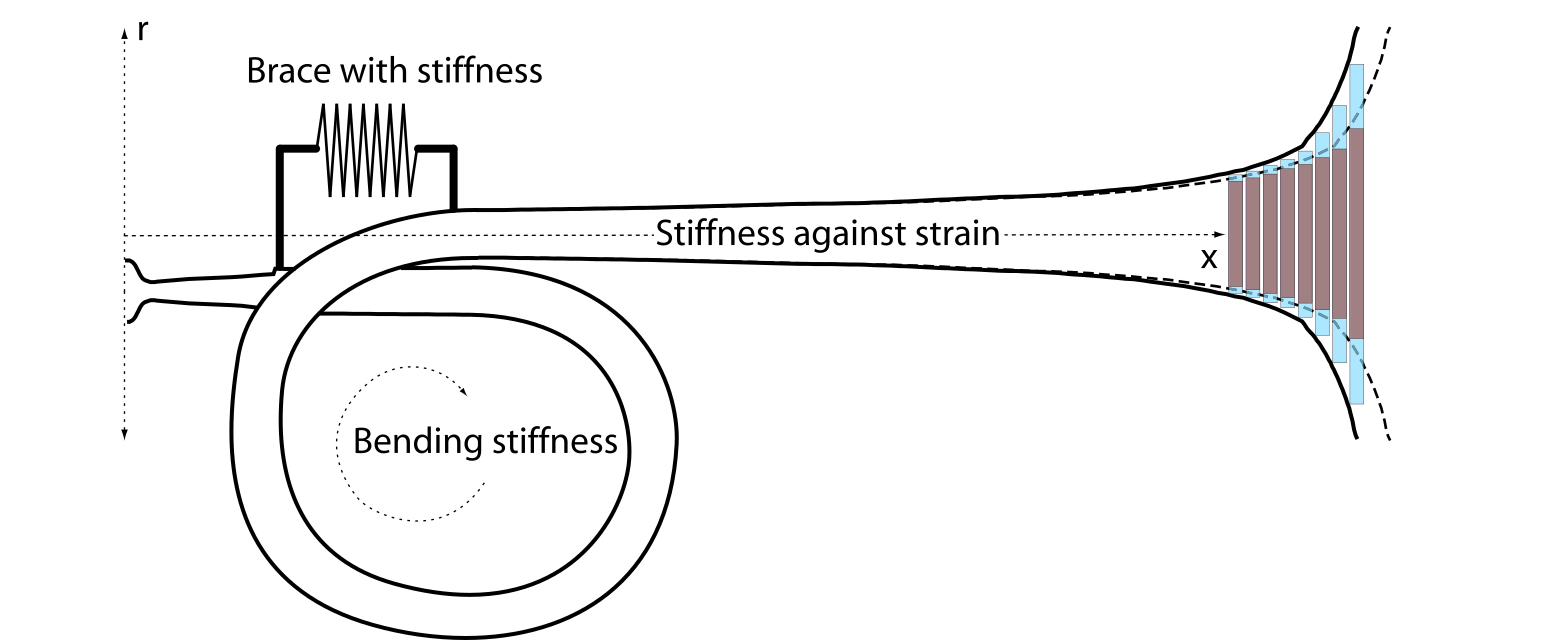
Abbildung 2. Schwingendes Blechblasinstrument mit Krümmungen und Verstrebungen.
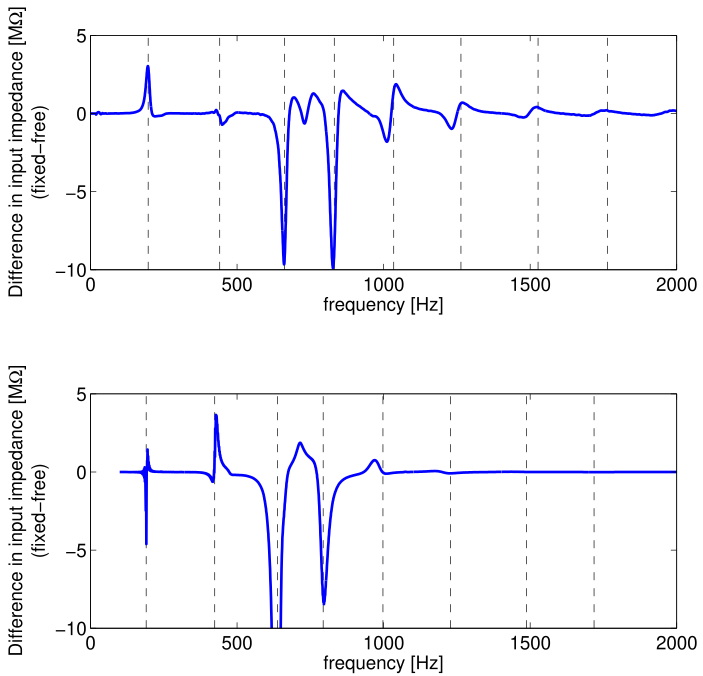 Abbildung 3. Unterschied in der Eingangsimpedanz des Schallbechers, verursacht durch Wandvibrationen, experimentell gemessen (oben) und numerisch berechnet (unten). Die gestrichelten Linien markieren die Positionen der Impedanzmaxima.