
> Gender-inclusive Language and Accessibility
> Guidelines and Supporting Materials
Language creates worlds. This implies that we do not merely employ language to describe our reality as it is – but that language plays a central role in shaping our individual and collective realities. Language is a powerful instrument and constantly in flux; it can reproduce, stabilize, or obscure social structures. Conversely, however, it can also serve to illuminate these structures and actively counteract them.
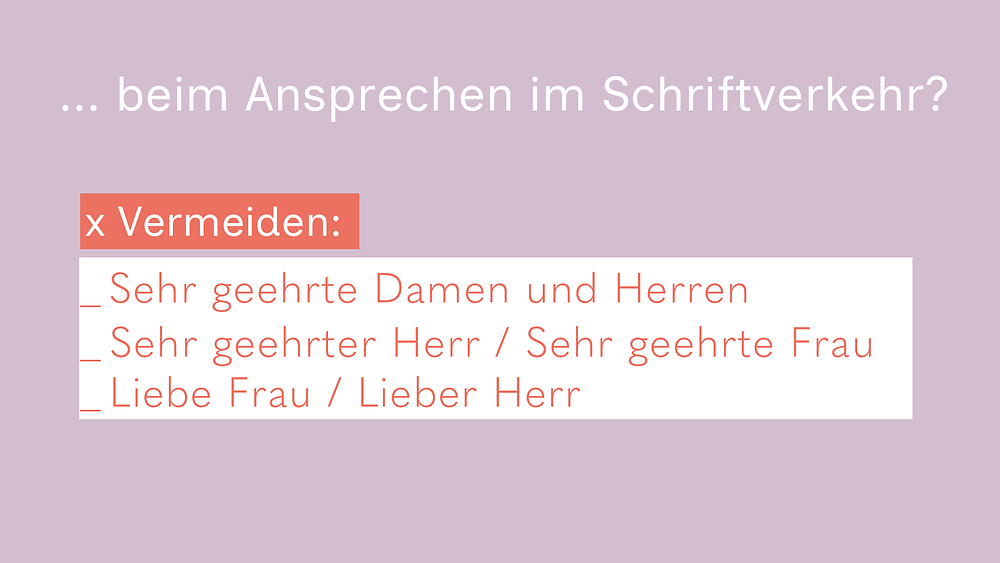
To illustrate: individuals who systematically rely on the generic masculine (i.e. the male form) in teaching materials, lectures or official correspondence, or who provide only »Mr« or »Ms« as options in application forms, student records or forms of address effectively render other genders – such as women and non-binary individuals – invisible. This creates a sense of non-belonging and ultimately contributes to constructing the university as a space in which artistic expression and academic excellence are reserved for exclusively male subjects. Gender-fair communication, in contrast, fosters a climate of inclusivity in which all students and members of staff feel seen, welcomed, and valued – regardless of their gender and their identity.
Universities are socially influential and play a significant role in setting norms; their members – lecturers, students and administrative staff – therefore share a collective responsibility to use language that reflects the existence of diverse genders. This entails practicing anti-discriminatory language and imagery, with the aim of actively countering additional structures of power and inequality in everyday communication – such as racism, ableism and classism. In accordance with the Austrian University Act (UG 2002), the requirements of the Women’s Advancement Plan and the 2022 recommendations of Universities Austria (Österreichische Universitätenkonferenz - uniko), mdw is committed to consistently implementing language that is gender-fair and free from discrimination.
Communicating at mdw
The university encourages its members to use spoken and written language, as well as imagery, in ways that reflect gender diversity and articulate equitable gender relations, as well as the diversity of lived experiences regarding sexual orientation, disability, age, race, ethnic background, religion, and belief.
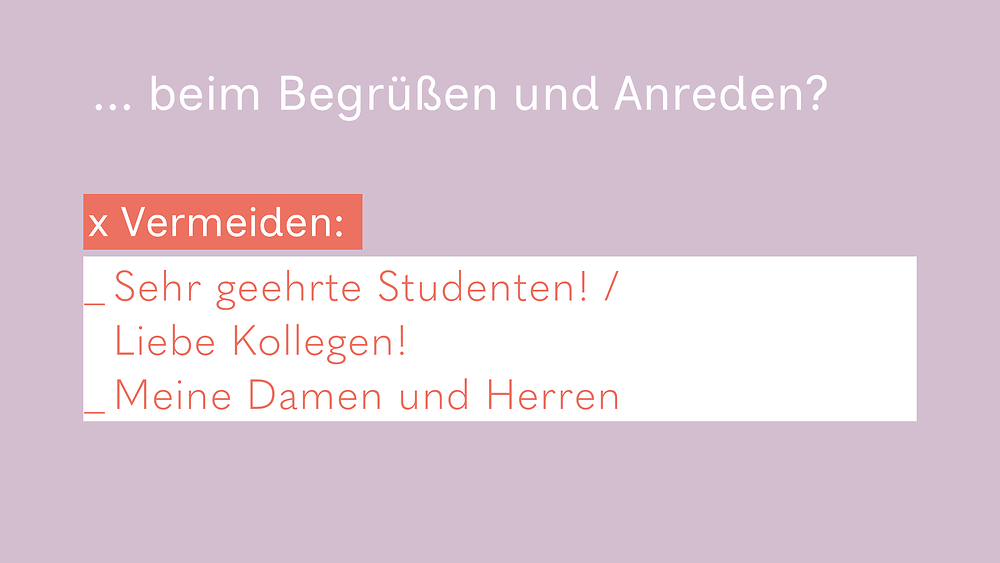
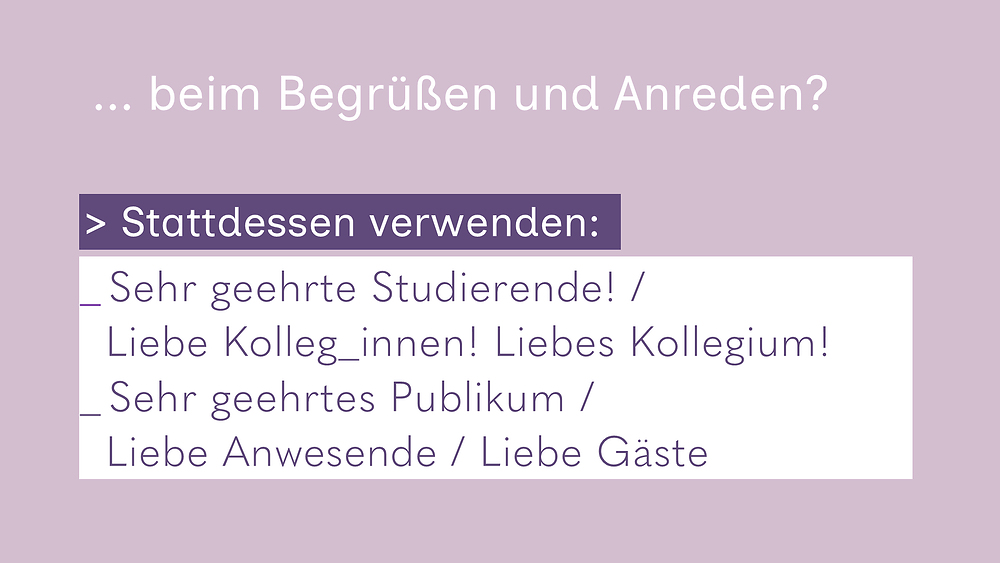
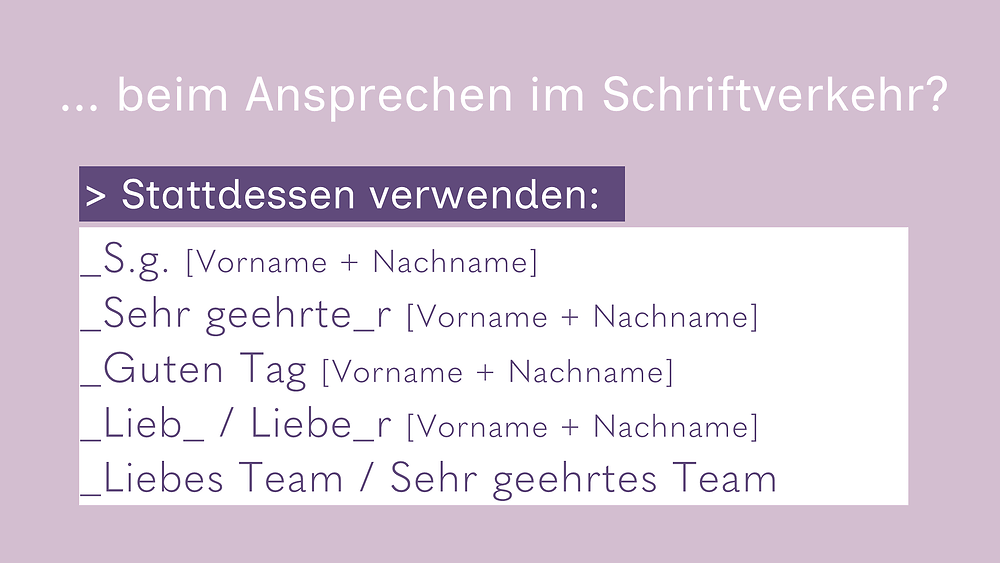
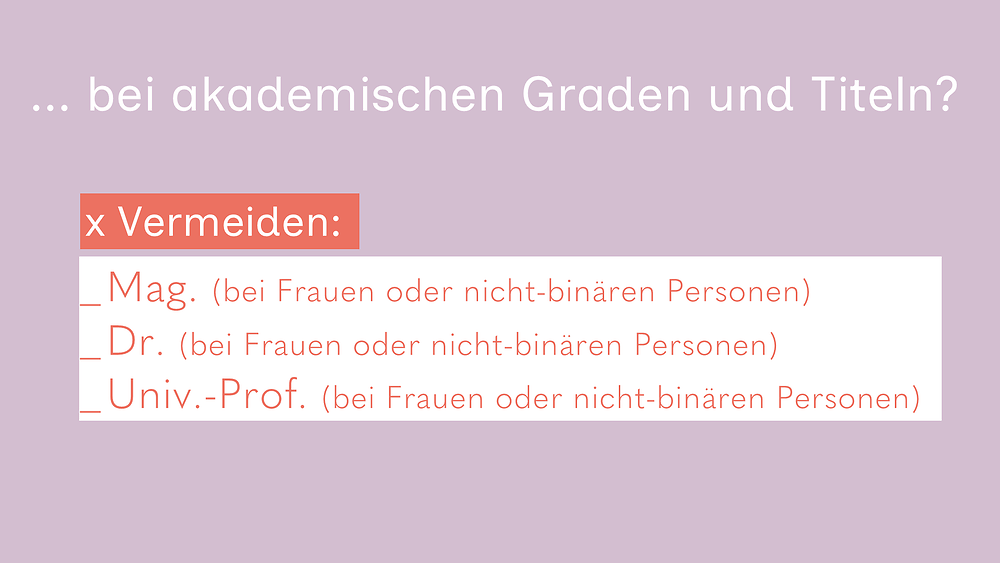
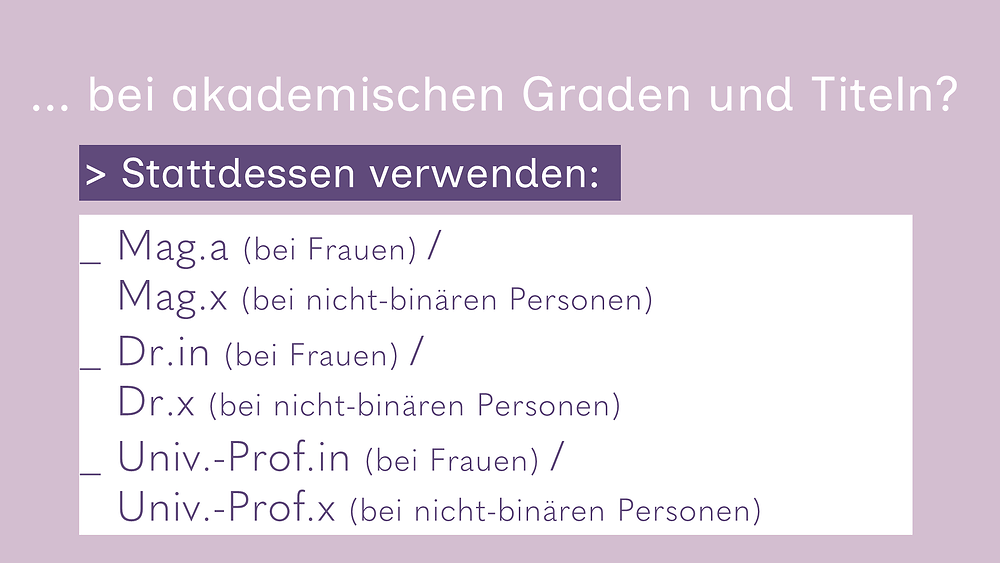
mdw’s rectorate recommends using the Gender Gap or Underscore in German (»_«, e.g. Student_innen) to render language gender-fair. This recommendation applies to official documents (mdw-bulletins the university’s development plan, etc.), to mdw publications (including the mdw-Magazine and job postings), and to external communication (e.g. the university website, mailings, talks, etc.). Academic papers must be written in gender-inclusive language. Students may choose the form of gender-inclusive language they prefer, in consultation with their advisors.
In 2016, mdw published the guideline Fair in Wort und Bild (links to the German publication), which provides foundational information and standards on gender-neutral language. These apply to teaching, studies, and administration and support of gender-fair wording and inclusive communication (see also the guideline’s condensed version).The guideline also refers to the use of the German »Binnen-I« (medial capital »I«) as an option for gender-fair language. However, this form reinforces the gender binary and consequently excludes individuals who do not identify within it. Gender-inclusive symbols such as the Gender Gap are therefore preferable. By moving beyond the categories of male/female, this form accurately reflects the diversity of human genders. In accordance with Section 9 of the Austrian Equal Treatment Act (Principle of Gender-Neutral Job Advertisements), the GGD offers a practitioner’s guide for mdw employees: Gender-fair Job Postings – Handreichung für geschlechtergerechte Stellenformulierungen (available in German). Further assistance is available through the Tricky Moments web tool.
Gender-inclusive Language and Accessibility
German often uses gendered-inclusive punctuation such as the asterisk (»*«, e.g., Künstler*innen) or the colon (»:« e.g., Wissenschaftler:innen). When choosing these forms, please be aware of their limitations within the mdw context due to accessibility barriers– particularly for blind or visually impaired individuals and when used with screen readers.
The screen reading software used at mdw recognizes and processes the underscore (»_«) most effectively: it is rendered as a natural pause in the context of the Gender Gap, it is not interpreted as punctuation, and carries no additional textual meaning. However, as any special characters can disrupt reading flow and impede comprehension, gender-neutral phrasing is particularly well-suited to equitable language use grounded in intersectionality. For example, you can use nominalized participles (e.g., Teilnehmende – people participating – instead of Teilnehmer_innen – gendered participants), refer to descriptions of roles and functions (e.g., Vertretung – deputy, adj. – instead of Vertreter_in – deputy, noun), or use other creative phrasing (i.e.: die leitende Person – the person in a managing position – instead of Leiter_in – gendered manager).
Gender-inclusive language and accessible language are not mutually exclusive. Language is dynamic and innovative and can continously be shaped to meet the needs ot specific situations and target groups. It is therefore essential to engage in continous dialogue with people with disabilities, to include their diverse perspectives, and to remain open to continually adapting language to new developments and evolving linguistic practices.
Guidelines and Supporting Materials
⸺
Further information on the fundamentals of gender-sensitive communications, including answers to frequently asked questions and practical examples of wording:
En, Boka/Humer, Tobias/Petričević, Marija/Ponzer, Tinou/Rauch, Claudia/Spiel, Katta:
Geschlechtersensible Sprache – Dialog auf Augenhöhe. Leitfaden
Gleichbehandlungsanwaltschaft, Wien (2023)
⸺
Further information on gender-fair wording beyond the gender-binary:
Non-Binary Universities.
Vademekum zu geschlechtergerecht(er)en Hochschulen
von Akademie der bildenden Künste Wien (2019)
⸺
Further information on non-discriminatory imagery:
Handlungsempfehlungen für eine diversitätssensible Mediensprache
von Goethe-Universität Frankfurt am Main (2016)
⸺
Further information on inclusive and anti-ableist language – including recommendations for replacing commonly used ableist terms and expressions:
Leitfaden inklusive Sprache. So vermeiden Sie Ableismus
von Agile (Schweizer Dachverband der Organisationen von Menschen mit Behinderungen)
Leitfaden
von Projekt Leidmedien.de (2012)
⸺
Further information on language and racism – examples commonly used examples to establish anti-discriminatory vocabulary:
Magsaam, Alexa/Varol, Çağan/Rathjen, Fenja/Tsianos, Vassilis:
Rassismuskritisches Wörterbuch
Fachhochschule Kiel, Kiel (2021)
Glossar
von IDA (Informations- und Dokumentationszentrum für Antirassismusarbeit)