
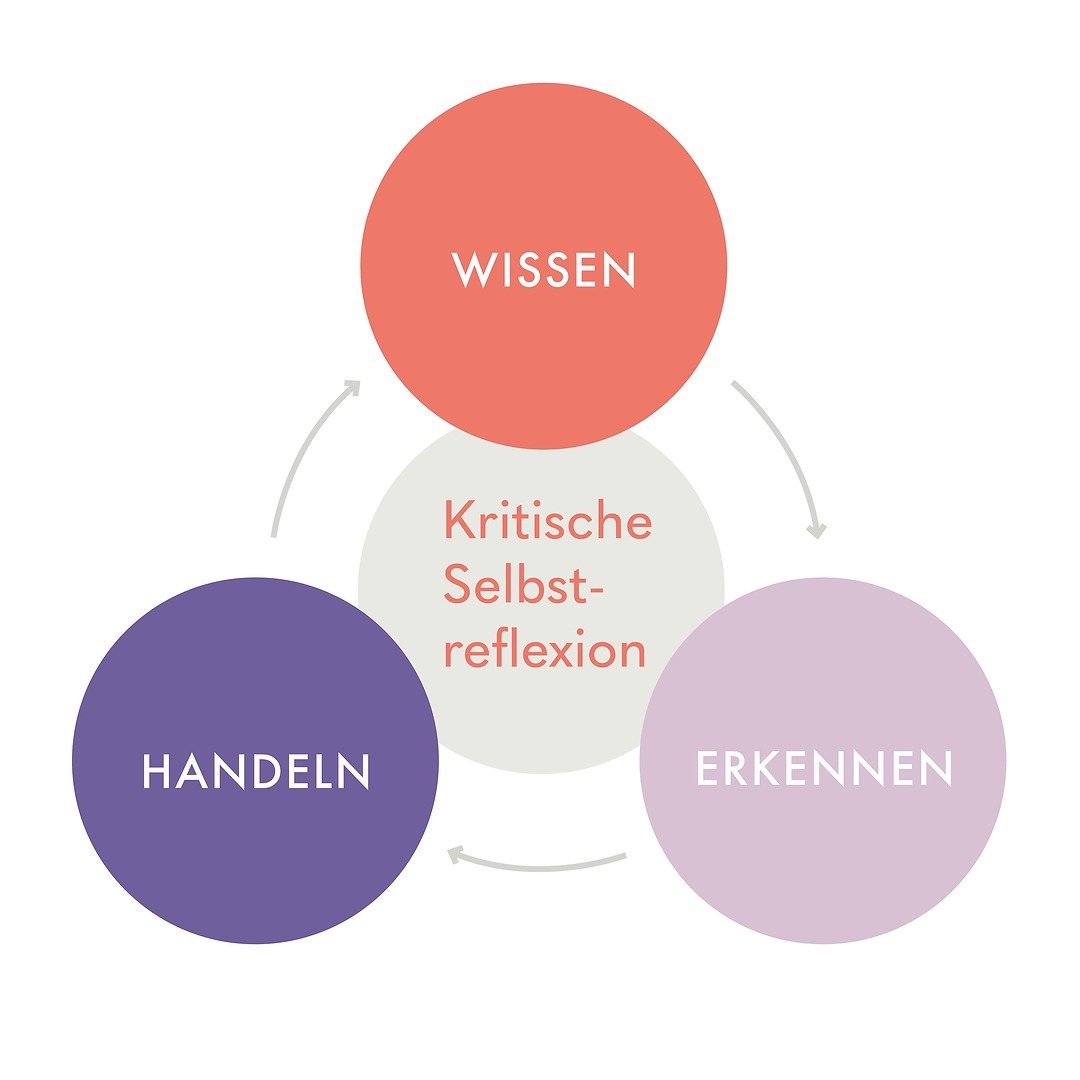
Model for systemically determination / Defining Gender and Diversity Competencies
Gender and Diversity Competence involves critical and reflective practices that actively contribute to making university life more equitable. These competencies serve as a quality standard for respectful and fair teaching, working and studying. Acting in a gender- and diversity-competent manner at mdw means being consciously aware of differences in lived experiences, acting in a discrimination-sensitive manner, and shaping university structures so that all members can participate fully and effectively.
This competence provides decisive advantages for one’s actions and influence: lecturers expand their didactic range and strengthen their capacity to navigate challenging situations in ways that are informed, self-aware, and responsible. Researchers gain a nuanced, power-critical perspective on how to design their research, formulate research questions, and in relation to their target groups. Students, in turn, benefit from a foundational attitude that critically engages with discrimination, fosters collaboration in heterogeneous study environments, strengthens social cohesion and solidarity, and helps them view their artistic and academic practices in everyday student and professional life with a heightened awareness of both privilege and discrimination.
Gender and diversity competence is composed of three interconnected levels: knowledge, awareness, and action. In this sense, gender and diversity competence describes the capacity
⸺
to acquire knowledge about historically evolved inequalities and power structures connected to diversity dimensions (gender, race, ethnicity, class, sexual orientation, disability, and many more), as well as the forms of discrimination associated with them, and to critically apply this knowledge to their current manifestations in academia, the arts, cultural production, and (classical) music;
⸺
to recognize one’s own social positioning within these power relations and the effects of one’s socialization (e.g. individual values, norms, expectations, prejudices and »taken-for-granted« assumptions) …
⸺
… and, to be able to derive from these processes, concrete steps for one’s own actions and to implement them in practice. [1]
All three levels of action require both the ability and the motivation for critical self-reflection. Consequently, self-reflection is the central foundation for acquiring gender and diversity competence. Rather than a singular, linear learning step, this competence is conceptualized in the following as a cyclical and sustained process It can only be developed over time, necessitating the continuous re-evaluation of one’s own assumptions, knowledge and conduct.
Here, mdw aligns its approach with the definitions of gender and diversity competence agreed upon in the Recommendations of the Austrian Higher Education Conference (HSK, link to a German-language document). According to this framework »a foundational recognition of the relevance of gender attributions within one’s personal work context and sphere of influence (knowledge) [is required]. This recognition is tied to the willingness (desire) and ability to engage with these issues and act accordingly – supported, where necessary, by gender experts and the findings of gender theories – in everyday student and professional life« [2].
Knowledge
Knowledge about categories of difference – and the fact that they are socially constructed – forms the basis for acquiring gender and diversity competence. Central to this is the realization that »difference« between humans does not denote natural facts but rather attributions and distinctions produced socially, politically, and culturally. These distinctions underlie the unequal distribution of privileges and disadvantages among individuals and groups: they determine who receives access to resources such as early childhood education, mentoring, family contacts and social networks, financial means, or access rehearsal spaces and performance platforms, and who is able to occupy positions of artistic and academic authority and recognition.
The development of gender and diversity competence aims to situate university education in music and the arts within a broader socio-political framework and to critically examine it as a field that is permeated by power relations and inequality. Acquiring this competence rests on scientifically grounded, theory-informed knowledge of the following aspects:
⸺
the central categories of difference along which discrimination manifest (e.g., gender, class, race, ethnicity, disability, sexual orientation, or age), and the historically entrenched power disparities in which such discrimination occurs (e.g., coloniality, classism, ableism, or patriarchy). This understanding is grounded in an intersectional approach, which seeks to identify and address multiple, overlapping forms of discrimination
⸺
the diversity of life worlds, needs and experiences of discrimination among different social groups (e.g.; the lived realities of individuals with a migration background or precarious residency status, the experiences of queer individuals, and the significance family income and education level for educational access)
⸺
the different layers of discrimination – including internalized, interpersonal, institutional, and structural forms [3] – as well as the ways in which discrimination can manifest, ranging from overt/explicit acts to covert/implicit forms.
For the context of education at a university of the arts, this specifically entails a differentiated analysis of …
⸺
data, facts, and case studies concerning structural inequalities, stereotyping, over- and underrepresentation, as well as multiple discrimination within one’s own professional or academic activities (teaching, studying, research, administration),
⸺
the established understanding of the arts and culture, including normative definitions, evaluative standards, and metrics such as excellence, aesthetics, virtuosity, or talent, and their impact on educational and career opportunities – as well as on the everyday realities of different groups within the arts and cultural sector
⸺
the existing diversity (with)in music, tradition(s), performing art(s), artistic subjects and forms of knowledge, as well their marginalization in higher art, music, and educational institutions, as highlighted in mdw’s Development Plan. Engaging with knowledge in this way also requires reflecting on which forms of knowledge and art are permitted to constitute the (classical) canon, and why they are accepted as legitimate, relevant, or excellent.
Awareness
Reflecting on one’s own position within social space – and becoming aware of the role that personal values, norms, attitudes, and mental images play in everyday work and study life – creates the possibility for developing a critical attitude towards discrimination. This involves regularly examining one’s own sphere of influence in a self-reflective manner – whether individually, as a team, in teaching, within an ensemble, or within research projects. The goal is to identify the potential for transforming our own structures, content, and courses of action so that members of marginalized social groups can enjoy working at mdw and achieve successful. [4]
From the perspective of gender and diversity competence, self-reflection and critical-awareness describe the process of continually engaging with the following aspects and issues:
⸺
Reflecting on one’s own societal positioning along social categories of difference:
How am I situated within institutional and societal power relations along dimensions such as gender, (national) origin, language, disability, class, sexual orientation, or age? How am I perceived by others? Within my team, working group or broader environment: Which experiences and perspectives are represented – and which are absent? Whose voices are heard and whose experiences are centered?
⸺
Recognizing aspects of one‘s own socialization and privilege:
Which influences – such as family, education, media, cultural environment, or previous educational institutions – have shaped my understanding of art and artistic quality? Which values, norms, and stereotypes influence my thinking, feelings, and behavior in everyday study and work life – for example, in my image of the »ideal« or »typical« student or in my defining criteria of artistic excellence? How have privileges – such as family support, financial security, whiteness or being cisgender - faciliated my access to the university and to education, or to professional success? Successfully passing entrance exams or maintaining one’s footing in competitive artistic environments requires access to cultural capital and specific resources. Becoming aware of privileges that my initially be invisible in these contexts allows for critical reflection on their influence in areas such as admission exams, competitions, and recruitment procedures.
⸺
Developing discrimination literacy in one’s field of study, work, or area of responsibility:
How do structures of power and inequality manifest in my specific environment? Which practices or »normativities« might reproduce exclusion – both at the level of content (e.g., in dramatic texts, screenplays, or repertoir) and through factors such as performance pressure, dress codes, deadlines or assessment criteria?
Even apparently neutral structures – such as stage formats, working hours, examination methods – are rooted in social norms and power relations that produce both inclusion and exclusion within the university context. Use your insights to foster change within your sphere of influence.
It is vital to recognize that good intentions do not automatically translate into discrimination-free behavior: Well-intentioned actions can still be perceived as demeaning or exclusionary. Assuming responsibility, listening, and learning from feedback are essential.
Action
Action informed by gender and diversity competence involves actively integrating discrimination literacy and reflective practices into personal practice. This means applying our knowledge and insights to the daily routines, decisions, interactions, and structures of the university. In doing so, it is essential to continually question, adjust, and reflect on one’s own routines, practices, and decisions – a dynamic process of ongoing learning and unlearning.
Analyzing one’s own agency is a central aspect of this process:
⸺
Where do I have leeway? What is my room for maneuver, and how can I leverage it strategically?
⸺
What are my limits, and where do I experience them? Which societal, institutional, or structural conditions shape them?
Such an analysis is significant on several levels [5]:
⸺
Internal: Recognizing personal attitudes, privileges, values, and stereotypes.
⸺
Interpersonal: Reflecting on interpersonal dynamics and power relations within teams or groups.
⸺
Institutional/Systemic: Scrutinizing the rules, norms, organizational culture, and processes of the university.
⸺
Structural: Recognizing societal power relations and exclusionary mechanisms that also influence university contexts.
The aim is to develop strategies to retain agency across these levels and to effectively utilize the opportunities at one’s disposal to create structures that are more equitable and inclusive.
Recommendations for Action:
⸺
The basis for gender-sensitive and diversity-aware actions lies in a justice-oriented attitude. This entails continually questioning one’s own position (of power) and assuming responsibility for the impact it has.
⸺
Perceive and respect differences without reproducing harmful tropes. The goal is to approach diversity with mindfulness and apprecation.
⸺
Language, imagery, and communication styles shape how people are perceived. Discrimination-aware communication requires a conscious effort to speak, write, and design inclusively – for example, by using gender-fair language, selecting diverse imagery, or providing accessible materials.
⸺
Change is more successful when undertaken in teams. It is important to seek allies, build alliances, and provide mutual support – for example, through already existing advocacy organizations or self-initiated exchange groups. In this way, discriminatory structures within organizations, educational institutions, or teams can be critically examined and transformed collectively.
⸺
Reflect on, when additional gender or diversity expertise is required – such as during conflict resolution, concept development, or decision-making processes that are prone to bias. Seek expert guidance and knowledge if necessary, for example from the organizational unit for Equity, Gender and Diversity or the Working Group on Equal Opportunities (AKG). Gender and diversity competence does not mean »knowing everything«, but rather becoming consciously aware of when dialogue and support are necessary and actively engaging with them.
Literature & Sources
[1] Vgl. Abdul-Hussein, Surur/Hofmann, Roswitha (2013): Diversitätskompetenz. erwachsenenbildung.at; Bargehr, Gabriele (2009). Diversitätskonzepte im Kontext politisierter Zugänge der Cultural Studies, In: Abdul-Hussain, Surur/Baig, Samira (Hg.): Diversity in Supervision, Coaching und Beratung. Wien: Facultas, S. 121-140.
[2] HSK (2018): Verbreiterung Von Genderkompetenz in Hochschulischen Prozessen: Empfehlungen Der Hochschulkonferenz - Langfassung. Wien: Bundesministerium für Bildung, Wissenschaft und Forschung, S. 36.
[3] In Anlehnung an »Race Forward« bzw. »Levels of Racism« -Modell. Vgl. hierzu: Jones, Camara Phyllis (2000): Levels of Racism: A Theoretic Framework and a Gardener's Tale, In: American Journal of Public Health, 90(8), S. 1212–1215; raceforward.org (o.D.): What is racial equity? – Understanding key concepts; DeZIM (2023): Rassismus und seine Symptome. Bericht des Nationalen Diskriminierungs- und Rassismusmonitors. NaDiRa-Bericht 2023. Berlin.
[4] Vgl. Mörsch, Carmen (2021): Diskriminierungskritische Perspektiven an der Schnittstelle Bildung/Kunst: Einführung, S. 14.
[5] Vgl. hierzu: Bargehr, Gabriele (2025): Machtkritisches Denken und Handeln in Organisationen. Multiperspektivische Herangehensweisen und Tools. In: Mayer, Ulli/Ellmeier, Andrea/Müller, Gerda (Hg.): üben und ver_üben. Diversität als diskriminierungskritische Praxis in Kunst, Kultur und Bildung. Bielefeld: Transcript.