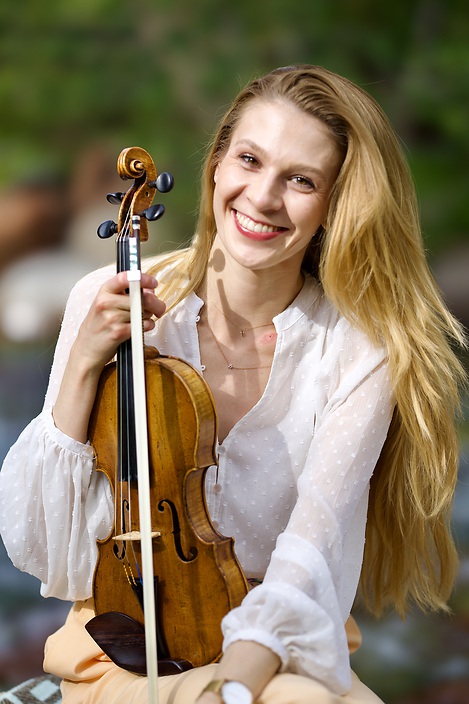
 Privat
Viktória Várkonyi is a Hungarian violinist with a versatile career as a performing artist, music pedagogue, and researcher. Since March 2024, she has been working as a PraeDoc Assistant at the mdw in the Department of Music in Dialogue (Music Mediation/Community Music), where she is also pursuing a PhD in Contemporary Arts Practice.
Her work is particularly shaped by an interest in new concert formats, interdisciplinary collaboration, and embodied forms of performance. As a freelance violinist, she has worked with various ensembles and toured internationally, engaging in crossover projects, especially collaborations with dancers. She has participated in master classes with renowned musicians such as Gil Shaham, Almita Vamos, Naoko Tanaka, and the Pacifica Quartet.
After graduating from the Béla Bartók Conservatory in Budapest, Viktória studied at the mdw in Vienna, where she completed her Master’s degree in Violin Pedagogy in the class of Georg Hamann. Alongside her musical education, she also earned a Master’s degree in Communication and Media Science with a minor in Intercultural Communication from Corvinus University Budapest.
In 2024 and 2025, she was an Instrumental Ambassador for the Benedetti Foundation, founded by violinist Nicola Benedetti, and worked as a substitute tutor for the community orchestra initiative Superar Wien. As an alumna of the 2022 Aspen Music Festival and School, she has been teaching violin since 2023 on an online platform in collaboration with AMFS, working with an internationally diverse student community.
Stage Presence as Embodied Music Mediation
This doctoral research project investigates stage presence as an embodied and relational practice among classically trained instrumentalists, with a particular focus on new concert formats. Rather than understanding stage presence as charisma or an innate artistic quality, this project examines how musicians actively cultivate presence through bodily practices such as movement, gesture, gaze, spatial awareness, and performative interaction.
Drawing on perspectives from music mediation, practice theory, and performance studies, this research explores how performers create connection with audiences through stage presence. Influenced by Erika Fischer-Lichte’s concept of performativity and Hans Ulrich Gumbrecht’s writings on presence, stage presence is understood not merely as an aesthetic effect, but as a relational process emerging between performers, audiences, and musical practices.
Using a qualitative research approach based on interviews, this study examines how classically trained instrumentalists in new concert formats develop stage presence practices within contemporary performance culture. Many of these forms of embodied interaction are applied intuitively and have rarely been systematically examined. By identifying recurring strategies and embodied forms of interaction, the project aims to make these tacit knowledges visible and open to reflection, contributing to a more conscious and relational understanding of stage presence as a form of embodied music mediation.