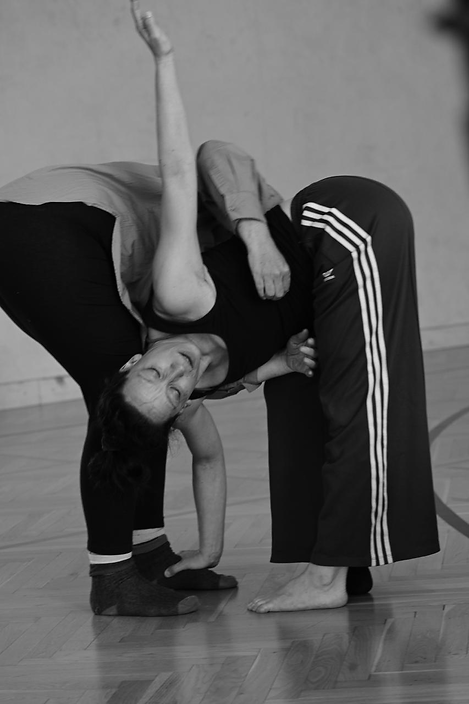
 © Allen Browne
DSA Sonja Browne, MA MAS is a graduate theatre scholar, dancer, choreographer, and educator whose work is rooted in inclusive artistic practice. In 1999, she founded danse brute, an ensemble of dancers with and without disabilities, followed by tanzMontage in 2006. Trained in ballet, contemporary dance, tap, acting, and singing, Browne has collaborated with artists including Editta Braun, Willi Dorner, Hubert Lepka, and Olivier Gelpe, and completed internships with Amici (UK) and Theater Stap (Belgium). She has brought her knowledge of dance and improvisation to festivals and institutions such as ImPulsTanz (Vienna), Ostertanztage (Salzburg), and Tanztage (Würzburg), while touring and teaching internationally in Germany, France, Japan, Hungary, Luxembourg, Switzerland, and Ecuador. Since 2020, Browne has also been collaborating with Dr. Andrea Amort. Together, they were engaged in research and archival projects, including work at the MUK – Music and Arts University of the City of Vienna and the Theatermuseum Wien.
sonja.browne@students.mdw.ac.at
Movement choirs as an educational, aesthetic and inherently political practice. The history, current state and methodology of choral movement formats and their potential applications in music and movement education (working title)
In addition to a historical discourse analysis, which aims to explore the social and cultural conditions for the emergence of movement choirs in the interwar period of the 20th century and their roots in the methods of François Delsarte, Émile Jaques-Dalcroze and Rudolf von Laban, this doctoral project focuses on contemporary forms of collective movement in theatre and performance. Against the backdrop of current observations regarding the isolation and virtualisation of human contact, the study examines the extent to which movement choirs today can be understood as a response to the need for physicality, community and participation. Furthermore, their potential as a meaningful complement to conventional music and movement pedagogy in amateur courses and in training for professional stage dance is examined.
At the heart of this work lies an artistic-pedagogical project to be explored empirically: in a movement choir comprising 50–100 participants, led by the author—who is a dance teacher and choreographer specialising in mixed-abled settings. Experiences of leadership and participation, individuality and community, as well as collective decision-making processes within a heterogeneous (large) group are examined. To this end, the information gained from the previous research on aesthetics, methods and techniques of historical and contemporary movement choirs, is applied to the group’s rehearsal process. The creative process and the performance of the choral piece are documented in writing and using video footage, and subsequently analysed. The aim of the project is to demonstrate the feasibility and value of using choral practices in contemporary music and movement education, as well as in choreographic work, through the documentation and analysis of the empirical material, and to compile a catalogue of scores for movement choir practices.