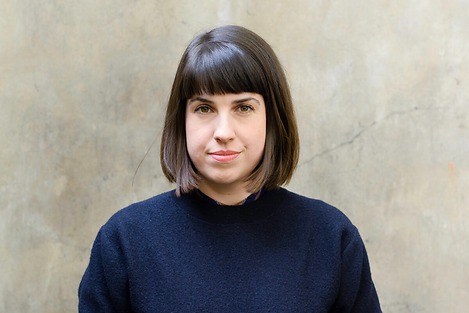
 © Petra Moser
Katharina Serles is a scholar of literature, comics, and image studies, with a particular emphasis on gender, performativity and visual culture studies. She teaches comics theory at the Kunstschule Wien and remains active as a moderator, journalist, cultural policy maker, performer, and winemaker.
Her academic trajectory includes research and teaching at the Dresden University of Fine Arts and the University of Vienna, where she most recently (2019–2024) served as applicant and collaborator in the research project “Visualities of Gender in German-Language Comics”.
From 2019 to 2023, Serles was editor-in-chief of the cultural-political journal KUPFzeitung and, in 2020, deputy managing director of KUPF OÖ in Linz. She has been engaged in cultural policy through her involvement with IG Kultur Wien and IG Kultur Österreich and – since 2018, as co-founder and board member of the Austrian Association for Comics.
+43 1 71155 - 2046
Weird Times. Queer Temporalities in Contemporary German-Language Comics
The dissertation investigates how German-language comics since the 1990s represent, question, and subvert dominant constructions of time. Building upon existing scholarship in comics studies, cultural and media studies, narratology, as well as image and queer theory, the research explores how comics produce non-linear, fragmented, ambiguous and „queer“ temporalities that challenge and disrupt (hetero-)normative models of chronology and history. In doing so, it addresses a significant research gap by providing the first systematic study of temporal structures and conceptualizations in German-language comics.
Through close readings and visual analyses, the project examines how formal devices – panel arrangement and transitions, framing, spatial composition, layering and repetition, and the use of the gutter – complicate the relationship between simultaneity and succession, continuity and rupture, presence and absence. It asks how visual-narrative strategies not only disrupt linear, progress-oriented temporalities but also open up affective, embodied, and relational experiences of time that resonate with queer modes of existence and perception.
Integrating postcolonial and performance-theoretical perspectives, the project situates German-language comics within transnational debates on time, gender, and memory. Ultimately, it shows that comics are particularly apt for articulating queer temporalities, producing what Scott McCloud has called an “infinitely weirder” sense of time – one that might reflect the complexities and incommensurabilities of contemporary life and open up alternative imaginaries of belonging, history, and (non-)futurity.