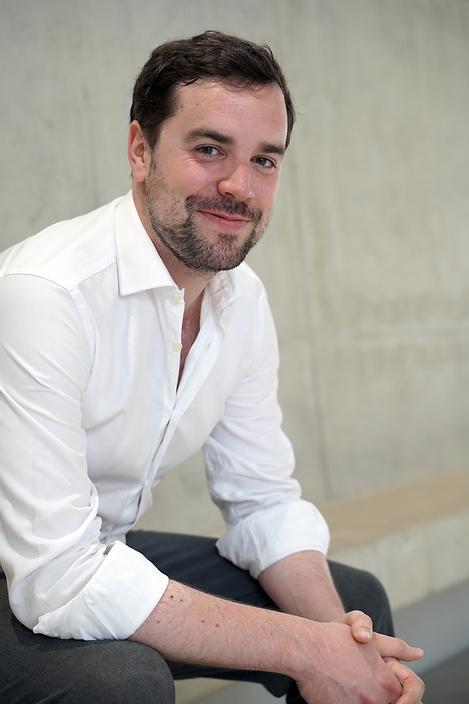
 © Arian Lehner
Carl Tertio Druml is an Austrian composer, music theorist and philosopher who is currently employed as a pre-doctoral researcher at the University of Music and Performing Arts Vienna (mdw) as a part of the Structured Doctoral Programme „Performing Matters: Manifold Temporalities“. He studied philosophy and composition in Amsterdam, before returning to his native Vienna to study composition (with Judit Varga) and music theory (with Gesine Schröder) at the mdw and theatre-, film-, and media studies at the University of Vienna. His research interests are opera theory, new music and orchestration. He has presented papers in front of, among others, the German association for music theory (GMTh). As a composer he did masterclasses with Salvatore Sciarrino and was performed by groups like Ensemble Modern, Symphonieorchester Vorarlberg and Quartetto Prometeo. He sings in the extra chorus at the Vienna State Opera.
Druml@mdw.ac.at
Time Restructured: Dramaturgical Analyses of Operas since 1945
Carl Tertio Druml is writing a dissertation with the working title: „Time Restructured: Dramaturgical Analyses of Operas since 1945“. In it he delves into the aesthetic and structural changes in compositional method and theatrical conceptualization since the Romantic period that led to a change in how composers understood musical time and how opera could process temporality as a narrative tool.
The study will take philosophical and musicological theories on temporality as well the latest insights from theatre-, film-, and media studies as its starting point and display not only how contemporary composers manipulate the perception of time but also how they theorise about time in music. Here it is conspicuous how philosophers (like Gilles Deleuze) and composers (like Salvatore Sciarrino) seem to identify similar changes in the modern perception of time and temporality, which has rarely been synthesised in academic scholarship.
In a next step, the research will be thematically structured and follow particular techniques in time construction since their antecedents in the Romantic period to the most recent operas. While the work will employ a myriad of examples to showcase the development and change in temporal dramaturgy, the sub-chapters will be capped off with in-depth analyses of particular pieces: in doing so, the thesis shines a spotlight on a few works, like Kaija Saariaho’s „Innocence“ (2021) for its approach to memory, John Adams „Doctor Atomic“ (1998) for its approach to time perception or Thomas Adès’ „Powder her Face“ (1995) for its construction of historicity through intertextual quotation of bygone styles and textures. As opera has been a multivalent art form since its inception, any close analysis happens in tandem with an examination of the musical ramifications on and interplay with performance, libretto and perception.