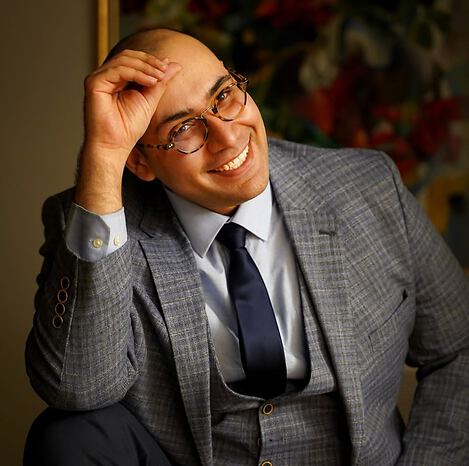
 © Uğur Karakan
Aria Torkanbouri is a pre-doctoral researcher at ERC-funded project “GOING VIRAL. Music and Emotions during Pandemics (1679-1919)” at the mdw-University of Music and Performing Arts Vienna. Between 2007-2020, he studied composition, music theory, orchestra conducting, and piano in University of Music and Performing Arts Graz, Hochschule für Musik Hans Eisler Berlin, Uzeyir Hajibeyli Academy of Music Baku, Mimar Sinan University of Arts Istanbul, and University of Arts Tehran, all under the tutelage of esteemed professors across various institutions. Since 2020, he enrolled in the Master of Ethnomusicology program at mdw, where he graduated with distinction in 2023 and won the ‘mdw Appreciation research award’ (mdw Würdigungspreis 2024) for his outstanding performance and achievement in his master’s studies. His master research focuses on unraveling the complex interplay of socio-political and music theoretical reasons behind the decline of Azerbaijan-Turkish Ashiq art activity over the past century. Beyond academia, he has been active as a composer, conductor, performer, juror, organizer, and manager. His award-winning works have been performed worldwide, and he serves as artistic director of Öst Ensemble in Vienna. He also writes fiction and librettos exploring creativity and culture.
+ 43 1 71155 3563
Harmonies of Resilience: Emotional Dimensions of Azerbaijani Music during Spanish Flu Pandemic (Supervisor: Professor Marie Louise Herzfeld-Schild, Co-supervisor: Professor Anna Oldfield)
Aria Torkanbouri’s doctoral dissertation examines the emotional and socio-cultural role of musicking in Baku during the Spanish Flu pandemic (1918/1919), which coincided with the brief yet transformative Azerbaijan Democratic Republic (ADR)—the first secular Muslim-majority democratic republic. Amid war, famine, displacement, and political turmoil, musical practices emerged as vital spaces of emotional negotiation, cultural resilience, and socio-political redefinition. Often overlooked in historical memory, the pandemic profoundly shaped everyday life, amplifying the urgency of musicking as a cultural and emotional response.
Focusing on Uzeyir Hajibeyli’s operettas Arşın Mal Alan and O Olmasın, Bu Olsun, his study explores how these hybrid works—merging maqam-dastgah, ashiq traditions, and Western forms—functioned as performative responses to instability, using humour, theatricality, and stylised excess to challenge gender and class norms.
Using archival research, ethnomusicological fieldwork, and carnal-music theoretical analysis, his study approaches historical sources as embodied encounters. By situating Azerbaijan–Turkish musical culture within wider global discourses on music, emotion, and crisis, it reframes the Spanish Flu not merely as a medical disaster but as an emotional and cultural inflection point. The study introduces new conceptual tools that challenge disciplinary boundaries and position musical performance as a site where emotion, power, and embodied practice coalesce in shaping collective responses to crisis.