IMP at the World Conference of the International Society for Music Education in Montreal
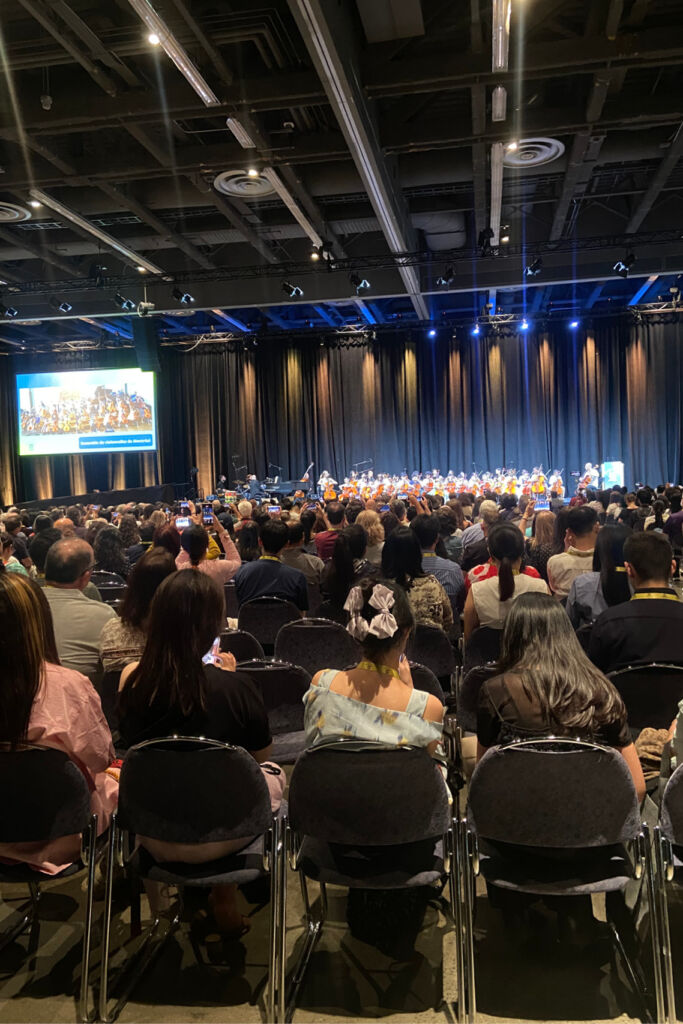
In July of this year, Montreal hosted the 37th World Conference of the International Society for Music Education (ISME), one of the largest international music education conferences worldwide. This latest edition welcomed more than 1,900 participants from over 70 countries and featured upwards of 1,300 presentations. The mdw’s Department of Music Education Research and Practice (IMP) was represented by multiple individuals: Michaela Hahn, Judith McGregor, Axel Petri-Preis, Monika Rak, and Priska Seidl gave talks and led panels, and Hannah Baumann presented a video. The conference theme, “Unity in Music Education: Building Bridges for All”, was reflected by all of the contributions on various levels.1
Each time slot at the conference featured over 25 workshops and presentations held in parallel, which made navigating the overall programme a challenge in and of itself. Though the participants often grappled with similar questions, they took them forward in different directions based on various educational systems and societal contexts. In this light, the true value of participating here lay not just in the opportunity to present but also in informal exchange—which gave rise to new contacts, collaborations, and perspectives that can now feed back into the mdw participants’ own work at our institution.
The wide range of topics and approaches seen at the conference as a whole was also evident in the contributions of IMP. Michaela Hahn, for example, joined forces with Luc Nijs, Taru Koivisto, and Michael Dartsch to focus on the significance of early childhood music education. They presented some initial findings from the Erasmus+ project CC-ECME (Co-Connecting Early Childhood Music Education – Towards Systems Thinking in European Music Institutions)2: there, a European questionnaire on early childhood music education (ECME) and an analysis of higher music education curricula have shown that the challenges involved in training ECME teachers manifest themselves both in the curricular context and in how the field is perceived. ECME has less of an established image than does instrumental teaching, and it is barely present at all in the education policy realm. This conference, incidentally, served the IMP team as preparation for the CC-ECME Workshops (22 & 23 Sep.) at the mdw, where international experts worked on topics relating to policy and capacity-building.
Judith McGregor gave the second of two talks on the project “Kooperieren” [Cooperating]3. She had introduced this project—which brings mdw students from the Music Education for Voice and Instruments (IGP) programme together with amateur musicians in mixed ensembles—at the CEPROM pre-conference seminar in Québec, whose theme was “Breaking down barriers to thriving music careers: Building community and connection”. A central theme in that first talk had been how students’ artistic identities develop when they make music together with amateurs as equal partners. The CEPROM seminar also saw McGregor elected to a six-year term as a CEPROM commissioner, in which capacity she hopes to strengthen the network’s European axis. At the World Conference itself, she expanded the perspective with an interpretation of “Kooperieren” as an example of how a university of music can fulfil its third mission through shared artistic practice.
The two contributions by Axel Petri-Preis scrutinised music mediation and community engagement with a critical eye to power relations. His panel discussion together with Emily Dollman, Julie Ballantyne, and Elsje Kibler-Vermaas addressed audience and community engagement as practiced by orchestras and festivals: around three decades ago, cultural institutions began cultivating relationships with their audiences and civil society in new ways—including through participatory concerts and community projects. The focus here was on how such offerings can be conceived so as to take anti-discriminatory concerns into account. Petri-Preis also partnered with Johannes Voit to pursue this question in a workshop where participants took the edited volume Handbuch Musikvermittlung 4 [Music Mediation Handbook] as a point of reference for reflections on privileges and disadvantages in cultural participation.
Just how programme booklets, school textbooks, and concert formats construct musical narratives took centre stage in the panel discussion “Communicative Practices of Music Mediation: Constructing and Negotiating Narratives”, which featured the mdw’s Monika Rak, Priska Seidl, and Hannah Baumann. Rak introduced interim data from her research, which investigates women composers’ presence in upper-secondary level German-language music school textbooks: insofar as they find their way into the existing canon at all, women composers typically receive at most brief biographies—and their oeuvres represent largely uncharted territory from a didactic standpoint. Seidl presented her own research findings: referring to programme booklets from nearly a century’s worth of performances of Alban Berg’s Wozzeck at the Vienna State Opera, she showed how such booklets select and order knowledge and to which voices they accord authority. Baumann’s video contribution, which employed footage from a musical theatre production at Beethovenfest Bonn involving deaf artists and a sign-language choir, reflected on how the featured collaboration saw communication itself become the central artistic element. The discussion that ensued zeroed in on questions as to participation and accessibility in international comparison.
One question was present throughout all of the contributions: that of who plays along, who gets heard, who has access—not just in research, but also in teaching. The discourse around this question has long since arrived on the international stage. And in Montreal, the mdw took part with multiple voices.