The formal ceremony for the conferral of the 2026 mdw young research award, held in the splendid ambiance of the Neuer Konzertsaal on Rennweg, saw more recipients honoured than ever before. For the fourth time, soon-to-graduate secondary school students from all over Austria had been invited to submit their final papers and projects (completed as the Abschließende Arbeit or ABA, an optional element of the Austrian Matura examinations). This year’s enthusiastic response came in the form of 54 submissions—and the quality of the 38 papers and projects nominated by the preliminary evaluators left the interdisciplinary mdw jury impressed indeed. The present edition’s total of five awards were accompanied by a renewed crop of eight honourable mentions plus the Special Award for Composition.
The papers and projects ultimately selected for recognition demonstrate vividly just how diverse the themes and approaches taken on by secondary school students were: they ranged from music, film, dance, and literature to society and history, uniting scholarly research with artistic practice while repeatedly zeroing in on present-day social issues.
One of the awards went to Lisa Arif of the Parhamergymnasium for her paper entitled “Leitmotifs in Film: Shaping Characters Through Music Using the Examples of ‘How to Train Your Dragon’”. The Piaristengymnasium’s Marianna Auer won with a paper entitled “Körperbilder im Tanz” [Body Images in Dance], and Noemi Friedrich of BRG Boerhaavegasse was awarded for an a cappella composition based on the folk song “As I Went Out One May Morning”. Katharina Pergler of the Bischöfliches Gymnasium Augustinum Deutschlandsberg was recognised for her paper entitled “Die Darstellung der biblischen Figur Lilith im Wandel der Zeit. Eine kreative Umsetzung” [The Portrayal of the Biblical Figure of Lilith through the Ages. A Creative Realisation]. And finally, Aaron Zwiefelhofer of the school BGBRG Biondekstraße in Baden won an award for his investigation of animated films’ portrayal of emotions and characters in which he referred to examples from the coming-of-age genre.
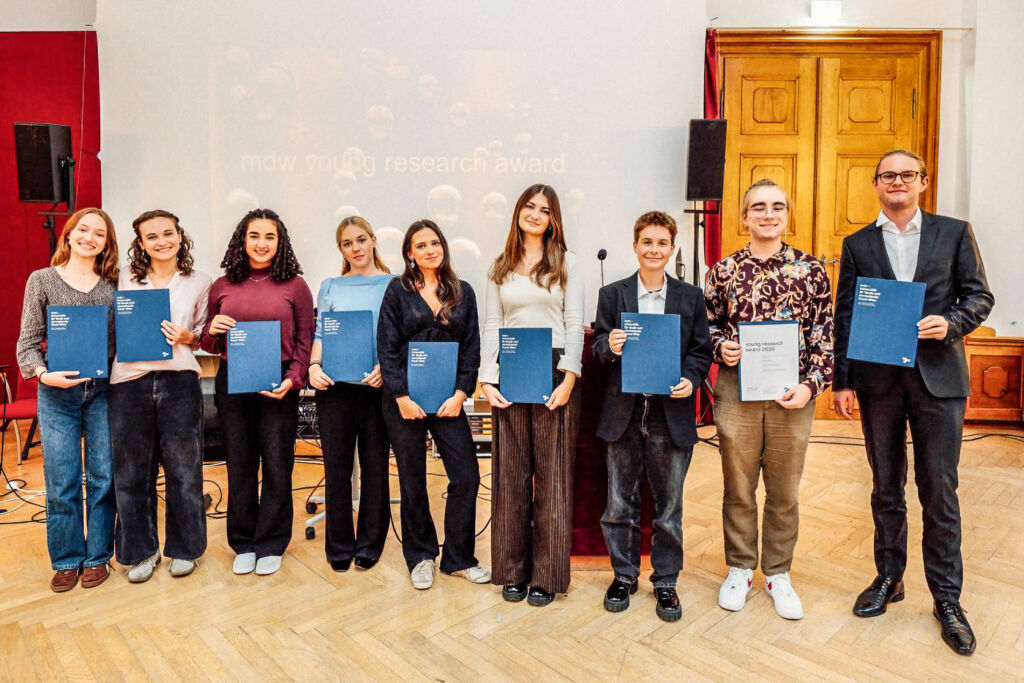
The eight honourable mentions likewise reflected the submissions’ broad range of themes and methodologies. The honourees included Gabriela Gvozden (BG/BRG Wels) for “Die Stimmen Bosniens” [The Voices of Bosnia], Eva Huber (BRG Boerhaavegasse) for “Geräuschüberempfindlichkeit. Ursachen, Auswirkungen und Bewältigungsstrategien” [Sound Hypersensitivity. Causes, Effects, and Coping Strategies], Alexander Kupzow (Akademisches Gymnasium Wien) for “Die Dan Cooper Chronik: Der Sprung und Fall eines Waghalses” [The Dan Cooper Chronicle: Jump and Fall of a Daredevil], and Franziska Raidl (BG Stubenbastei) for “Bewegung und Ideologie – Entstehung einer Choreographie zum Thema Radikalisierung” [Movement and Ideology – Creation of a Choreography on the Theme of Radicalisation]. Further honourable mentions went to Paulina Roßhap (BGBRG Keimgasse Mödling) for “HELDENPLATZ RELOADED – Eine exemplarische Neuinszenierung” [HELDENPLATZ RELOADED – An Exemplary Re-Staging], Laurin Emanuel Zinggl (BGBRG Oberpullendorf) for “Der kreative Entstehungsprozess eines Kurzfilms – Genre: Action-Komödie” [The Creative Process behind a Short Film – Genre: Action-Comedy], Fabian Salzmann (BRG Petersgasse, Graz) for “Nichtbinäre Geschlechtsidentitäten in indigenen Kulturen” [Non-Binary Gender Identities in Indigenous Cultures], and Emma Weiskopf (ORG Zams) for “Paris Paloma – Labour: Die Stimme der Veränderung. Feminismus und Musik im Fokus” [Paris Paloma – “Labour”: The Voice of Change. Feminism and Music in Focus].
A special emphasis was placed on the combination of research and composition. With input from Annegret Huber of the mdw’s Department of Composition Studies and Music Production (IKT), the Special Award for Composition was awarded to Marko Calic for “Komponieren mit mikrotonalen Systemen” [Composing with Micro-Tonal Systems]. His project’s recognition centred a practice that treats musical research not just as a subject but also as a creative process.
The award ceremony also provided a musical opportunity to hear and experience how research and artistic practice are closely intertwined at the mdw. Matthias Eberharter, a student of Peter Plessas at IKT, presented his Flock of Sheep (Nischenmarkt)—a work for a composed instrument using the software Pure Data—as part of the pre-ceremony mdw Campus tour for awardees, further competition participants, and music education inspectors from all over Austria. Following this, Flo Schauer, Leo Winter, and Kan Zhang—who study in the Contemporary Arts Practice MA programme at the Department of Music and Movement Education/Rhythmics and Music Physiology—presented their interdisciplinary work Radical softness – an improvisatory soft and radical Performance for viola da gamba, recorder, bass, vocals, and electronics.