The first time I heard about TENOR (the International Conference on Technologies for Music Notation and Representation) was through an open call back in 2018. As an artist who works primarily on a freelance basis, I tend to view such calls with a fair degree of scepticism. But after talking to Sandeep Bhagwati (who was organising that edition of the conference, to be held in in Montreal), I decided to respond to the call and submitted a composition along with an audio score. My submission was accepted, I went to Montreal to attend—and I was blown away! I got to know a community there that was very open and interested in all kinds of approaches to dealing with notation. What I found particularly interesting was the mix of scholarly and in part highly technical lectures, workshops, and artistic contributions. Composers, programmers, and scholars hailing from the most varied disciplines and geographic origins discussed new software, composing concepts, and philosophical questions. It was an international community in which I felt like I belonged. The year thereafter, I wrote the paper “Sound as Score”—which was admitted to the 2019 TENOR proceedings—and attended the conference in Melbourne. All this sparked a desire in me to bring both this conference and its community to Vienna. “Sound as Score” ultimately led to a successful PEEK submission—and as part of the resulting FWF project, my wish came true.
For a freelance artist, participation in an academic conference is something extraordinarily difficult. Unlike attendees who are employed by universities and have their costs covered by their home institutions, one has to pay one’s own participation fee and also fund one’s own travel and accommodations—despite how it’s precisely freelance artists, researchers, and programmers who can provide huge enrichment at such events. This is why TENOR awards participation grants to freelancers, a feature that distinguishes it from other academic conferences and can serve to highlight what’s so special about its community.
Every TENOR conference has a particular thematic emphasis set by its organising institution. While the 2025 edition in Beijing revolved around AI and notation, the Vienna conference focused on innovative developments in the realm of audio scores—encompassing notation, technologies, composing methods, interpretation, psycho-acoustic questions, and aesthetic analyses having to do with the concept of mimesis. The various contributions here made it possible to engage with these topics in a deeper, broader, and more nuanced manner. Doing precisely this had been a special desire, since only very few scholarly articles on the overall theme had appeared so far. In addition, the conference contributed to international awareness of this thematic complex and thereby aided efforts to admit audio scores to the canon of notation methods, in the process subjecting them to both scholarly and artistic evaluation and differentiation.
TENOR 26 Vienna is part of the research project “Sound as Score”, elements of which are being funded by the Austrian Science Fund (FWF) and organised in Vienna by the mdw and the Austrian Academy of Sciences (ÖAW).
Of the over 100 submissions that the conference received, 30 papers, nine workshops, four posters, and 18 sound-based works were ultimately presented. Nine participation grants worth between € 500 and € 1,500 were awarded, making it possible for freelance artists, programmers, and researchers from Europe, the USA, China, Taiwan, and Australia to attend. All submissions went through a peer review process—with all papers being evaluated by three reviewers, all workshops and posters by one external reviewer, and all sonic works by one external reviewer plus Artistic Chair Thomas Grill. Altogether, 61 external reviewers participated in this process.
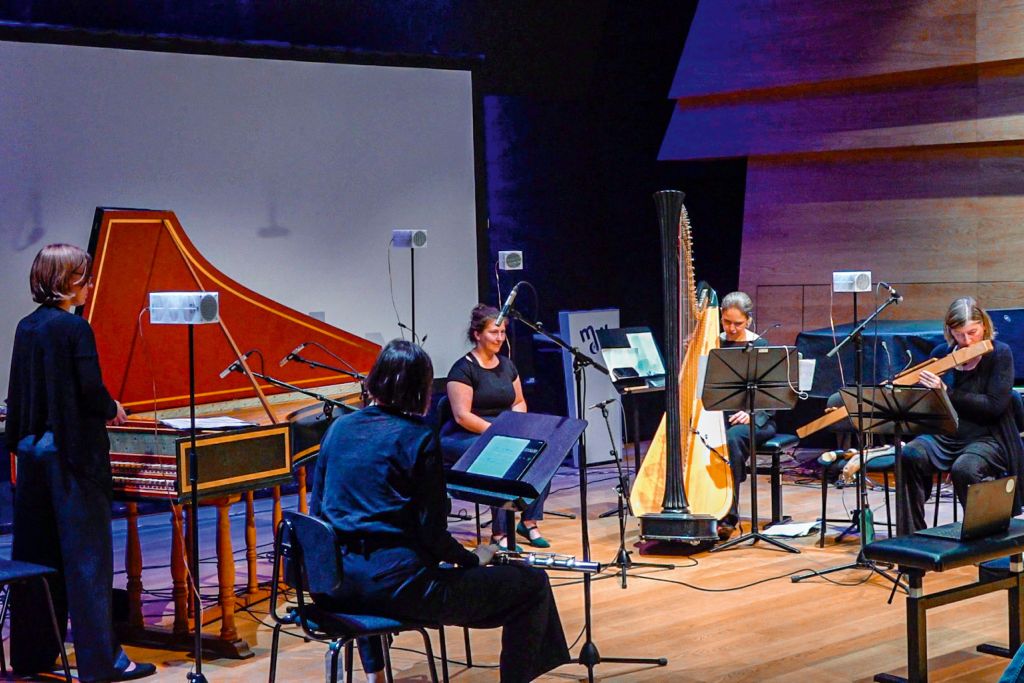
Florian Bogner brought the compositions to life in the Sound Theatre of the mdw’s Future Art Lab, and the submitted sound-based works were interpreted by the ensembles airborne extended, Black Page Orchestra, ANNEA, and the Soundscore Ensemble—the last of which was founded expressly for this conference and brought together mdw students under the baton of Jaime Wolfson.
The PEEK project “Sound as Score” is based at the mdw’s Artistic Research Center, and it is thanks to the fruitful collaboration between the participating mdw departments and the ÖAW’s Acoustics Research Institute (ARI) as well as the extraordinary support provided by mdw Vice Rector Johannes Meissl that it became possible to bring this conference to Vienna.