How the mdw’s Science Communication Activities Open Up New Perspectives
In the following conversation, Therese Kaufmann (head of the Office of Research Support), Anna Wukovits-Zethner (Office of Research Support), Ralf von Appen (professor of Theory and History of Popular Music), and Bianca Jasmina Rauch (film scholar and freelance journalist) provide mdw Magazine with some impressions from their experiences with science communication. They also talk about why science communication is about far more than just conveying research findings, the formats that reach people outside of the University, and ways in which dialogue with the public can open up new prospects for one’s own research.
In recent years, science communication has become an important topic. What is its significance to you, personally?
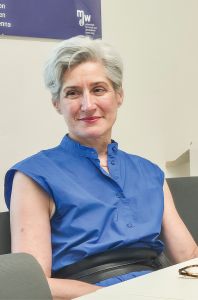
Therese Kaufmann (TK): For us at the Office of Research Support, science communication encompasses far more than just conveying research to the outside world. It also means creating new dialogue-oriented formats and involving different target groups. We want to get knowledge across but also open up the scientific and scholarly process itself, enabling it to be understood and thereby supporting the capacity for critical judgment.
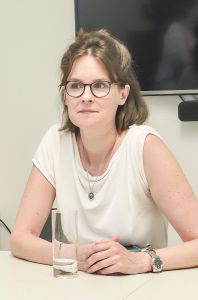
Anna Wukovits-Zethner (AWZ): We run further education offerings like the format “Wissenschaft im Ohr”, which provides guidance to researchers as they develop a podcast. And at the same time, we raise awareness around science communication and also do our own work to make research visible. In our view, this is all part of a university’s societal mission and lives from dialogue and exchange on an equal footing.
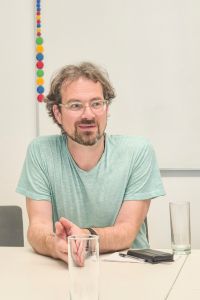
Ralf von Appen (RVA): I often end up engaging in science communication when someone from the media contacts me. When Oasis got back together, for instance, I was interviewed for a podcast—which represents a format that offers more space to sort through things than print journalism and also reaches different target audiences than the classic academic publication formats do. And an aspect that’s especially important to me is working with schools. We offer seminars where our students develop teaching formats that bring present-day research into the classroom. Beyond simply conveying knowledge, this is also about exchange—with the school kids’ perspectives often providing new impulses for research.
Bianca Jasmina Rauch (BJR): During my doctoral studies at the mdw, I was also active as a cultural worker. So in my case, scholarship, mediation, and cultural practice overlapped from the very beginning. Together with my colleague Barbara Wolfram, for example, I launched a podcast in order to make our research and that of our colleagues visible and easily accessible. I also consider events at cinemas, panel discussions, and introductory talks for film programmes part of science communication. They open up new perspectives and inspire further research.
How does the mdw support researchers as they go out in public with their work?
AWZ: Our office’s current performance agreement enables us to create offerings for our researchers on three levels—namely, those of annual awareness events, needs-based further training, and diverse ways of attaining visibility—like visiting schools as a science ambassador, contributing to the Long Night of Research, writing an article for mdw Magazine, or producing a digital format.
The option of generating visibility in schools—like via the platforms of the OeAD—and offering instructional material in addition to physical visits is a further way of building out contact with schools of general education. And where young people are concerned, we should also mention the mdw Young Research Award—which, since 2023, has been recognising Matura candidates’ pre-academic Matura papers as well as (since 2025) creative Matura submissions that pertain to music and other performing arts. With this award, we seek to honour young people’s active enthusiasm for these themes while also creating an awareness of the diversity of the mdw’s research themes and disciplines among the schoolteachers who advise students on these projects.
TK: We provide researchers with tools so that they can decide on their own how they’d like to convey their research or design formats that encourage active participation. To this end, we’ve developed formats of our own that support researchers in becoming active themselves. And next semester, we’ll also be offering media training.
How has the interest in science communication developed at the mdw in recent years?
AWZ: The degree of interest varies widely. On the whole, though, I sense a great deal of approval that’s only grown over the years. A good example is the Long Night of Research. What began with a lecture and a quiz on Heldenplatz has now come to encompass over 40 contributions on the mdw Campus alone. I’m convinced that every research topic has its audience, with the crucial thing being how the respective audiences can be reached.
BJR: A huge strong point of science communication is its immediacy. While publications and conferences often take a long time to come together, podcasts and other formats allow research to be seen sooner.
And work with schools is something I think is especially important. Particularly where the humanities are concerned, it’s at school that many young people first experience how they’re an area of research in the first place.
RVA: I can only second that. It really delights me how formats like YouTube videos, radio interviews, and—as mentioned—podcasts provide opportunities to convey research far more directly, in contrast to how the phases leading up to peer-reviewed publications can often take years. That’s a welcome challenge, almost similar to improvisation in jazz.
TK: It’s about entering into dialogue with people in various ways and affording them access to research. One thing that shows how the interest here is growing is the new science communication programme of the Austrian Science Fund (FWF), thanks to which we now have a digital musicology project on Vienna’s New Year’s concerts being conducted at the mdw.
Has science communication influenced your own research or even led you to new research questions?
BJR: Absolutely. In the podcast project with Barbara Wolfram that I mentioned before, she and I learned lots from each other and our respective methodological approaches as well as from the concerns and questions of our guests. And the intense exchange with Barbara also gave rise to new projects and research questions.
RVA: I recently received an enquiry as to just what relevance rock music might still have in 2026. It’s a question that wouldn’t necessarily have occurred to me. The journalist said that she was seeing a revival, but I was more sceptical—and that gave rise to an interesting discussion. I’ve since dug deeper into the topic, and the article I wrote as a result is something I’ll soon be discussing with my students. What’s more, it’s entirely possible that the work I’ve done here might ultimately produce a scholarly essay.
What contribution can science communication make to dealing with scepticism toward science and research?
TK: Science communication alone can’t counter such scepticism. But it can lend some transparency to just how scholarly and scientific inquiry arise and function, in the process cultivating trust in research institutions as well as strengthening skills like people’s critical faculties.
RVA: I think it’s important to ensure that kids in schools are already clear on what distinguishes science and scholarship from mere expressions of opinion—things like critical scrutiny, methodologically grounded work, and peer review. This can help school kids more accurately assess media reporting.
AWZ: I see huge potential in using science communication tools to reach people who aren’t actively interested in research. In schools, you reach a far broader audience than at events like the Long Night of Research. What’s more, kids and teens can act as multipliers.
BJR: Things get problematic when research is harnessed for political purposes or when individual disciplines—like gender studies—are denied their right to exist. That can intensify scepticism and hostility toward science and research, which is why it’s all the more important to make scientific and scholarly work transparent and allow its societal relevance to become visible.
Science communication is time-intensive. How do you manage to do it alongside research, teaching, and all your other responsibilities?
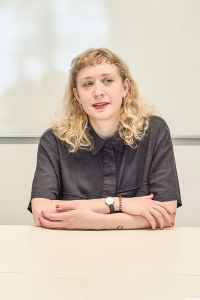
RVA: I try to respond to enquiries by concentrating on a single aspect. So if an enquiry come in that’s outside of my thematic wheelhouse, I’ll perhaps offer to analyse an individual song rather than provide an entire overview of a musician. That way, I can contribute something of substance and show how I do scholarly work.
BJR: It used to often feel like science communication activities hardly registered with funding bodies or in terms of one’s academic career—for which reason many people preferred to invest their time in other work that would earn them clear-cut academic recognition. Nowadays, however, science communication is valued a great deal more—and that provides people with additional motivation to invest time in it.
TK: Our overall desire is to support researchers—through further training, various types of advising, and formats that facilitate science communication. We’re indeed seeing great interest and a huge willingness to take advantage of these options, and we’re very grateful to all researchers who are willing to include science communication in their activities. They lend visibility to the research going on at the mdw. And in the process, they make an important contribution to countering disinformation and supporting discursive competence as well as the development of democracy.