Talking sheep are nothing new in cinema and television, one might think at first blush. And even so, the central animals in the new series by Alex Reinberg and Leni Gruber (who shared both screenwriting and directing) are more than just fluffy lead characters in an absurd story. Reinberg and Gruber plus Florian Brüning (production) and Dominic Kubisch (editing) met with mdw Magazine to offer a deeper look into their innovative and entertaining miniseries project.
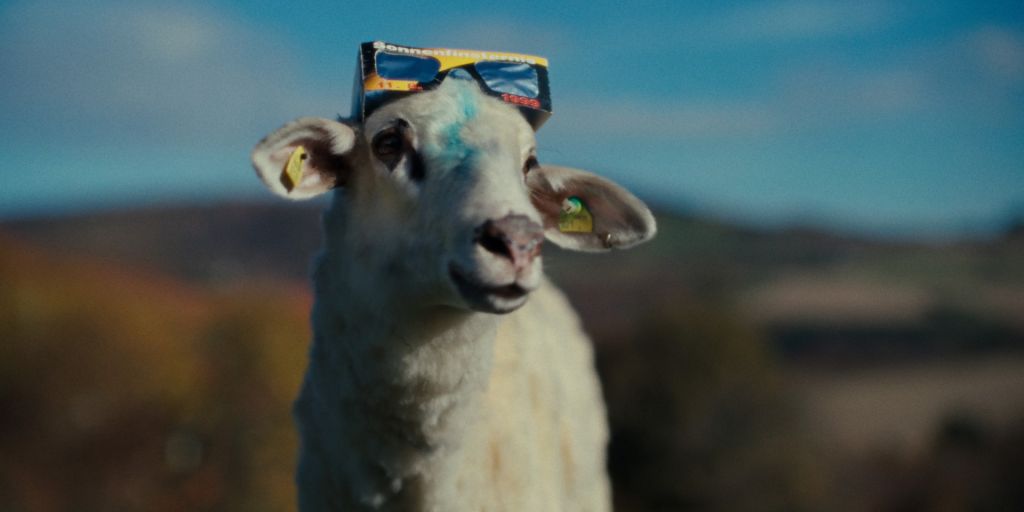
“We domesticated humans and shaped them in accordance with our ideals.” This statement of belief, uttered by one of the woolly leads, is heard very early on in the successful new series SHEEP. So the shock is accordingly extreme when it begins to dawn upon them that human beings—first and foremost their own farmer—perhaps aren’t so nice and harmless. And that their herd is actually destined for slaughter. But first things first: at the outset of this series, it’s only the sheep Oliver who becomes privy to this “revelation”. He subsequently embarks upon a journey where he has to to confront his fears, convince his own herd, and save them from certain death. Whether he succeeds is a question we’ll leave open, here. Regardless of how it all ends, the series creators succeed in exploring philosophical conundrums while also questioning the meaning of life, traditions, and hierarchies with an unbelievable degree of lightness and simultaneous seriousness. Their lovingly detailed story unfolds in a way that initially disguises itself as light entertainment—but with every dialogue and every scene, it becomes increasingly clear that it’s about far more than just cute sheep on a farm.
The overall idea arose from a childhood experience had by the director and screenwriter Alex Reinberg. He authored the script’s initial rough draft together with Leni Gruber—after which Sebastian Huber from the satirical online newspaper Die Tagespresse was brought on board for the final humouristic touch. Realising the series became possible thanks to a pitch made to the ZDF broadcasting format “Das kleine Fernsehspiel”. This avenue of cooperation had been suggested by Florian Brüning, film producer and founder of the production company HORSE&FRUITS, who was looking to realise a project with the two. Their idea ultimately won over not just the German broadcaster ZDF but also Austria’s ORF. The principal characters—namely, the sheep themselves—were carefully selected, hand-raised by animal trainer Katja Hawliczek, and gently acclimated to each filming situation no matter how unusual. “Since the idea of animal protection was especially important to us, we didn’t remove any lambs from their natural environments. Instead, we maintained close contact with sheep farmers who’d get in touch with us whenever they had lambs who’d been rejected by their mothers,” explains Brüning. Despite their training, the team’s animal partners remained the biggest challenge. “What’s great about animals is that they always perform authentically and well. But gazes, sight lines, and angles were difficult, since those are often a matter of millimetres,” explains Gruber, to which Reinberg adds: “You have to find innovative solutions, and limitations like these also give rise to their own sort of creative freedom.”
The film’s editing was done by Dominic Kubisch together with his colleague Pia Huemer. And in this postproduction work, as well, it was the sheep that posed the greatest difficulty—because while actors’ dialogues can’t be changed after the fact, it was indeed possible to change the material showing the sheep. “Always having the option to change everything was a challenge. But a helpful aspect here was that both the editing and the directing work were done in two-person teams, with decisions being made jointly. What’s more, the fact that we had two mixed-gender duos at work here also provided a wonderful sort of balance,” Kubisch explains. He and Huemer departed from the conventional strategy of dividing up their work by episode, instead adopting a job-sharing model in which they divided up the individual steps between them. “This way, we were both responsible for everything and always informed about every step.” Brüning’s take on such a division of labour is likewise positive: “It’s fantastic for the creative process, of course—though it’s also clear from a producing standpoint that it’s slower and more expensive this way. In everyday production reality, there don’t yet exist any clear-cut structures for this kind of work as a collective. Things are indeed changing in this respect, but if you want to follow this approach today, you still have to figure out a lot for yourself.” What Leni Gruber especially values about this kind of job-sharing is the built-in second opinion and additional perspective, which can provide support and allow new ideas to arise. “A project like SHEEP, where the production budget is fairly low and you just do need to help out differently at the directorial level, wouldn’t have been possible alone,” says Reinberg.
Starting October 13, 2026, on ORF
To dub the animals’ voices, the project succeeded in engaging true greats from the German-speaking acting scene like Jella Haase, Merlin Sandmeyer, Birgit Minichmayr, Roland Düringer, and Michael Ostrowski. “When we first heard the sheep with these voices, it was a huge aha moment. It was touching how Oliver, for example, suddenly came alive,” recalls Reinberg. Gruber, Reinberg, and Kubisch studied at Film Academy Vienna as part of the same intake and had worked together on projects before—including the short film Preiswerte Lösungen für ein besseres Leben, which won the Thomas Pluch Screenwriting Award. Brüning had graduated earlier, but he and the others knew each other from when their studies overlapped. Large parts of the crew likewise studied at Film Academy Vienna. “Our collaboration shows what makes this programme so special: you meet the others in your intake, grow together by collaborating on projects in a protected environment, and ultimately go out into the industry as a strong collective,” says Kubisch.
The fact that the intelligent existentialist humour in SHEEP also works for an international audience has since been proven by the team in Cannes. At Canneseries, which is to series what its more famous sibling on the Côte d’Azur is to films, SHEEP received the Student Award. “Getting invited and participating had already ensured us a fantastic experience, but receiving the Student Award—which is conferred by film students, meaning colleagues from a new generation of film professionals—was just unbelievable,” says Gruber in hindsight.
“SHEEP is something very special and perhaps not your classic show for the 8:15 p.m. timeslot. And to Leni and me, it was important to tell the story of a character who has a conflict and who’s relatable,” says Alex Reinberg. Their success so far is proving how right their decision to do so was, and both TV and streaming audiences will be able to get their own impressions of Oliver and his herd beginning in October on ORF television and its streaming service ORF ON.