Musical New Year’s Greetings for 1938 by Hans Gál and Leonhard Märker
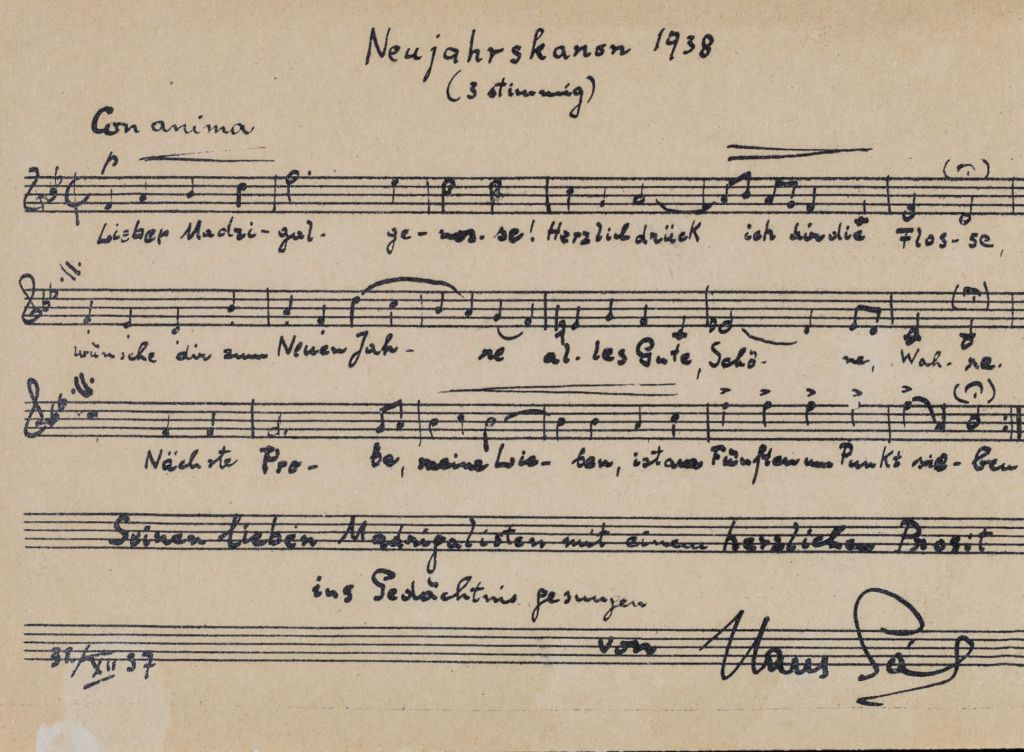
Dear madrigal comrade mine!
I grasp your paw, so warm and fine,
and wish you for this year so new
all that’s good, fair, and true.
The next rehearsal, my dearest lot,
is on the fifth, at seven on the dot!
It was with these tongue-in-cheek lines that Hans Gál (1890–1987) gently but firmly reminded the members of his madrigal choir of their first rehearsal in 1938. This musical good-luck pig was served up as a three-part canon formatted as a postcard and garnished with tastefully placed madrigalisms. And indeed, madrigals were a huge love of this versatile musician—a fact that even earned him the nickname “Madri-Gál”.1
This brought his initially meteoric career to an abrupt halt. Gál’s rise—interrupted only by his military service in World War I—had been a classic success story: studies in composition under Eusebius Mandyczewski in his hometown of Vienna, a State Prize in Composition in 1915, the resounding success of his second opera Die Heilige Ente [The Sacred Duck] upon its première in 1923, and finally his 1929 appointment as rector in Mainz. For his fourth opera, Die beiden Klaas [Rich Claus, Poor Claus], there had even been a double-première planned for 1933 in Dresden and Hamburg—a testament to the great public resonance he had achieved as an operatic composer.3
These performances never took place. Due to his Jewish origins, Gál was struck from the season’s programmes—and following his dismissal as rector, he returned to Austria. Around the same time, Ödön von Horváth created a drama whose relevance extended to Gál’s situation in life: Hin und Her was premièred in Zurich with Gál’s stage music in 1934. Gál went on to grapple in a stirring and confessional manner with the theme of ephemerality in his cantata De profundis op. 50 of 1936/37.
Following the aforementioned New Year’s, the choir that had been motivated by its director in such a witty way was left only weeks to rehearse with him. On 11 March 1938, Federal Chancellor Schuschnigg resigned. German troops marched into Austria the next day, with Austria then being annexed by Nazi Germany on 13 March. Two days thereafter, Hitler was celebrated by the masses in Vienna. And with that, Gál found himself compelled to pack his bags for a second time. His subsequent journey took him to London, the Isle of Man (where he was interned as an “enemy alien”), and Edinburgh—where he then settled.
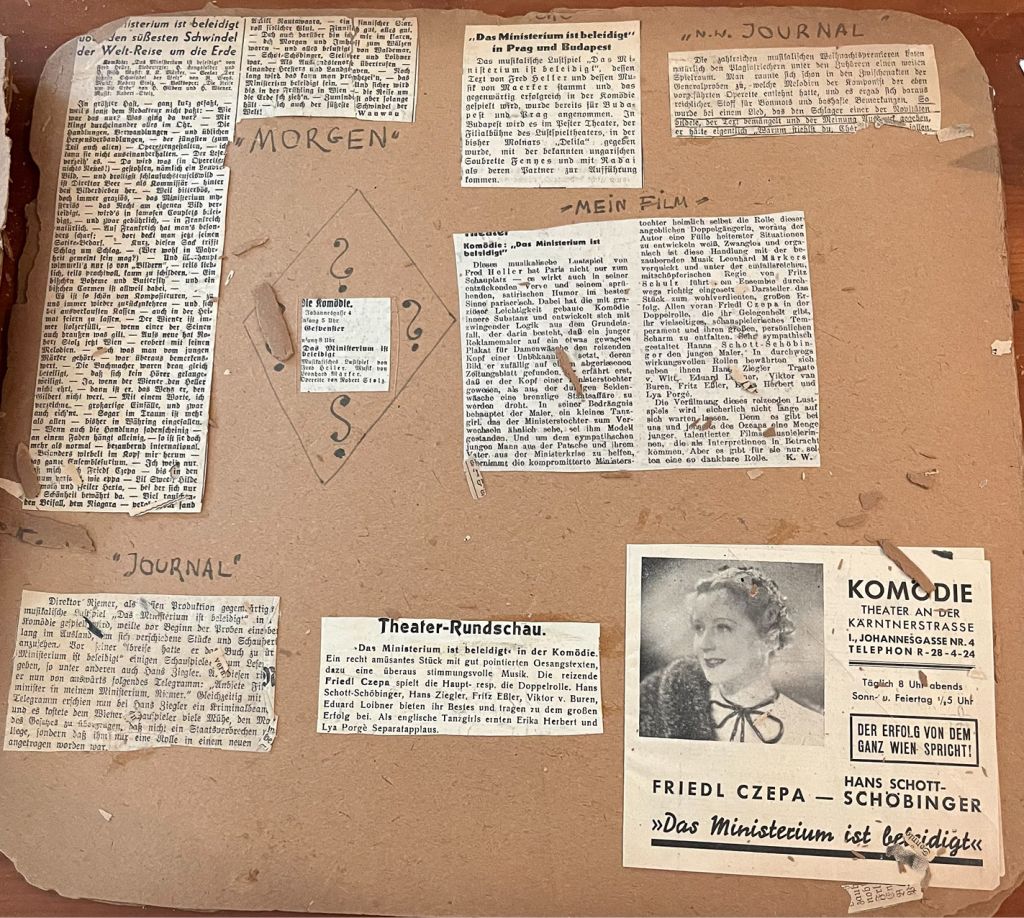
Meanwhile, even as a large image of the new strongman dominated the front page of the Wiener Salonblatt of 20 March 1938, some things seemed to carry on as usual on the newspaper’s back pages. Between reports on celebrities and the nobility, one finds news of a sensational success: at the “Komödie” at Johannesgasse 4 (now the cinema Metro Kinokulturhaus), the comedy The ministry is insulted [Das Ministerium ist beleidigt] had just logged its hundredth performance. Its music was by Leonhard Märker, one of Gál’s former composing students.4
Märker, who had been born as Leonhard Kuhmärker in 1910 to a Jewish family in the Galician town of Brody (now in Ukraine) and had grown up in Vienna, studied composing with Hans Gál for several years and then continued his solid compositional training with Alban Berg. With the skills he had acquired from these two composition teachers of widely divergent stylistic bents, he then devoted himself to the composition of musical comedies and film music beginning in 1934.
It was with music for the comedies Der schiefe Hut (André Birabeau, translated by Bertha Zuckerkandl), Why are you lying, darling? and the aforementioned The ministry is insulted that he began establishing himself in Vienna’s theatrical scene around 1936. Märker’s career then advanced in a remarkable and lightning-fast way: in 1937, his music was heard at the (Vienna) Scala, the Raimundtheater, the Theater in der Josefstadt, the Volksoper, and at theatres in Baden, Graz, Linz, and Innsbruck. A great many of his musical numbers were also published and broadcast on the radio.
For New Year’s Eve in 1936, Märker and his lyricist Hans Lengsfelder had still come up with carefree New Year’s couplets. Nothing comparable has come down to us for the New Year’s celebrations of 1937/38, and from January 1938 we have a song entitled “Es geht ein kalter Wind durch die Stadt” [A Cold Wind’s Blowing through the City]. In November of that year, with the Nazi terror having reached a new fever pitch, Märker managed to emigrate to France.
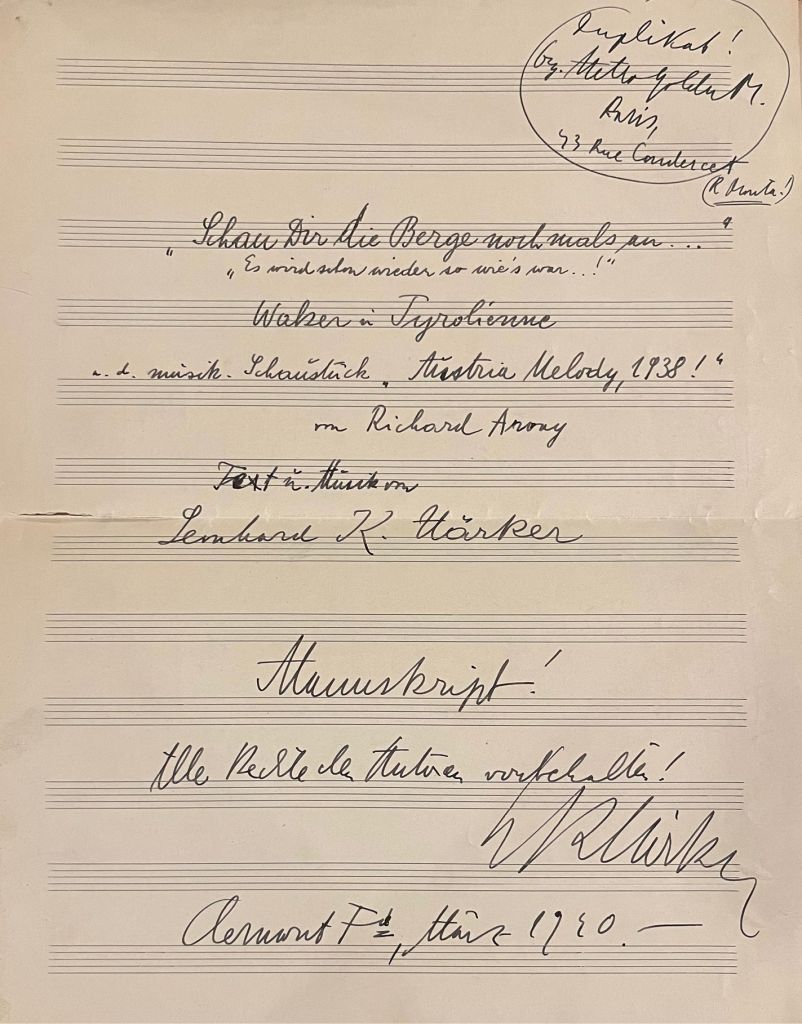
Several pages have come down to us from a March 1940 piece composed in Clermont-Ferrand: these are from Märker’s music for a “musikalisches Schaustück” [musical pageant] by the screenwriter Richard Arvay entitled Austria Melody, 1938. A couple of evocative titles and incipits have been preserved: “Schau Dir die Berge nochmals an…” [Take another look at the mountains…], “Es wird schon wieder so wie’s war…!” [Things will go back to how they were…!] and “Es gibt im Leben Stunden…” [There are hours in one’s life…].
Leonhard Märker was interned in multiple French camps beginning in 1940—and in 1942, he was finally able to emigrate via Casablanca to the USA, fleeing to safety at quite literally the last possible moment. He was successful there with a few songs (released under the newly adopted name Leonard Marker), and his multiple years of collaboration with Erwin and Maria Piscator proved extremely productive. However, he never achieved a level of success comparable with that of his pre-war career. Marker died in New York in 1993. In 1945, he had received a letter from Richard Arvay, who had also emigrated to the USA. However, Arvay made no mention of the piece on which they had collaborated in 1940. Indeed, nothing was as it had been.
Post scriptum. Early August 2026, Philadelphia: together with the composer’s son James Marker and granddaughter Emily Marker, I am sitting in front of twenty archival boxes that have been filled over the preceding days. They contain items including the manuscript of a symphony, postcards from Alban Berg, dozens of Lieder, chansons, and songs, letters from internment camps, a sheet of music with a friendly dedication penned by Robert Stolz, numerous programmes and posters, and hundreds of reviews; thousands of pages filled with euphoria and fear, hope and despair. This intermediate step on a journey of discovery leaves us both overwhelmed and reflective.
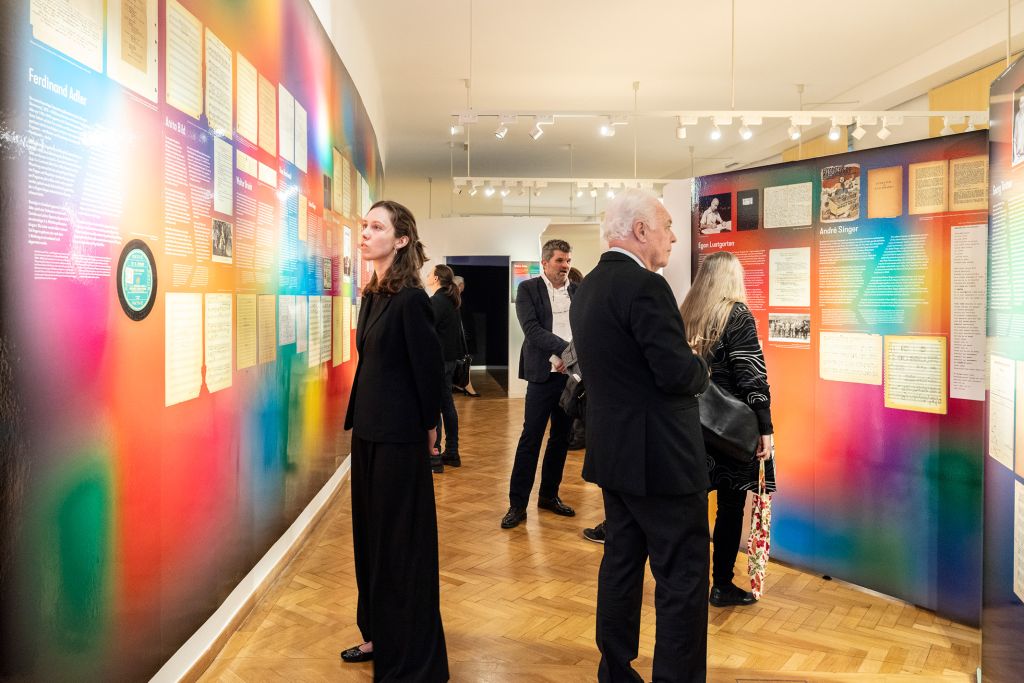
The artistic estate of Hans Gál resides at the Exilarte Center of the mdw. An initial impression of the Center’s collection, which includes the estates of over 40 musicians, can be obtained at the anniversary exhibition Out of the Shadows into the Light – Persecuted Composers and their Legacy, open to the public at Lothringerstraße 18 until 19 December 2026.
- For an overview of Gál’s life and works, see Eva Fox-Gál and Anthony Fox, Hans Gál, Ein Jahrhundert Musik. Berlin, 2012. Warm thanks for their research contributions and comments on this text are due to Katja Kaiser, Katharina Reischl (both of Exilarte, mdw), Christine Blanken (Bach Archive Leipzig), and Johannes Volker Schmidt.
- Uwe Wittstock, Februar 33: Der Winter der Literatur. Munich, 2021.
- On the opera Die Heilige Ente, see Michael Haas, “Hans Gál, His Sacred Duck and Beyond,” blog Forbidden Music, 3 February 2020 (forbiddenmusic.org/2020/02/03/hans-gal-his-sacred-duck-and-beyond), last accessed on 7 August 2026.
- Wiener Salonblatt, 20 March 1938, p. 11.