Recognising Innovative, Societally Relevant Research in the Academic Doctoral Programme
in the Academic Doctoral Programme With its conferral of the 2026 Herta and Kurt Blaukopf-Award, the mdw has once again recognised excellent dissertation projects that stand out for their innovative methods, interdisciplinary approaches, and socio-political relevance. This award carries forward the legacy of Herta Singer-Blaukopf (1924–2005) and Kurt Blaukopf (1914–1999), two scholars persecuted under National Socialism whose work had a lasting impact on both musicology and music sociology, and simultaneously helps to position the mdw as an international centre of academic research.
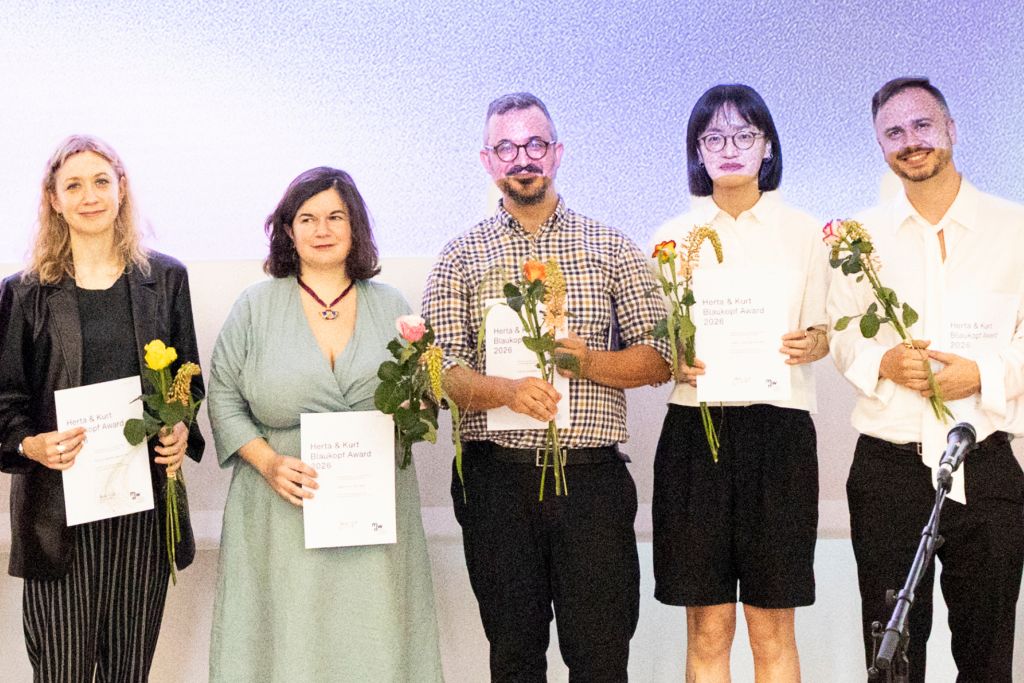
Rector Ulrike Sych, in her opening remarks, stressed the importance of scholarly diversity—especially in view of current developments at universities: the mdw, she stated, must remain a place where research on societally relevant topics enjoys protection and support even when the topics in question are supposedly “niche”. This year, awards went to five dissertation projects that impressively demonstrated the thematic breadth of research at the mdw. In Vocal Yiddishkeit. Postvernacular Transmission and Performance of Yiddish Folksong, Isabel Frey examined the transmission and performance of Yiddish folk music. Bianca Jasmina Rauch, in Widerständige Blicke: Weibliche Identitätssuche im Coming-of-Age-Film [Resistant Gazes: The Search for Female Identity in the Genre of the Coming-of-Age Feature Film], devoted herself to female perspectives in film. In Music in the Experience of Forced Migration from Syria to the European Borderland, Ioannis Christidis explored the role played by music in the experiences of Syrian refugees. Alexander Flor analysed the interpretation and presentation of early music on the record market in Das Dramma per Musica im Konzeptalbum [The Dramma per Musica in the Concept Album]. And finally, in The Elusive Dancefloor, Tianyu Jiang examined music, club spaces, and social relationships within Shanghai’s queer and women-centred underground music scene. The jury members gave brief introductions of the award-winning projects, after which the awardees themselves provided insights into their research. A noteworthy aspect of this presentation was the matter-of-fact coexistence of starkly contrasting research fields—ranging all the way from Yiddish musical culture to flight and migration, queer club cultures, and historically informed performance. Moreover, a particular strength of the mdw that visibly emerged here was precisely the combination of such diverse topics—encompassing up-to-the-minute social and political issues as well as specialised artistic matters—with superlative academic standards. The award ceremony’s artistic programme echoed the themes of the recognised dissertations. Syrian musician Salah Ammo presented musical contributions relevant to the research of Ioannis Christidis, while an excerpt from Jessica Hausner’s film Flora took up Bianca Jasmina Rauch’s perspective as a film scholar. A historical take on the academic legacy of the event’s namesakes was provided by Rosa Reitsamer: in her lecture, entitled “The Archival Turn in Music Sociology”, she highlighted the significance of the Kurt Blaukopf Archive for the history of music sociology in Austria while also calling audience members’ attention to the frequently overlooked contributions made to the “Viennese School of Music Sociology” by Herta Blaukopf, Elena Ostleitner, Irmgard Bontinck, and Dora Schimanko. In all of this, the award ceremony bore renewed witness to how the mdw is a place where scholarship, artistic practice, and social responsibility enter into productive symbiosis—entirely in the spirit of Herta and Kurt Blaukopf’s work.