Musica inaudita is a student initiative at the Berlin University of the Arts (UdK) that strives to provide audibility and visibility to marginalised composers who’ve received little or no attention in the classical music world. Just how they accomplish this was recently explained to mdw Magazine by Musica inaudita’s Sophie Mattiuzzo and Jelena Wißmann, who had come to Vienna for the conference Excellently Engaged. At the conference, they held a workshop together with the inn.wien ensemble entitled “Unlearn the canon – diverse repertoire now!”.
Since you’ve led a workshop today—far from your first, of course—we’d be interested to know: What actually happens in a workshop like this one?
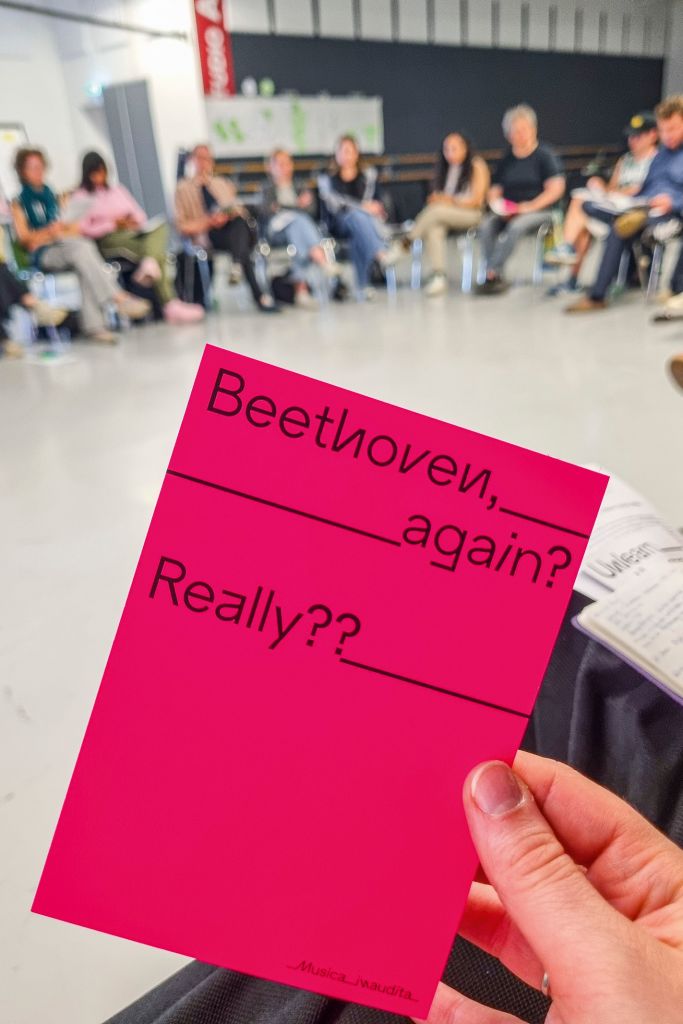
Sophie Mattiuzzo and Jelena Wißmann (SM/JW): We start out by explaining why we arrived at the imperative to ‘unlearn the canon’ and how we justify it. An important place to start from here is to ask what a canon actually is. And to our minds, it’s crucial highlight just how strongly “the canon” is shaped by societal power dynamics. Which is why we also address music theory, since this is a pivotal factor behind what music is held to be of value, what gets taught, and what ends up enduring over time. To this end, we form small groups and dig into scholarly texts from the realm of musicology and elsewhere1 with an intent to spark collective processes of reflection. And we conclude by presenting our digital database of initiatives, archives, and various media formats, which we compiled with an eye to facilitating further research.
How did this initiative come together? And how is the work you do integrated into your university’s internal structures?
SM/JW: Our initial idea had been to organise a concert series, the hope being that students would discover music there that appealed to them aesthetically and could be included in their own repertoires. However, we soon realised that a single concert isn’t enough to achieve this effect. What it actually takes are ongoing concert formats supplemented by scholarly engagement with “the canon” as such.
Even so, we do also see how it’s particularly our concert work that provides an important argument. We have outstanding musicians on board, here, and the quality is in no way inferior to that of other concert formats. But it’s this combination of academic inquiry and artistic practice that makes our work so strong. We’re not simply claiming that alternative repertoire is compelling; we’re demonstrating it in concrete ways. Our concerts therefore serve as a sort of practical counter-proof vis-à-vis the status quo.
As far as institutional anchoring goes, creating space for our work in the first place requires us to be active in university politics. We’re therefore in close contact with our dean and other top university administrators. But at the same time, we have to rely on student assistant positions and support from individual professors. And while our university does provide us with resources like office space and the use of concert halls, our work is still carried out on a predominantly voluntary basis.
The UdK Berlin also has a “Critical Diversity Policy”, which serves as a framework for anti-discriminatory and diversity-related efforts and covers various areas of action and measures. Is your work integrated into this?
SM/JW: Not directly, even if we often refer to the Critical Diversity Policy and the measures it lays down in order to justify our efforts. We do, however, work very closely with the UdK’s equality officers—both at the central level and within the individual faculties.
What do you think it will take for the repertoire at university-level institutions to become more diverse? Where exactly can universities and academies take concrete action?
SM/JW: In our view, examination guidelines and curricula represent key levers for change. In today’s workshop, for instance, the question came up as to how entrance examinations are actually devised and whether one couldn’t deliberately specify more diverse repertoire. And at the mdw, you do indeed have lists of recommendations that include works by composers outside of the traditional canon. However, these lists can sometimes be difficult to find. When you initiate changes in a given area, some friction is inevitable. This is partly owed to how the existing systems are very closely intertwined. The works called for in the entrance exams already pave the way for those in the final exams—which, in turn, are modelled on orchestral auditions and competitions. Everything’s interconnected. We do believe, however, that these instances of irritation are necessary—and if things start to move in many places simultaneously, the overall structures will also experience gradual change. The university acts as a multiplier, here.
What are you looking to pass on to students as they continue their own journeys?
SM/JW: The certainty that even if you sometimes feel alone, it’s worth it to follow your own convictions. It takes courage to question existing structures. Particularly when you’re a student, you’re dependent on people in positions of authority in lots of ways—which can easily give rise to a feeling that you can’t contradict anyone and have to please everyone. Our own experience, however, looks different: it’s often the case that as soon as you muster up the courage to take a stand, you realise how there are others who harbour similar questions or doubts. You find allies with whom you can join forces.
- Ewell, Philipp A.: “Music Theory and the White Racial Frame.” In: Music Theory Online. Issue 26, no. 2, 2020.
Huber, Annegret: “Meisterinnenwerke und Meisterwerkanalyse.” In: History Herstory: Alternative Musikgeschichten. Eds.: Annette Kreutziger-Herr and Katrina Losleben. Böhlau, 2009, p. 125–139.