Minority Research at the mdw – A Success Story
November 2019 witnessed the establishment of the Music and Minorities Research Center (MMRC) at the mdw, made possible by the Wittgenstein Award (EUR 1.4 million) conferred upon Ursula Hemetek for her ethnomusicological minority research in 2018. On 30 April 2026, the Wittgenstein Award-funded phase of the MMRC’s activities ended after 7 years.
A few facts about these 7 years:
Following the initial start-up phase, which drew on the EUR 1.4 million award and significant support from the mdw, we established a thriving research centre. Since then, the MMRC has attracted over EUR 2.1 million in additional third-party funding. The financial and intellectual support provided so far has proven to be a rewarding investment in the mdw as a place of research.

The MMRC has successfully completed 7 research projects, and 7 more are currently in progress. Over 25 individuals have been or are currently involved on site, and the international Advisory Board with its 6 current members plays a central role. Another 7 international experts are former members.
The online journal Music & Minorities is publishing its 5th volume in 2026, for which there are currently (as of July 2026) 7 articles and 3 reviews. The number of article submissions is steadily growing, and the strategy of publishing special collections of articles on specific topics in addition to open submissions has proven successful.

The publishing activities of the MMRC’s team members have been remarkably prolific (over 90 publications), and the MMRC has also acquired expertise in creating digital exhibitions: Ružake gila logs around 1,000 page views per day worldwide (with a cumulative total of 700,000 so far), the next exhibition—Objects and the Archive—will be presented this autumn, and a further exhibition—Music, Conflict and Forced Migration—is currently being planned. The number of lectures and presentations delivered by individuals associated with the MMRC in Austria and abroad now stands at over 120.
The MMRC’s international visibility and standing are evident, among other things, in the growing interest in Advancing Music and Minorities Research (AMMR), its annual seed money programme for the development of research grant applications. AMMR attracted 17 submissions in 2026, by which time 9 fellowships had already been awarded. 2 fellows are currently working on new applications. And of the 7 applications submitted by past fellows to the Austrian Science Fund (FWF), 5 ultimately resulted in the awarding of grants—entailing a success rate in excess of 70 %. By comparison: in 2025, the average approval rate for the FWF funding programmes in which the AMMR fellows were successful—“Principal Investigator Projects” and “ESPRIT”—was around 28 % for each.
The MMRC has built numerous cooperative relationships both domestic and international as well as a strong network of experts from the various relevant communities. This is also evident from the many events held each year. Since its founding, the MMRC has successfully staged 13 major public events and collaborated with its partners on further events. Minority research is now established internationally in the field of ethnomusicology—and in the MMRC, it has a visible hub in Vienna. Many initiatives originate here, and strong international interest also supplies the MMRC with a wealth of ideas from elsewhere for new and relevant research approaches.
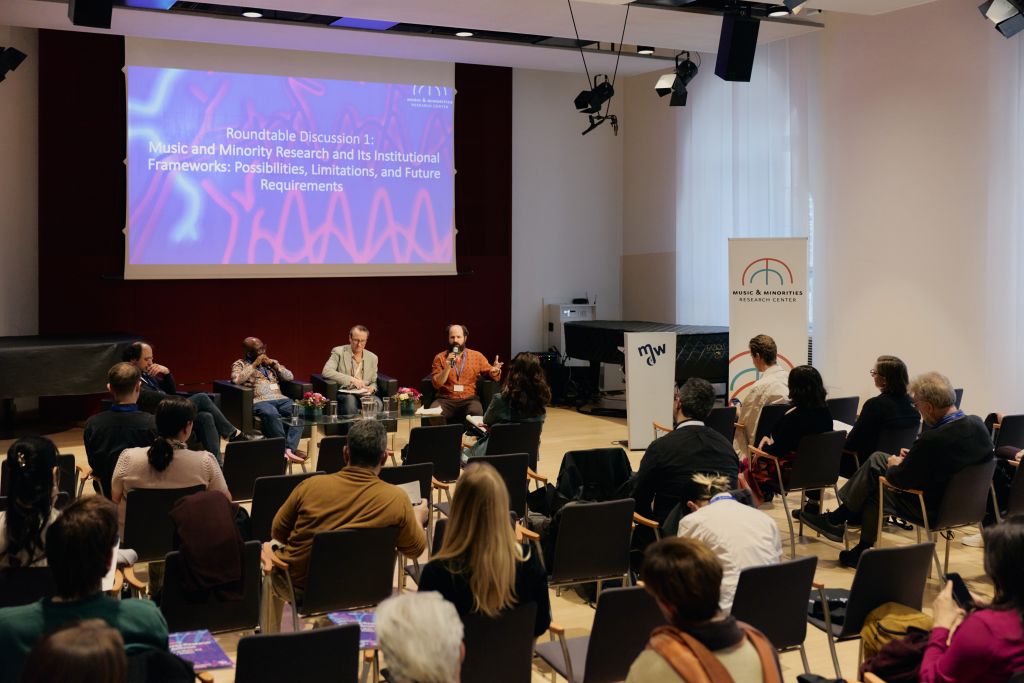
The MMRC is and will remain committed to ethnomusicological research of socio-political relevance. Moreover, the MMRC’s activities are consistently informed by a socially engaged and dialogue-based approach in keeping with the University’s broader objectives. In its projects and events, the MMRC strives to counteract discrimination against marginalised groups and individuals and to help the mdw become a “place of discourse for cultural diversity” (Development Plan of the mdw, p. 49). The MMRC views its integration into civil society as central to its work. Through its sustained commitment, it aims to promote knowledge-sharing collaborations, socio-political relevance, and transdisciplinary impact.