Wide-Ranging Services and Reliable Standards in a Great Location
A mid-October day at 2 p.m. The University Library (ub.mdw) is bustling with activity. The handheld scanner at the circulation desk beeps about once per second; off to the side, orchestral scores are being prepared for a concert at the Schönbrunn Palace Theatre. Out in the reading room, some first-year students are being introduced to the library’s collection of complete editions. A PhD student has dropped by the subject specialists’ office for advice on open access publishing options for her doctoral thesis, while a writing group discusses the potential of freewriting with the writing tutor in the group room. And in the periodicals lounge, there’s a student power-napping on a sofa between lectures.
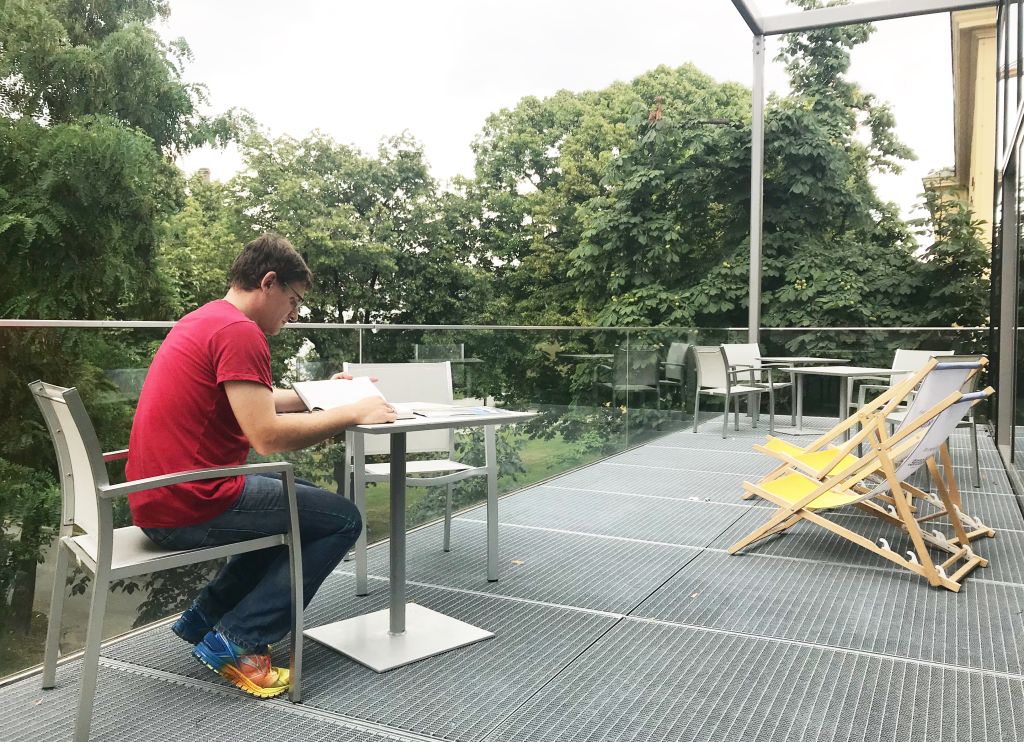
It’s been a full ten years since the ub.mdw moved from the former Academy building at Lothringerstraße 18, its home of over a century, to Anton-von-Webern-Platz. Since then, it’s been providing even more effective support to students, lecturers, administrators, and music enthusiasts—with services as diverse as its users’ needs. The mission being pursued is twofold: to preserve knowledge and to help shape the future. And with its move to the Campus, the ub.mdw has evolved into a state-of-the-art music library that is now even better equipped to fulfil what has become libraries’ 21st-century mission—namely, to be “facilities that preserve, that mediate and educate, and that protect society”1. Above all, its relocation to the mdw Campus—and thus to the heart of our institution—brought with it a significant gain in space. Space for easier access to resources, for quiet zones and study areas, but also for socialising and knowledge-sharing. And while numerous libraries are increasingly sending their physical collections to offsite closed-stack facilities or refraining from the acquisition of any new materials, the ub.mdw still views itself as a hybrid library. So alongside a continually growing range of e-books, e-journals, databases, and digital sheet music, it will remain possible to browse the shelves and perhaps discover a book or a piece of music that one might not otherwise have come across. Even so, still more things are required in order for knowledge to be preserved and new knowledge to arise—things like quiet spots where thoughts can wander and creative ideas can grow. The open-access book area, affectionately known as the “treehouse”, is just such a spot, having been redesigned this past summer with comfortable seating and modern workspaces. And another place to peruse things from the comfort of a sofa is the newly created periodicals lounge by the open-access music scores.
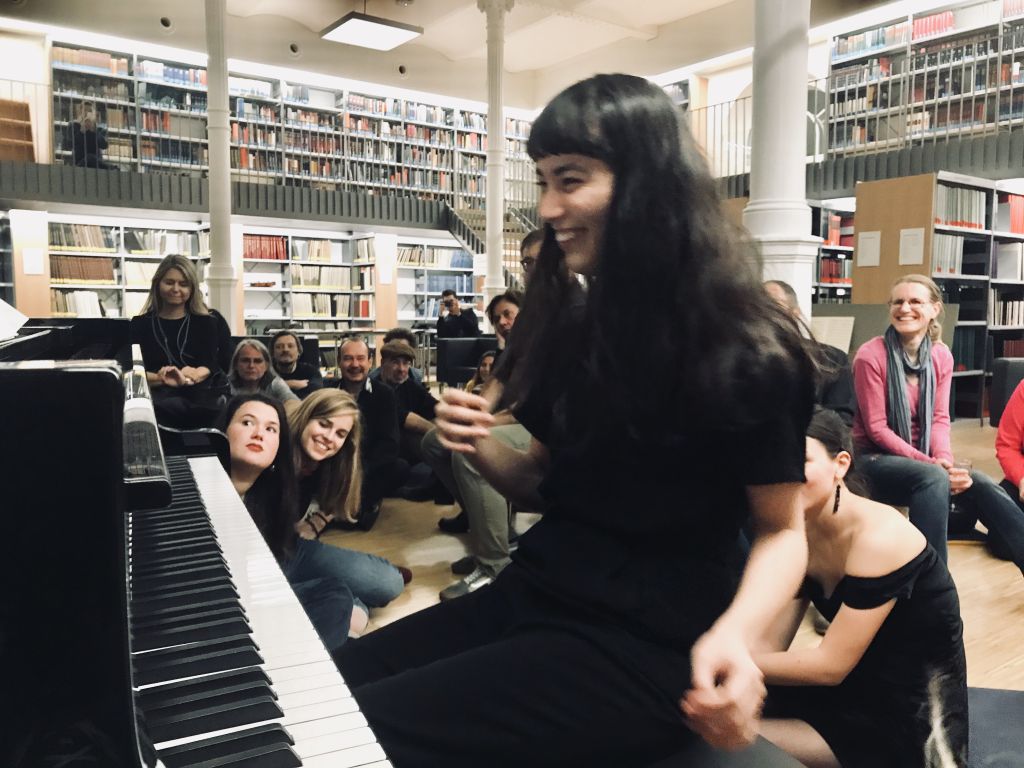
The move to the Campus has also made it possible to integrate the library more deeply with other parts of the University. In early 2021, mdwPress—the mdw’s own open-access academic publisher—was established as a joint effort of the ub.mdw and the Office of Research Support. Today, it is still the only university press situated at an Austrian university of the arts. mdwPress has published sixteen books since its founding, it also publishes regular issues of three journals, and a double-blind peer-review process guarantees that all publications meet the highest standards of quality. Free access to scholarship and education is a key priority of the ub.mdw. For this reason, the library also provides targeted support intended to bolster the visibility and dissemination of publications produced in-house—not only in the context of research, such as via the open-access publication service pub.mdw, but also in connection with teaching. The ub.mdw serves this latter area by providing guidance on the creation and publication of “open educational resources” (OER).
Safeguarding standards of quality is one of the key tasks that will fall to libraries in the future. In an age of information overload, fake news, and artificial intelligence, such standards should provide orientation, build trust, and—to put it bluntly—form something like a “protective wall against the outside world, against the world of barbarism”2. In order to support students in learning the standards of “good scientific practice”, the ub.mdw established its Writing Centre in 2020. There, it offers one-on-one help with academic writing as well as workshops and training sessions on topics like source evaluation, artificial intelligence, and multilingualism. In the future, teaching students how to handle search engines and artificial intelligence will become increasingly important. However, the ub.mdw’s present-day users value something else perhaps even more—namely, personal advising and subject-specific exchange. Violinist Marie Radauer Plank, while visiting the ub.mdw to look through the estate of the composer and pedagogue Mary Dickinson-Auner, summed it up like this: “I believe that despite all the new possibilities like search forms, artificial intelligence, and so on, it’s primarily through conversation—rather than by typing something into a search engine—that you hit upon ideas about where and how to continue your research.”3
On 20 November, the ub.mdw will be celebrating its tenth anniversary with a very special event. For now, let’s just say that an Austrian composer will be leaving his mark on the library—in the truest sense of the word. Details will follow soon at bibliothek.mdw.ac.at. Stay tuned!
- Jens Mittelbach, “Editorial: Zukunftsgestaltung in Bibliotheken”, in: Bibliothek Forschung und Praxis, vol. 50, no. 1, 2026, p. 1–3, here p. 1, https://doi.org/10.1515/bfp-2026-0007.
- Michele Calella in: “100 Jahre ub.mdw. 1909–2009.” youtube.com/watch?v=sn0CW8XUFqk, accessed on 31 Jul. 2026, 0:20–0:26.
- Barbara Fuchslehner, “Fermata. Einblick von außen. Marie Radauer-Plank”, in: Forum Musikbibliothek, vol. 44, No. 3, 2023, p. 60–62, here: p. 62, https://doi.org/10.13141/fmb.v20233943.