A Survey of the mdw’s Music Education Programmes
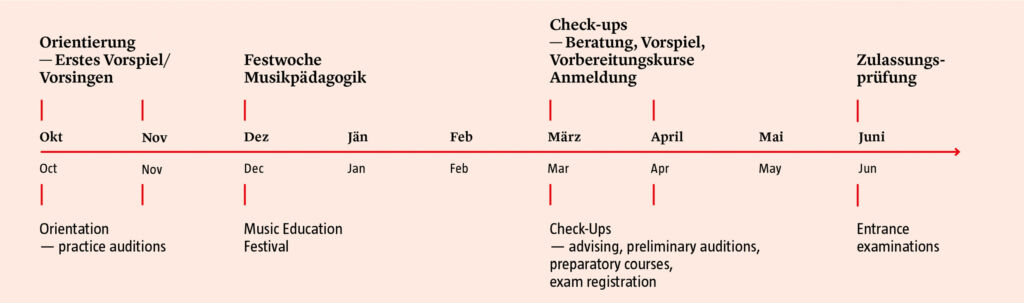
Education policy shifts, socio-demographic developments, and recent studies point quite clearly to a continually growing need for qualified school music and music school teachers in the years to come. The mdw is responding to this situation with its promotional concept “Your Job: Music!”—an October-to-May series of comprehensive informational and preparatory offerings intended to help orient musically interested school students as they choose what to study and aim for as a career. It simultaneously acquaints university students, music school teachers, and music teachers with our music education programmes’ current content and options in order to facilitate targeted advising and make them aware of the programmes that might suit them best. After all, the easier it is for young people to associate their own interests and abilities with possible career perspectives, the more sustainable and successful their professional training will be.
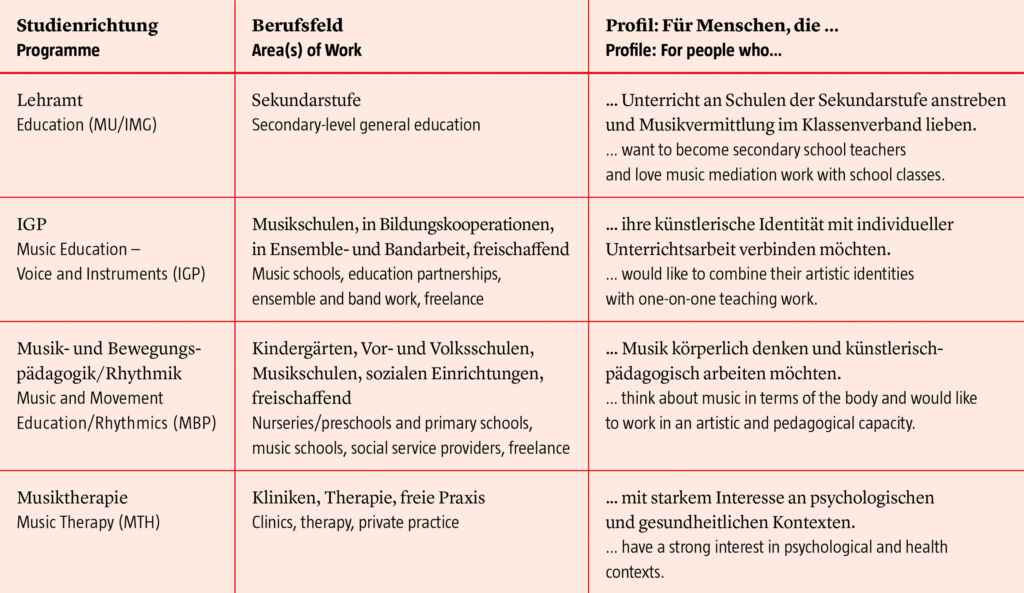
Music, pursued as a profession, can take on many forms: it can resound in classrooms, mature in private lessons, be experienced via the body, and have measurable effects in therapeutic settings. To these ends, the mdw offers four programmes with distinct profiles: Education (MU/IMG), Music Education – Voice and Instruments (IGP), Music and Movement Education/Rhythmics, and Music Therapy.
Education: Music (MU) and Instrumental Music & Voice (IMG)
The Education programme equips aspiring schoolteachers with artistic training as well as practical musical skills and knowledge of music theory combined with pedagogical professionalism and scholarly reflection. Students choose two teaching subjects: alongside music (MU), most students focus on a second subject at the University of Vienna; alternatively, Instrumental Music and Voice (IMG) can be studied as a second teaching subject at the mdw. The total duration of study (for those who combine the bachelor’s and master’s degrees) is ten semesters.
MU is oriented toward teaching secondary-level classes and covers a broad musical and didactic spectrum. IMG focuses on group-based vocal and instrumental instruction with emphases such as choir, band, and ensemble directing. The entrance examination covers artistic suitability, basic piano skills, singing, music theory and ear training, the ability to work with groups, and the ability to reflect on education-related topics. The programme includes individual artistic work, practical experience in schools, and well-founded didactic training. Graduates are capable of teaching music in an inspiring way and contextualising musical phenomena both historically and socially, and they find employment at compulsory secondary schools, academic secondary schools, schools that offer music specialisations, and vocational schools.
Music Education – Voice and Instruments (IGP)
IGP qualifies its graduates to give instrumental and voice lessons in both individual and group-based formats. The eight-semester BA programme allows for individual specialisations, and its graduates can go on to earn a master’s degree and a PhD.
The central component here is continuous development in one of the programme’s main artistic subjects (which feature classical and pop variants) supplemented by ensemble work and projects. At the same time, students also acquire comprehensive didactic skills and gather practical experience at music schools. The entrance examination assesses artistic suitability for one’s intended main artistic subject, piano skills, listening ability, and musical imagination. Holders of the bachelor’s degree possess advanced skills as artists and educators as well as a deeply considered and inclusive understanding of teaching. IGP graduates work at music schools and in education partnerships, with ensemble and band formations, and as freelance teachers with people of all age groups. Specialised profiles situated in the areas of elemental music education, inclusive practice, and community music expand the range of possible professional pursuits.
Music and Movement Education/Rhythmics (MBP)
The Rhythmics programme starts from the method of Émile Jaques-Dalcroze and conceives of music and movement as inseparable forms of expression. One’s instrument and/or singing voice, musical improvisation, and percussion as well as movement techniques and improvised movement form the artistic foundation here. Extensive practice teaching with learners from various age groups as well as observation serve to supplement training. The entrance examination calls for appropriate musical abilities, movement skills, and improvisational abilities as well as strong faculties of expression and communication. This programme enables students to shape music- and movement-based learning processes creatively and holistically. Graduates work at nurseries, preschools and primary schools, music schools, and providers of social services and/or realise mediatory and performance projects of an artistic nature.
Music Therapy (MTH)
Since 1959, the mdw’s Department of Music Therapy has been offering what is Europe’s oldest academic music therapy programme—which now encompasses bachelor’s degree, master’s degree, and PhD-level studies. Its training is grounded in a humanistic outlook and depth psychology. Core elements here are free improvisation, supervised clinical internships, and both individual- and group-based experiential work. The bachelor’s degree already comes with professional certification to practice with shared responsibility in a legally recognised health profession, while the master’s degree qualifies its holders to work independently—including in private practice. Music therapists work at hospitals, nursing facilities, facilities for individuals with disabilities, and freelance. The entrance examination assesses applicants’ musical breadth, improvisatory abilities, and personal suitability in terms of qualities such as empathy and stability.
Four Paths – Abundant Prospects – Music at the Centre
As much as their profiles differ, all of these programmes of study unite artistic and pedagogical quality with social responsibility. And be it in the classroom, in individual lessons, in movement spaces, or in clinical contexts: music is consistently conceived of as a medium of education, development, encounter, and healing.