He brings music to theatre. Imre Lichtenberger Bozoki is a true allrounder of the Austrian theatre scene—and since last autumn, he’s been teaching Music and Dramatic Expression at the Max Reinhardt Seminar. He talked with us about how he went from trumpeter to stage director, why he thinks the Viennese scene is one-of-a-kind, and why his subject is probably the most relaxed one of all at the Max Reinhardt Seminar.
During the half-hour he’d set aside for our interview, Imre Lichtenberger Bozoki could’ve attended ten different plays at as many different theatres or touched base with one of his numerous contacts in the Viennese theatre scene—which is nothing short of “overwhelming”, to hear him tell it: “It’s always been that case that I missed stuff when I wasn’t around, stuff that I then ‘socially mourned’.” However, actually being present in Vienna hasn’t really done anything to ease his FOMO, as he also describes it. After all: “You miss a lot even when you’re here. There’s nowhere near enough time for all of it.” Lichtenberger Bozoki’s description of his calendar as filled-to-overflowing is something one can easily believe.
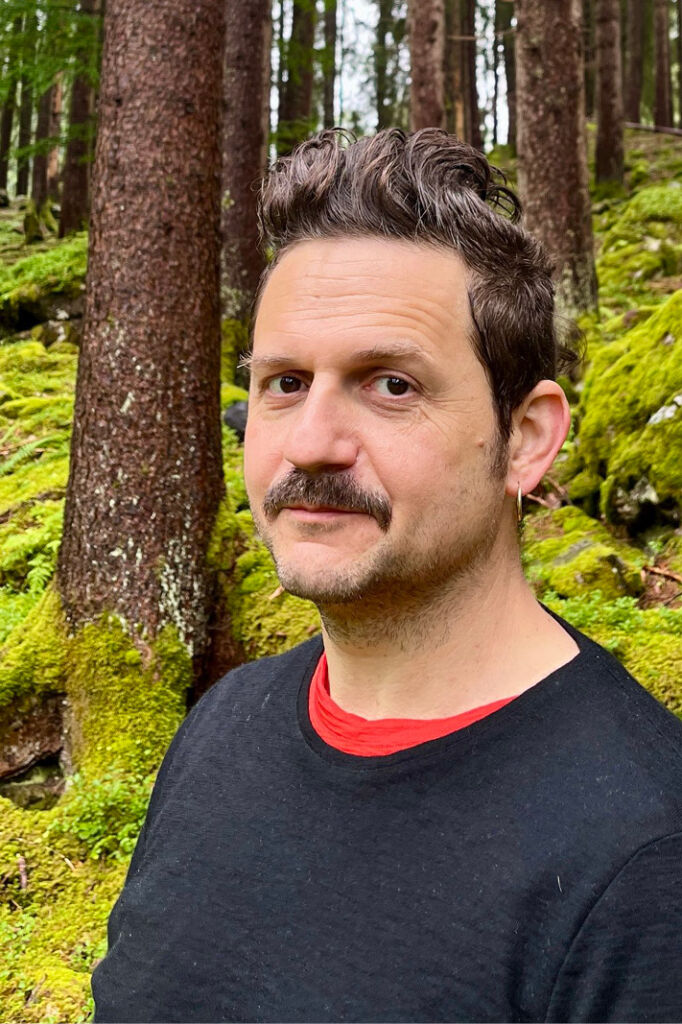
This theatre musician, music director of numerous productions, and stage director in his own right is busy and in high demand, as his biography quite impressively shows. He originally studied jazz trumpet but soon shifted his focus to theatre music—a change of genre that isn’t necessarily common among jazz students. Alongside his particular talents and musical abilities, it’s something as banal as accident insurance that he has to thank for this switch. “Hans Kresnik, a choreographer and stage director who’s unfortunately no longer with us, had decided he wanted to work with street musicians at the Grazer Schauspielhaus. The Schauspielhaus immediately told him he couldn’t, since allowing uninsured people onstage was a no-go.” It was thus that Lichtenberger Bozoki—who, as a jazz student and part-time busker, did indeed have accident insurance—entered the scene and hence took the theatrical stage for the first time. “That’s how it started. And it wasn’t long at all before this magic of the theatre had me captivated. It was marvellous, magical, just really great work.”
Having spent many successful years working at all kinds of theatres in Austria and abroad, Lichtenberger Bozoki is now looking to pass on this magical spark to students at the Max Reinhardt Seminar. When he talks about the subject of Music and Dramatic Expression, which he’s been teaching since autumn 2025, one can hear his longstanding passion for theatre in every syllable. “It’s a very, very generous, very supportive, very relaxed atmosphere here.” He actually finds such near-arcadian conditions almost a bit suspect. “I’m constantly waiting: When will things hit a snag? When will it all get uncomfortable? But it just doesn’t.” It’s especially the students who’ve grown near and dear to his heart during his brief time here so far. He attributes this to things like how he understands actors better than he does virtually anybody else. “I love actors. My wife [Suse Lichtenberger—Ed.] is one, and my son [Imre Lichtenberger—Ed.] also acts. I’m a people person to begin with, but it’s actors I understand. I just have this feel for the stuff they’re made of, and it’s a milieu I like. I like theatre folks.”
It was also the opportunity to interact with young people, something in which he’s extremely well versed thanks to having three sons who are now young adults, that motivated him to take on his position at the Max Reinhardt Seminar. “Our kids are the same age as the students here, so I felt like: Hey, I understand.” And as a theatre-maker, he’s spent decades getting to know and learning to comprehend the many parts that make up the whole. “I know what it takes to be good, and passing on that knowledge is what I wanted to do.” Though it was also “just good old FOMO”, he says with a laugh—since this job requires him to be in Vienna for extended periods.
His teaching subject of Music and Dramatic Expression itself soon convinced him of how right his decision had been. “I’m extremely happy to be teaching a subject where I can allow myself to do something other than just run on a hamster wheel, just working towards the next première.” His lessons are much rather about helping the students develop a certain “emotional permeability”, he says: “Emotions just can be accessed a bit more easily and faster through singing than through acting. It’s because you don’t have this intellectual level in between.” For example, one desired effect of his teaching would be for someone to be able to sing onstage just as if they were singing in the shower. “Getting that stage-ready and enabling this feeling to be transferred to acting”, he says, is his (semi-seriously) declared goal. “I’m more interested in who students are and in aspects of their present reality that they can draw upon. What’s the next step?” That could entail many different facets of music-making, from introductory or advanced music theory to learning to read music or compose, re-learning a once-learned instrument, or setting one’s own monologue to music. ”I don’t see any limits, here.” And: ”Every single person holds a new surprise in store”—like personal tastes ranging from hard rock to musicals, which Imre Lichtenberger Bozoki often has some discrete fun attempting to guess.
The admittedly somewhat mean and/or naive question of whether there are any unmusical acting students is one that Imre Lichtenberger Bozoki answers directly but with a twinkle in his eye: “Yes, there are.” And with such students, he’ll just listen to music—or do something that’s part of an artist’s fundamental training to begin with: “We talk a bit about life. Simply to draw out some emotions in one way or another.” And it can also be just rhythm exercises or simple pieces, as long as they allow students to “open up” a bit. Students’ skill sets, levels of emotional maturity, and experiences with music just are very different, he says, and it’s these that have to form the starting point. “The ‘music and dramatic expression’ that I’m working on here allows me to do something different from what happens in the voice lessons given by my colleagues. Those are a great offering on the part of the University, and being able to accompany that whole process and expand upon the corresponding skill set is just really cool.”
Our half-hour is over, and Lichtenberger-Bozoki has to rush off to a theatre première—for whose music direction he’s responsible, as is so often the case. Just this one event is happening this evening, so his FOMO is limited. But who really knows just what the coming hours will bring—because for Imre Lichtenberger, “every evening” is somehow “crazy”.