Comments Off on Alumnus in Focus: Georg Traxlmayr
0
640
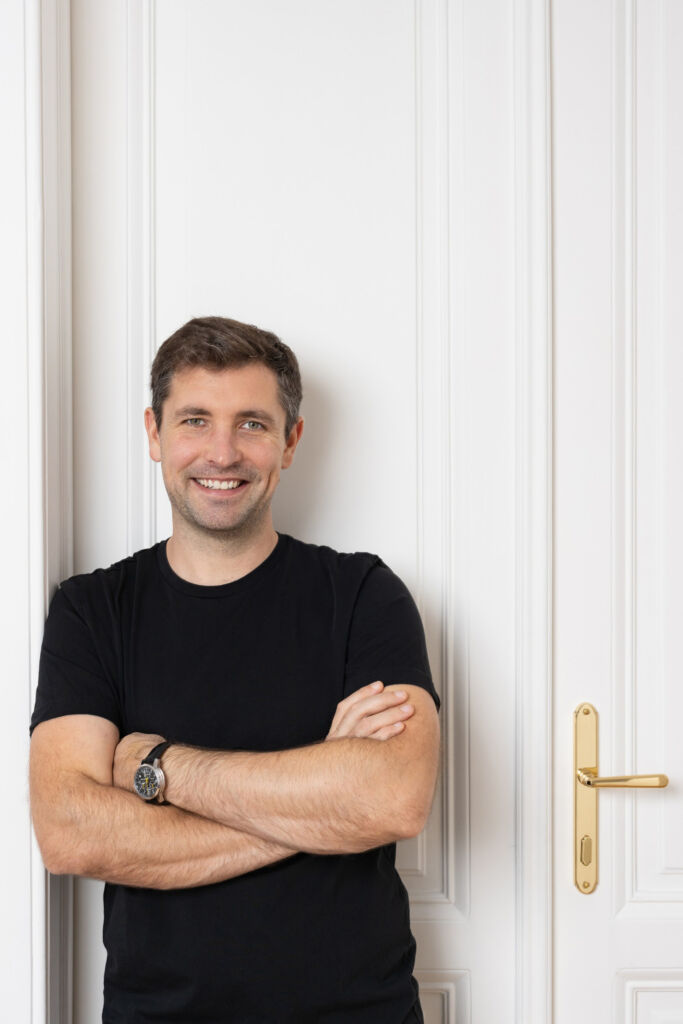
“One of my earliest specific memories is from my musical training as a small child. We were standing around an open grand piano and were supposed to see how long we could actually hear a note,” remembers the passionate musician. Thanks to music-loving parents who wanted to give him the opportunity to acquire a musical education, the Lower Austria native began with piano lessons in the first form of primary school and then took guitar and saxophone lessons later on. The idea of a profession in music first came up during his teenage years. Together with his piano teacher, Georg Traxlmayr considered going into popular music—but he ultimately decided against doing so. “I’d always wanted to keep music present in my life, but not at the highly professional level you need for serious instrumental or voice teaching.” Traxlmayr went on to put in three semesters at the Vienna University of Economics and Business during his early 20s before realising that what he really wanted to pursue was a profession where the focus would be on working directly with people. It was during a musicology seminar he took at the University of Vienna that the young student then experienced a presentation on music therapy. “That got me excited right away, as if a blindfold had come off: it was the perfect combination of areas where I do well. Minutes later, I’d already begun looking through the mdw’s curriculum,” says the music therapy graduate with a laugh.
What I’d tell future students about the entrance exam is that once doesn’t count! You can’t let yourself be discouraged.
Thanks to years of music lessons, the purely musical part of the entrance examination was no problem for this aspiring mdw student—but the music therapy-related content was somewhat more difficult. It was on his third attempt that he finally got accepted to study at the mdw. “After my second try, I almost gave up—but then I had this feedback session with the teacher Elena Fitzthum, who advised me to take a break, concentrate on other things, and then come back.” He took that advice and spent a season as a skiing instructor at the Arlberg. “During that year, I learned to let go—which helped me go back into the exam situation way more relaxed. The openness I learned there is now extremely helpful in my everyday work, and it’s something I’ll always be grateful for.” He took his initial steps as a fully trained music therapist at Psychosomatisches Zentrum Waldviertel, a rehab clinic in Gars am Kamp with up to four group therapy sessions and between forty and fifty patients a day. “When you’re a student, every music therapy session you do is accompanied and supervised. But that’s different in the professional world, and you end up with all these impressions that you then have to digest.” Despite how he enjoyed the job, it was a huge challenge for the young graduate to solidify his identity as a music therapist. Today, Georg Traxlmayr has his own practice for psychotherapy and music therapy in Vienna.
It’s impressive to see the kinds of development people can go through thanks to music therapy.
Being able to help people and see how they improve in a lasting way is something he describes as a special enrichment of his own life. This experience is also reflected in his work with the social psychiatry unit of Diakoniezentrum Gols as well as at its and senior and nursing residence. “Music helps find a way to get through to residents whom it’s difficult or even impossible to reach by way of language. These people often come away from their sessions with a bit more vitality and zest for life, so it’s a way of enabling them to age with dignity.” Despite the fulfilment to be had from such work, the profession does have its dark sides. “The fact that you can’t help everyone with these therapeutic offerings is difficult to accept—and it’s not always easy to maintain boundaries, either,” says the experienced therapist. It’s therefore especially important to him that he can take advantage of regular supervision. For beginning students, says Traxlmayr, observation-based coursework provides a good opportunity to get to know both the overall professional field and music therapy itself in actual practice. And an authentic interest in people, lots of curiosity, and enjoyment of improvisation are qualities that this well-versed music therapist describes as must-haves for future music therapists. “Therapy means setting out to go somewhere together. So you need a certain openness that allows processes to develop—and some understanding for how solutions often don’t immediately become apparent. You have to be able to handle that.” Another challenge is the often palpable pressure—linked with things like inhibitions about playing an instrument—that’s present in some patients’ musical biographies. So in light of his own personal experience as a music therapist, he seeks to facilitate a zero-pressure approach to music not just for his clients but also for his own children. “Making music and doing free improvisation with my two-year-old son are things that I hugely enjoy. Because he, too, just like me way back when, stands beside the open piano full of curiosity, just listening to the notes.”
What I’ve taken with me from the mdw is a joyful approach to music.