A Monday in December at the Vienna Gasometers. I’m moving between shops, escalators, and long glassed-in corridors. The four gasometer towers here can be viewed as something like a city-within-the-city, being home to around 1,500 people. Their approximately 220,000 m2 of floor space play host to residential flats, offices, retailers, and cultural offerings. It’s a place of everyday life—and it was precisely here that the fourth edition of the community music series “Grätzl Töne”, which I experienced as an enrolee in the music mediation course “Vermittlung von Musik”, played out.
The event was conceived by mdw Senior Artist for Community Engagement Martin Schlögl. Grätzl Töne saw students of the mdw’s “Music in Dialogue” programme join forces with artists to develop musical formats that engaged directly with the Gasometer complex and the people who live, work, and shop there. The event’s contributions were of a deliberately open character, with the audience being invited to get involved, try things out, or just listen. Community music as realised in this project is a low-threshold, group-oriented practice that plays out in dialogue with people and their surroundings.
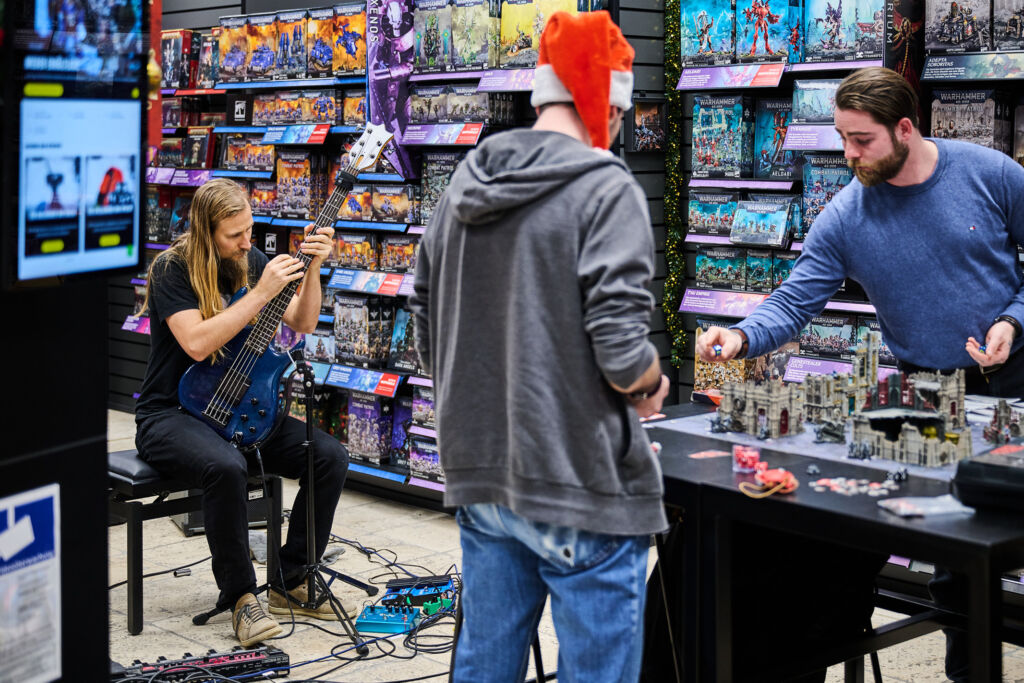
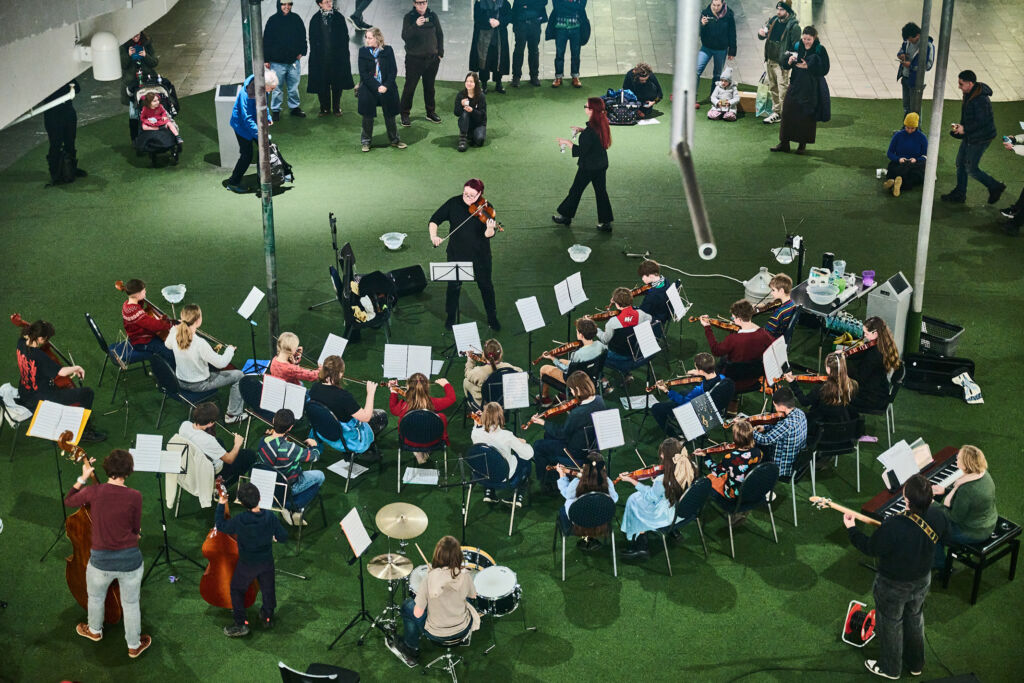
Music was heard at a total of nine different locations from Tower A to Tower D. In the entrance area of Tower A, singer-songwriter Lynnie V made for a calm moment amidst the pre-Christmas hustle and bustle with her voice, guitar, and loop station. Passers-by took a break from their everyday errands to listen. At the tabletop gaming retailer Warhammer, bassist Robin Gadermaier set a fantasy strategy game to music on his bass guitar. With the gaming community gathered around the game table, the music also drew attention from others within earshot. In Tower B, the youth string orchestra of Vienna’s Johann Sebastian Bach Music School brought a rather bare pass-through area to life. A special atmosphere nourished by the children’s enjoyment of playing together arose here despite the bleak surroundings. In the glassed-in skyway between Tower B and Tower C, students from the course “Präsentation und soziales Engagement” (Presentation and Social Commitment) made music inspired by the motions of people passing by. The musicians realised people’s steps, speeds of travel, and gestures in audible form, allowing them to become part of the music. The space leading to Tower D witnessed a performance by the Johann Sebastian Bach Music School’s recorder ensemble. A calmly concentrated atmosphere thus arose in this cold, sparsely lit corridor, embracing those who came along and deliberately stopped to listen.
Music retailer Klangfarbe, which supported the overall event with instruments and equipment, hosted a performance by the Polgar Inclusive Band. This inclusive ensemble made it possible to experience the phenomenon of musical sharing in this special setting. And just outside Klangfarbe’s entrance, visitors could use a random process involving a turntable to create their own songs that mdw students then rendered live. Here, a moment I found especially memorable was when an older woman repeatedly expressed her thanks for the piece of music created “for her” in response to her activation of the turntable.
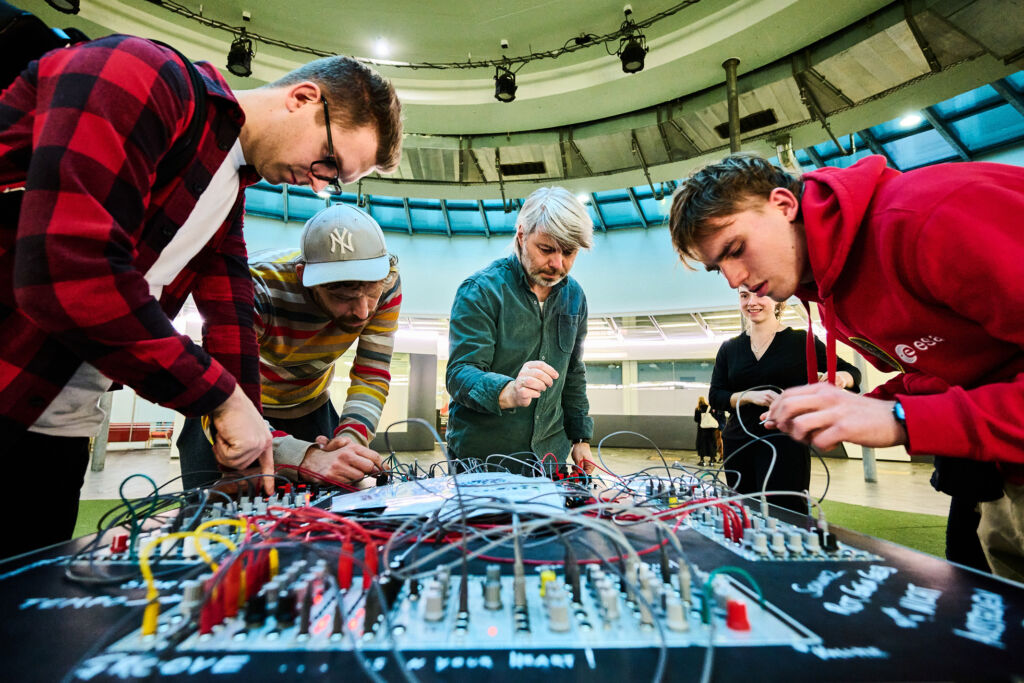
In Tower C, which features a large circular space with a conspicuous glass roof and a characteristic echo, electronic sounds by the community artist Gammon as well as the ensemble Studio Dan were heard. Studio Dan performed a contemporary work by Rudolf Wakolbinger composed specifically for the acoustics of this location. Colourful score visualisations showed the work as it was performed. Gammon, with his “modular table”, enabled several passers-by to make music together—a low-threshold opportunity that required zero prior knowledge.
The afternoon’s various strands came together at the Music in Dialogue space in Tower C. Introductory remarks by mdw Rector Ulrike Sych emphasised the society-wide significance of music and of formats that bring together the arts, education, and social reality. In the concert that followed, violinist Lisa-Maria Sekine impressed the audience with her virtuosic yet very unpretentious performance. And I was particularly touched here by the contributions of Open Obdach as well as Manu of Earth, an ensemble formed around the lead singer of the inclusive rock band Monkeys of Earth. Manu animated the audience to sing along and clap. I’ve seldom experienced a concert where a frontwoman was able to captivate and sweep along the audience in such a free and matter-of-fact way. Much the same can be said about the musicians of Open Obdach, a music project in cooperation with the Vienna Social Fund’s assistance initiative for the unhoused, which brings formerly unhoused individuals together with students to make music together.
A talk then complemented the musical programme by adding further depth: Rehearsal Spaces of Democracy saw Ursula Berner, Axel Petri-Preis, Hanns Stekel, and Anna Dempsey speak with moderator Miriam Damev (of the alternative weekly paper Der Falter) about how music can contribute to social solidarity particularly in difficult times. Hanns Stekel also used this opportunity to introduce the Community Music Center, an initiative of Vienna’s Johann Sebastian Bach Music School in collaboration with the mdw’s Music in Dialogue division.
This convivial afternoon left me quite touched on a personal level: encounters, exchange, and collective artistic activities are an expression of what strengthens and unites us as a society—and Grätzl Töne showed quite impressively how music can manifest this unifying effect and mediatory power.